
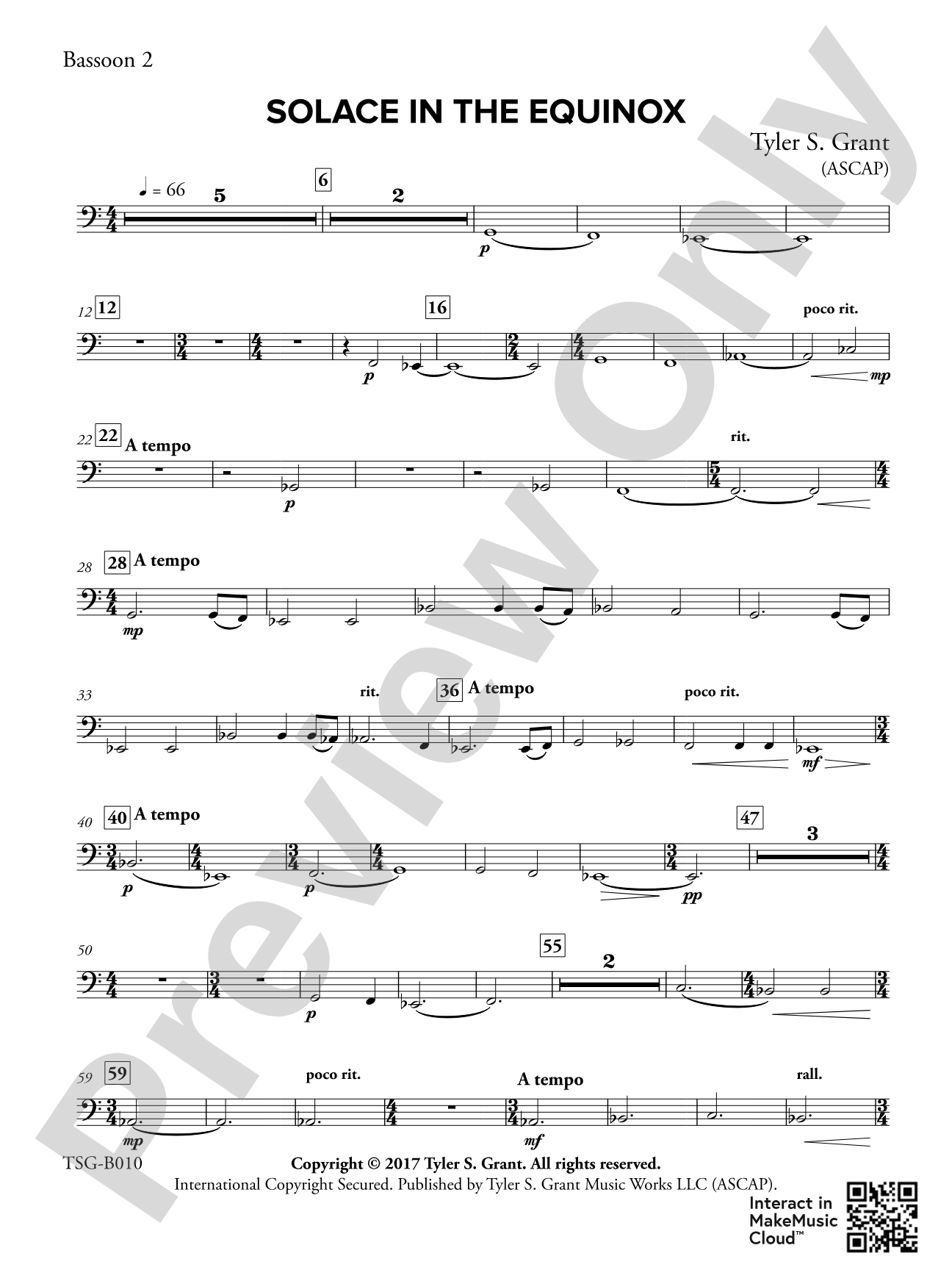

Solace in the Equinox: 2nd Bassoon
By Tyler S. Grant
Grade: 4
Item: 98-PC-TGB010_B2
$4.50
Pickup currently not available
Description
Instrumental colors abound in this emotionally moving memorial piece, Solace in the Equinox by Tyler S. Grant. Impressionistic passages float in and out of varied instrumental combinations, creating sonic palettes of pastel colors and swirling shapes. Just as the fall equinox balances darkness and light, the music exhibits a harmonious balance between moments of quiet and delicate textures with contrasting fully scored statements of brightness and joy. (7:00)


Solace in the Equinox: 2nd Bassoon isn't in MakeMusic Cloud just yet...but it could be. Let us know you'd like to see it, and you'll help shape what comes next. In the meantime, start a free trial and dive into thousands of interactive titles your students can play along with today.
Request This Title
Tell us you want it.
Start Your Free Trial
Explore everything that's ready to play right now.
Sample Audio
1
Audio File
--:--
0:00
0:00
Sample Video
Additional Details
Series:
Tyler S. Grant Music Works
Publisher:
Tyler S. Grant Music Works, LLC.
SKU:
98-PC-TGB010_B2
More about this title
About the Composer: Tyler S. Grant

Tyler S. Grant has built a distinguished career as a composer, arranger, and conductor whose works appear regularly on honor ensemble programs and curated repertoire lists across North America and internationally. His composition Panoramic Fanfare won the Dallas Wind Symphony's 2014 "Call for Fanfares" Competition and has since gained frequent performance by college and professional ensembles. Since 2010, Grant has maintained a steady output of commissions and new publications while conducting clinics with over 100 school programs across more than 15 states.
Grant's education at the University of Alabama in instrumental music education, combined with mentorship from composer Brian Balmages, shaped his approach to writing for student and professional ensembles alike. His works have been performed at Carnegie Hall, the Meyerson Symphony Center, The Midwest Clinic, Bands of America Grand Nationals, and the Macy's Thanksgiving Day Parade. Beyond composition, Grant has contributed to Alfred Music's Sound Innovations: Ensemble Development series and regularly appears in interviews across podcasts and publications including School Band & Orchestra Magazine and The Instrumentalist.
Why we love this
Grant's orchestration in this piece moves beyond standard concert band sonorities, layering instrumental combinations in ways that challenge students to listen actively and play with genuine musical intention. The balance between delicate, impressionistic textures and bold, fully scored moments gives conductors a chance to shape emotional arc rather than simply keep time; musicians respond to that kind of expressive direction. A piece this thoughtfully written for a competitive/festival context stands out because it honors the memorial purpose without leaning on heavy-handedness.
What to expect
The music unfolds like watching light shift across water, with instrumental voices drifting in and out of focus. Quiet, pastel moments create space for reflection before the band blooms into full, joyful statements of brightness. The overall arc mirrors the equinox itself: a meditative exploration of balance between darkness and light, stillness and presence.
Who it's for
Concert bands at the Grade 4 level seeking repertoire that combines emotional depth with accessible orchestration and offers meaningful performance at contests and festivals. Conductors drawn to programmatic music with clear thematic intent will find this piece rewarding to work with a developing ensemble; the writing requires attention to balance and phrasing rather than technical virtuosity.
How to get the most out of it
- Shape the impressionistic passages by thinking in long phrases rather than individual measures; let the instrumental colors emerge naturally from balanced dynamic control across sections rather than adding artificial swells.
- Prepare students to hear how the pastel textures contrast with moments of brightness by isolating those transition points in sectional rehearsals and discussing the emotional shift each one carries.
- Lock in the balance between parts during full-band runs using a clear conducting gesture; when multiple instrumental combinations are moving simultaneously, a steady, purposeful pattern prevents muddiness and lets each color register distinctly.
- Encourage horn, clarinet, and woodwind players especially to sustain with consistency through the floating sections where their voices carry the primary melodic or harmonic weight.
How to use it
Program this as a centerpiece of a concert built around thematic programming; its contemplative opening and triumphant middle sections pair well before or after more athletic or celebratory works. The seven-minute duration makes it ideal for festival competition schedules where pacing matters, and its emotional resonance gives audiences a chance to experience genuine expression from a student ensemble.
Skills your students will build
- Balancing independent instrumental lines while maintaining ensemble cohesion
- Sustaining tone quality through extended passages with minimal staff movement
- Responding to conducted changes in dynamic and emotional intensity without losing rhythmic security
- Listening to and blending with varied instrumental combinations across pastel and fully scored sections
- Interpreting impressionistic musical language and translating conductor gesture into expressive, unified sound