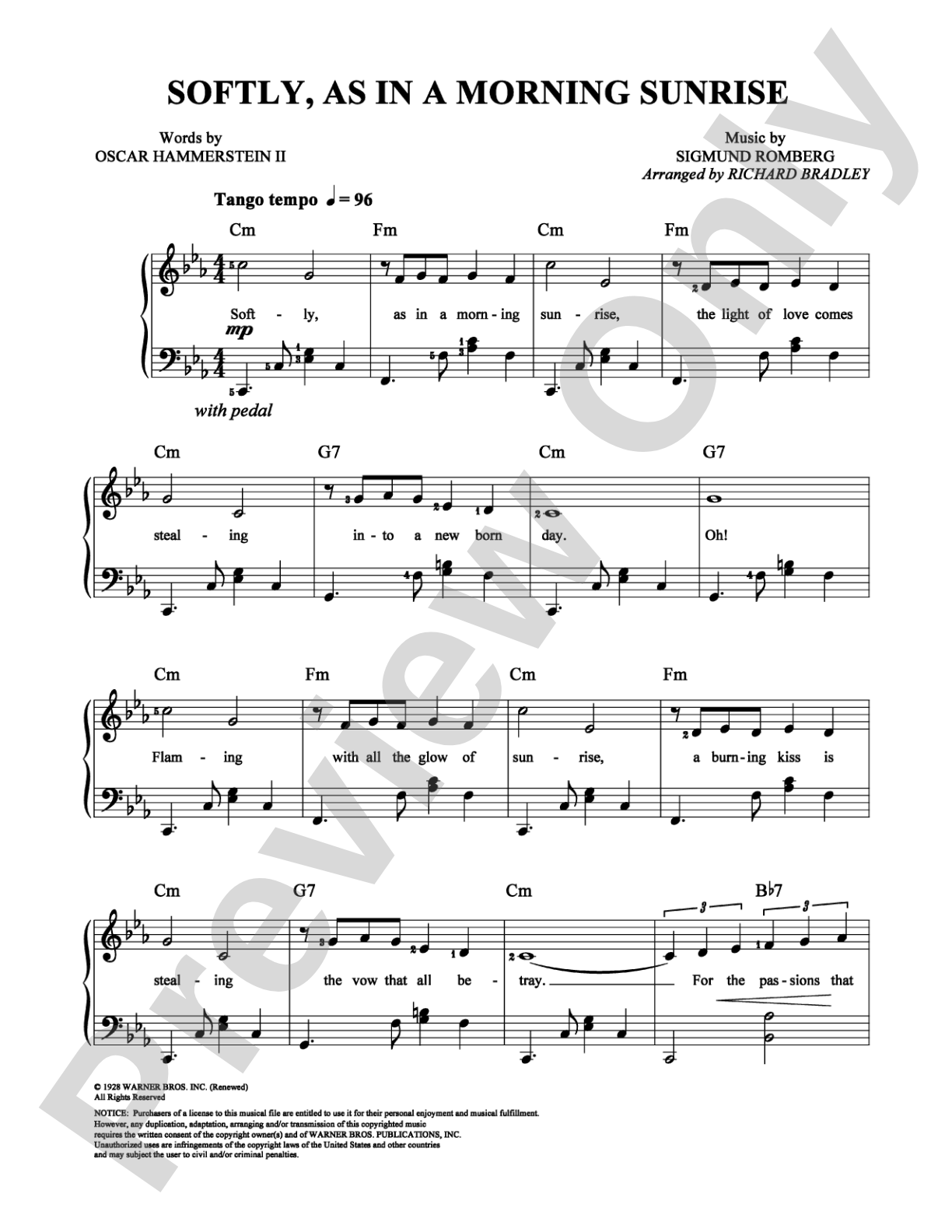
Softly, As in a Morning Sunrise: Easy Piano Digital Sheet Music

Softly, As in a Morning Sunrise: Easy Piano Digital Sheet Music

Sigmund Romberg

Item: 00-PS-0008414

Digital Download
$3.99
Description

Softly, As in a Morning Sunrise: Easy Piano Digital Sheet Music isn't in MakeMusic Cloud just yet...but it could be. Let us know you'd like to see it, and you'll help shape what comes next. In the meantime, start a free trial and dive into thousands of interactive titles your students can play along with today.

Sample Audio
No sample audio found.
Sample Video
Additional Details
SKU: 00-PS-0008414

More about this title

About the Creator

Oscar Hammerstein II and Sigmund Romberg created "Softly, As in a Morning Sunrise" for the 1926 operetta The Student Prince, a work that defined the romantic musical theater sound of its era. Hammerstein's lyric captures a moment of tender awakening, while Romberg's melody sits naturally for the voice yet translates beautifully to keyboard, making it a standard that pianists return to across generations.

Why we love this

This arrangement captures the wistful, introspective quality that makes the original such an enduring standard, without requiring advanced technique to bring it to life. The easy-piano voicing opens the piece to students who might otherwise need years of study before tackling this iconic melody, making it an accessible entry point to golden-age songwriting.

What to expect

Hushed and contemplative, like watching the sky shift from gray to gold during those quiet moments before dawn fully arrives. The arrangement preserves the composition's innate lyricism while maintaining an intimate, almost confessional quality throughout.

Who it's for

Intermediate-to-early-advanced pianists seeking accessible arrangements of jazz standards and American songbook classics. Students working toward recital repertoire or exploring arrangements that bridge classical training and popular song.

How to get the most out of it

  • Allow the melody to breathe in the opening phrases; resist the urge to rush despite the gentle character. Space and silence are as important as the notes themselves.
  • Use the sustain pedal conservatively to support the harmonic movement without blurring the distinction between chords. Change with harmonic shifts rather than on every beat.
  • Shape the melodic line with subtle dynamic shaping that mirrors the text's imagery of sunrise and morning light. Bring out the melody slightly while keeping the accompaniment supportive.
  • Maintain even rhythm in the accompaniment to anchor the emotional expression in the melody. A steady foundation lets the tune float expressively above it.

How to use it

Feature this as a solo recital piece in an all-American songbook concert, or pair it with other standards to explore how jazz harmonies shaped twentieth-century popular music. The piece works equally well as a teaching piece that introduces students to interpreting melody-driven compositions with sophisticated underlying harmonies.

Skills your students will build

  • Voice leading across jazz-influenced harmonies
  • Balancing melody against harmonic accompaniment
  • Shaping phrasing without relying on technical virtuosity
  • Interpreting rubato and expressive timing in a lyrical context
  • Reading and executing pedal technique for tonal blending

You May Also Like