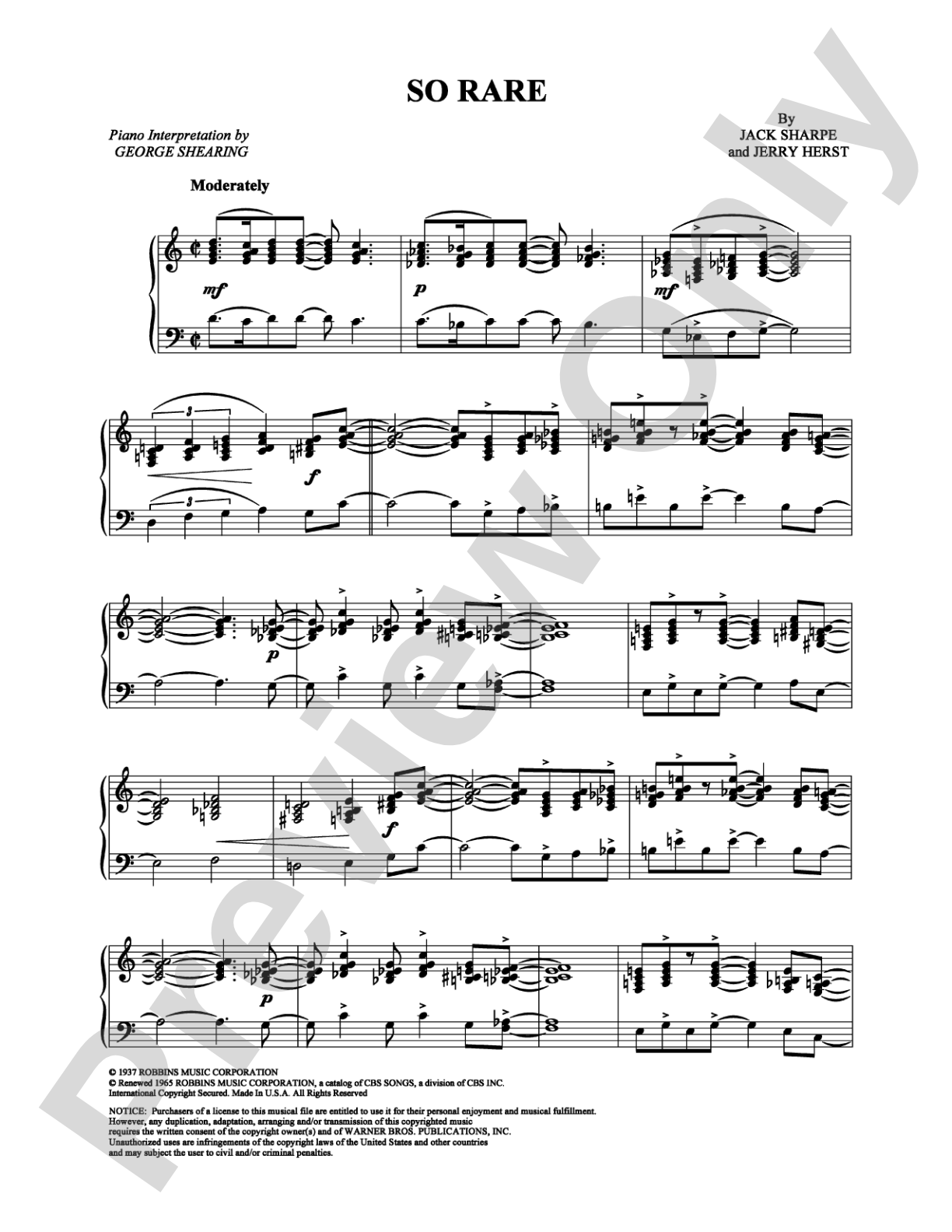
So Rare: Piano Digital Sheet Music

So Rare: Piano Digital Sheet Music

George Shearing, Jerry Herst, Jack Sharpe

Item: 00-PS-0007299

Digital Download
$3.99
Description

So Rare: Piano Digital Sheet Music isn't in MakeMusic Cloud just yet...but it could be. Let us know you'd like to see it, and you'll help shape what comes next. In the meantime, start a free trial and dive into thousands of interactive titles your students can play along with today.

Sample Audio
No sample audio found.
Sample Video
Additional Details
SKU: 00-PS-0007299

More about this title

About the Artist: George Shearing

George Shearing (1919-2011) was a British jazz pianist and composer whose sophisticated harmonic approach and refined touch shaped cool jazz and standards interpretation for decades. Blind from birth, he developed an extraordinary ear and became known for his block chord voicings and elegant comping style, influencing generations of jazz pianists in both concert and educational settings.

Why we love this

Shearing's interpretation of this standard showcases the kind of harmonic sophistication and tasteful restraint that students rarely encounter in beginner-level jazz repertoire. His recorded version serves as an excellent listening model for understanding how jazz pianists voice changes and shape phrasing with economy of motion.

What to expect

Elegant and introspective, the piece unfolds with the quiet confidence of a musician completely at ease with both the melody and its harmonic possibilities. There's an intimacy in how the arrangement breathes, asking the pianist to think as much about what not to play as what to emphasize.

Who it's for

This arrangement suits intermediate to advanced pianists who want to deepen their jazz interpretation skills through a standard that rewards careful listening and stylistic awareness. It works well for students studying jazz history, transcription, or those preparing recital repertoire that demonstrates maturity and harmonic understanding.

How to get the most out of it

  • Listen to Shearing's recorded version multiple times before attempting the arrangement; pay attention to his touch and the space he leaves between phrases.
  • Study the voicings carefully and practice them slowly to build muscle memory for the chord shapes before working up to tempo.
  • Focus on the left hand's comping rhythm and how it complements the melody rather than overshadowing it.
  • Shape the dynamics subtly across the bridge section; avoid sudden jumps in volume that would disrupt the balladic quality.

How to use it

Include this on a jazz recital or standards showcase to demonstrate sophisticated voicing and restraint; it pairs naturally with other cool jazz interpretations or with classical standards to show how different traditions approach similar melodic material. It also works as a listening and analysis tool in jazz history or improvisation curricula.

Skills your students will build

  • Voicing jazz standards with 7th chords and extended harmonies
  • Balancing melody and accompaniment in a jazz context
  • Phrasing and shaping in the standards tradition
  • Understanding the interplay between swing rhythm and straight notation

You May Also Like