So Goes the Moon Sheet Music Preview

So Goes the Moon: Piano

By Christopher Goldston

Item: 98-DW9227

Digital Download
$2.50
Description
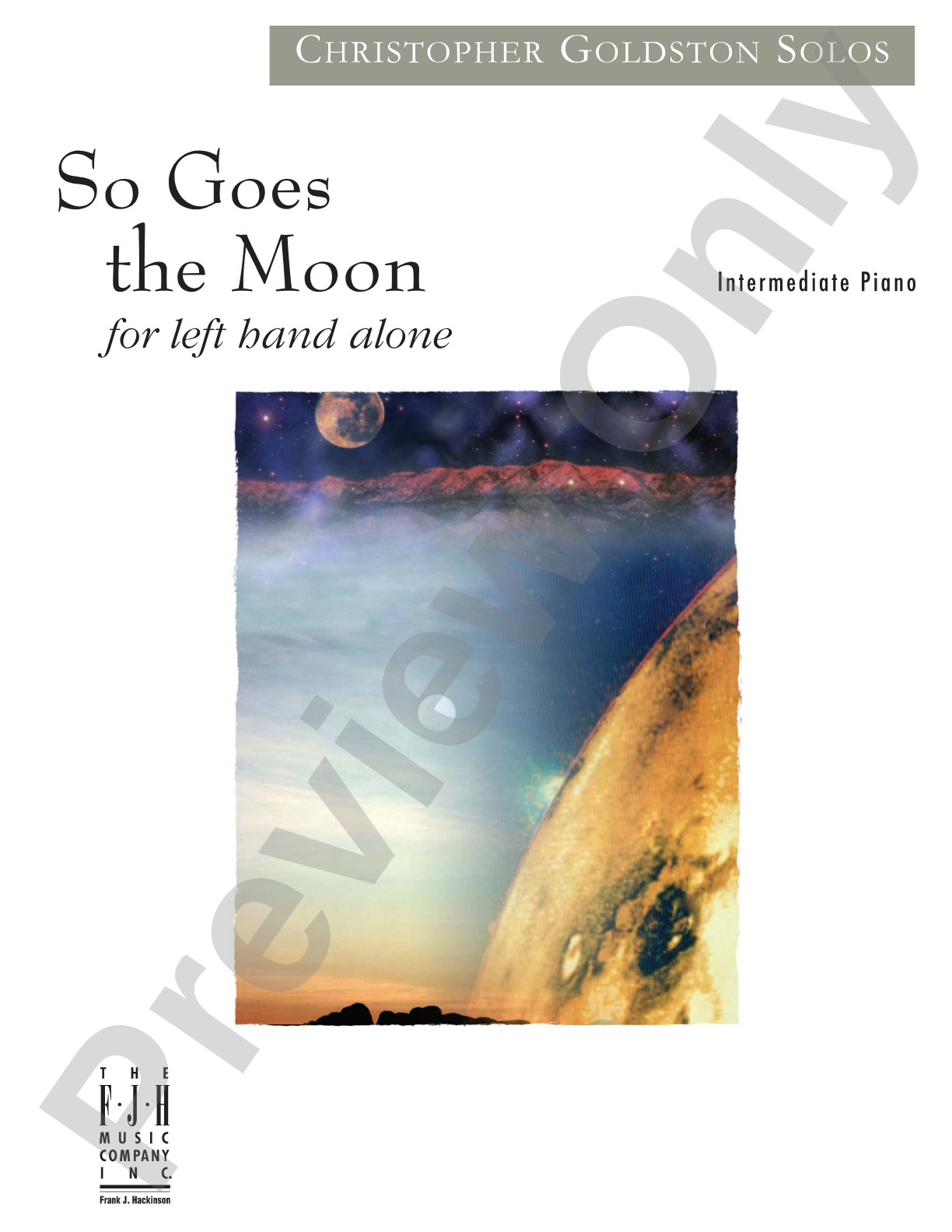
This inquisitive, celestial piece has a wondrous five-note melody. So Goes the Moon has a kind of Close Encounters theme, but is perhaps best understood as more personal and introspective. Goldston has masterfully written a simple piece, with an eloquent sense of awe. Written for LH alone.

So Goes the Moon: Piano isn't in MakeMusic Cloud just yet...but it could be. Let us know you'd like to see it, and you'll help shape what comes next. In the meantime, start a free trial and dive into thousands of interactive titles your students can play along with today.

Sample Audio
No sample audio found.
Sample Video
Additional Details
Series: Written For You
Publisher: The FJH Music Company, Inc.
SKU: 98-DW9227

More about this title

About the Composer: Christopher Goldston

Christopher Goldston

Christopher Goldston earned his Master of Music in piano performance and pedagogy from Northwestern University and his Bachelor of Music from the University of North Carolina-Greensboro. He has served on the faculty at Columbia College Chicago, Roosevelt University, and Sherwood Conservatory of Music, and continues to maintain both an independent studio and virtual teaching practice in Chicago.

Goldston's compositional voice emerged early: in 1991, he received the National Federation of Music Clubs Lynn Freeman Olson Composition Award for his first work, Night Train. Since 2010, he has served as national coordinator for the MTNA Composition Competition. His leadership within the music teaching profession includes presidencies of the Illinois State Music Teachers Association and the Chicago Area Music Teachers Association. In 2020, he was named an MTNA Foundation Fellow, and he served as MTNA National Secretary-Treasurer from 2021 to 2023. His commissioned work Four Virtues for oboe, violin, and piano premiered at the 2022 MTNA National Conference.

Why we love this

Goldston captures genuine wonder in a piece that sounds far more sophisticated than its technical demands suggest. The five-note melodic idea carries surprising emotional weight, and the decision to write exclusively for the left hand transforms what could have been a novelty into a focused study in voice and nuance. This is a composer who understands how restraint deepens impact.

What to expect

The piece unfolds with the quiet certainty of watching something celestial move across the night sky. There is an almost meditative quality to the unfolding melody, combined with a sense of awe that never tips into sentimentality. The music feels personal and observational at once, inviting the listener into a private moment of reflection.

Who it's for

Intermediate pianists ready to work with sparse, meaningful material will find depth here. Teachers seeking a repertoire piece that builds voice independence and musical maturity without excessive technical barriers will recognize this as a teaching opportunity worth programming.

How to get the most out of it

  • Shape the five-note melody with subtle dynamic contours; the simplicity of the material means every breath and swell will be heard clearly.
  • Explore the harmonic movement beneath the melody by giving the accompanimental voice independence in tone and articulation from the primary line.
  • Allow silence and space to feel as important as the notes themselves; this piece invites introspection rather than continuous sound.
  • Listen to how the melody sits within the hand's natural weight distribution; avoid forcing the notes and instead let gravity and a relaxed wrist support the phrase.

How to use it

Pair this with other contemplative works in a recital devoted to introspection and modern simplicity, or use it as a bridge between more dramatic pieces in a mixed program. The intimate scale and left-hand focus make it an excellent choice for a student recital that values emotional substance over display.

Skills your students will build

  • Voice independence between melody and accompaniment within a single hand
  • Phrasing and shaping with minimal harmonic support
  • Dynamic control and the expressive use of silence
  • Comfort sustaining a single melodic idea across changing harmonic context

You May Also Like