So Far Away Sheet Music Preview

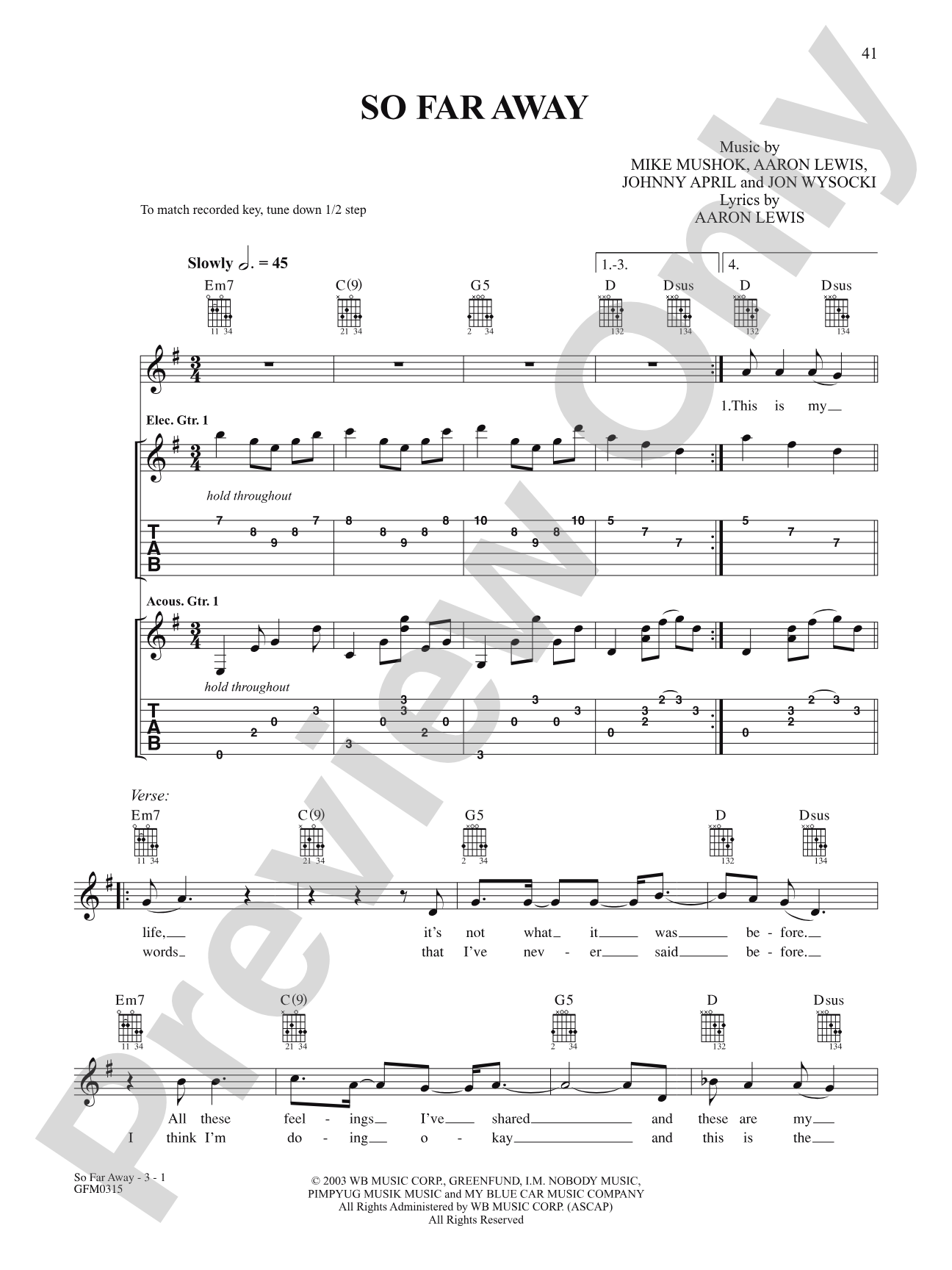
So Far Away: Authentic Guitar TAB

Staind

Item: 00-PSG-000066

Digital Download
$2.99

One moment…

Description
This matching folio, edited by Staind's guitarist Mike Mushok, incorporates his actual tunings and fingerings exactly as he plays them, without which many of the guitar parts would not be playable. This folio includes four pages of full-color photos. Titles are: Price to Play * How About You * So Far Away * Yesterday * Fray * Zoe Jane * Fill Me Up * Layne * Falling Down * Reality * Tonight * Could It Be * Blow Away * Intro.

So Far Away: Authentic Guitar TAB isn't in MakeMusic Cloud just yet...but it could be. Let us know you'd like to see it, and you'll help shape what comes next. In the meantime, start a free trial and dive into thousands of interactive titles your students can play along with today.

Sample Audio
No sample audio found.
Sample Video
Additional Details
Publisher: Alfred Music
Page Count: 88
SKU: 00-PSG-000066

More about this title

About the Artist: Staind

Staind emerged from Springfield, Massachusetts in the 1990s as a leading voice in post-grunge rock, building a dedicated following through emotionally direct songwriting and guitar-driven arrangements. The band's acoustic ballads and heavy rockers alike showcase careful attention to tone and texture, with guitarist Mike Mushok's playing central to their signature sound across studio albums and live performances.

Mushok's editorial work on this folio reflects the careful craftsmanship that defines Staind's approach. His decision to preserve exact tunings and fingerings honors the technical specificity of these arrangements, ensuring that players can access the genuine texture of his original parts rather than generic adaptations.

Why we love this

Mike Mushok's direct involvement in transcription elevates this beyond standard tabs. A guitarist learning these songs gets the actual voicings and tuning approaches Mushok uses, which means the sonic payoff comes from playing it right rather than fighting against generic fingerings. The breadth of material, spanning 14 tracks across the band's catalog, offers variety in style and difficulty without losing coherence.

What to expect

These arrangements balance moments of intimate, fingerpicked vulnerability with heavier rock textures, often within the same song. The tuning choices create natural resonance and sustain that reward careful listening and playing; there's a textural richness that comes from Mushok's deliberate approach to each song's sonic landscape.

Who it's for

Guitarists already familiar with Staind's music who want to play these songs accurately rather than approximating them from ear or generic transcriptions. Intermediate to advanced players comfortable with alternate tunings and non-standard voicing approaches will benefit most from Mushok's specific guidance.

How to get the most out of it

  • Study the full-color photos to see hand positioning and fretboard approach. Mushok's unconventional tunings often enable open string resonance that standard tuning would require awkward stretching to replicate.
  • Verify your tuning against the notation before each session. Non-standard tunings are the backbone of these arrangements; even a half-step variance changes the intended sonics.
  • Work through slower passages first to absorb the fingering logic, then build tempo. The tabs show exactly where Mushok moves, not approximate positions.
  • Listen to the recorded versions while following the tabs. Mushok's tone and dynamics inform why certain voicings matter; visual tab alone won't capture that intention.

How to use it

For guitarists preparing a Staind retrospective set or tribute performance, this folio ensures stylistic authenticity and performance cohesion. The mix of ballads and rockers also serves teaching contexts where you're building a student's repertoire across contrasting emotional and technical approaches.

Skills your students will build

  • Reading and executing alternate guitar tunings
  • Translating tab notation into idiomatic fingering patterns
  • Building awareness of how voicing choices affect tone and sustain
  • Developing consistency across songs with shared tuning systems
  • Understanding the relationship between composition intent and performance technique

You May Also Like