
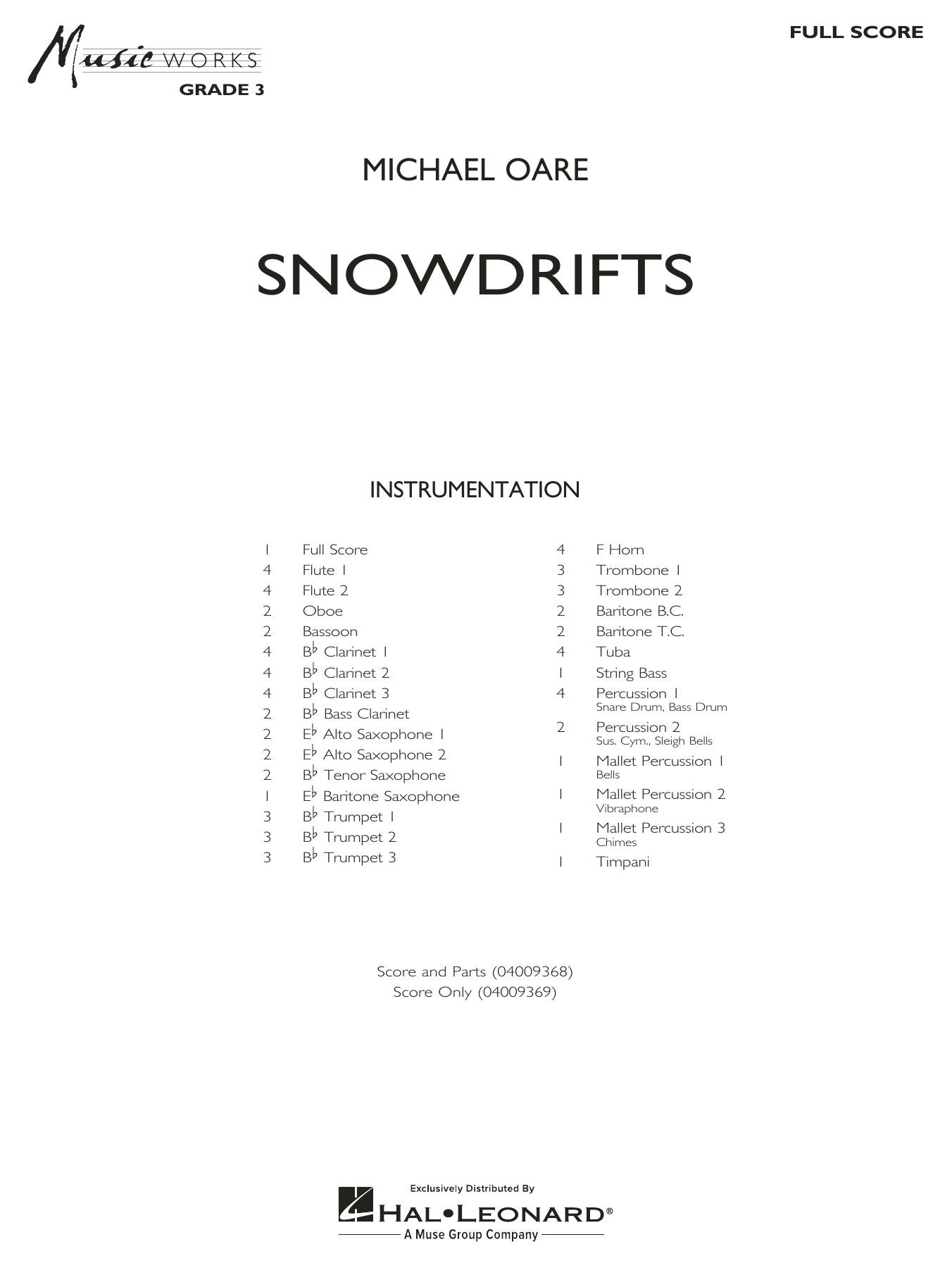

Snowdrifts: Concert Band Conductor Score & Parts
By Michael Oare
Grade: 3
Item: 35-PK01649632
$75.00
Pickup currently not available
Buy Extra Parts (Digital PDF Download)
| Product | Price | Quantity |
|---|---|---|
| Snowdrifts - Conductor Score (Full Score) | $10.00 | |
| Snowdrifts - Flute 1 | $6.00 | |
| Snowdrifts - Flute 2 | $6.00 | |
| Snowdrifts - Oboe | $6.00 | |
| Snowdrifts - Bassoon | $6.00 | |
| Snowdrifts - Bb Clarinet 1 | $6.00 | |
| Snowdrifts - Bb Clarinet 2 | $6.00 | |
| Snowdrifts - Bb Clarinet 3 | $6.00 | |
| Snowdrifts - Bb Bass Clarinet | $6.00 | |
| Snowdrifts - Eb Alto Saxophone 1 | $6.00 | |
| Snowdrifts - Eb Alto Saxophone 2 | $6.00 | |
| Snowdrifts - Bb Tenor Saxophone | $6.00 | |
| Snowdrifts - Eb Baritone Saxophone | $6.00 | |
| Snowdrifts - Bb Trumpet 1 | $6.00 | |
| Snowdrifts - Bb Trumpet 2 | $6.00 | |
| Snowdrifts - Bb Trumpet 3 | $6.00 | |
| Snowdrifts - F Horn | $6.00 | |
| Snowdrifts - Trombone 1 | $6.00 | |
| Snowdrifts - Trombone 2 | $6.00 | |
| Snowdrifts - Baritone B.C. | $6.00 | |
| Snowdrifts - Baritone T.C. | $6.00 | |
| Snowdrifts - Tuba | $6.00 | |
| Snowdrifts - String Bass | $6.00 | |
| Snowdrifts - Percussion 1 | $6.00 | |
| Snowdrifts - Percussion 2 | $6.00 | |
| Snowdrifts - Mallet Percussion 1 | $6.00 | |
| Snowdrifts - Mallet Percussion 2 | $6.00 | |
| Snowdrifts - Mallet Percussion 3 | $6.00 | |
| Snowdrifts - Timpani | $6.00 |
Parts Added to Cart!
Description
The peace and tranquility of a soft falling snow and the thrill of sledding down the hill all wrapped up into one great work. Lots of dramatic and impact moments along with high energy rhythms. Perfect for holiday, winter and spring programs.


Discover MakeMusic Cloud: thousands of interactive titles your students can play along with today.
Sample Audio
No sample audio found.
Sample Video
Additional Details
Publisher:
Hal Leonard
SKU:
35-PK01649632
More about this title
About the Composer: Michael Oare

Michael Oare brings three decades of classroom experience to his compositions for young musicians. After earning degrees in composition and music education from Old Dominion University, he spent 33 years directing bands at Great Bridge Middle School in Chesapeake, Virginia, where his ensembles achieved superior ratings on the Virginia Concert Band Performance Assessment for 32 consecutive years. His work has been recognized in GIA Publications' Teaching Music Through Performance series, and he has received the National Band Association's Citation of Excellence twice.
Beyond the classroom, Oare maintains an active career as a composer, arranger, conductor, and adjudicator. He currently conducts the Bay Youth Orchestras of Virginia Concert Band and performs with the Virginia Wind Symphony. His deep understanding of what middle school musicians can accomplish informs every score he writes.
Why we love this
Oare captures two distinct moods in a single work without losing musical coherence. The contrasts between serene, soft passages and energetic sledding sequences give your band something genuinely engaging to sink their teeth into, and the Grade 3 difficulty ensures neither section demands unreasonable technical chops. This is the kind of winter piece that actually holds up through rehearsal because it offers real musical substance alongside the seasonal appeal.
What to expect
The opening establishes a hushed, contemplative atmosphere as soft snowfall unfolds across the band. Then the mood shifts: rhythmic energy builds, and suddenly you're racing down a snowy hill with exhilaration and momentum. The piece lets students experience the full emotional arc of a winter day, moving between peaceful reflection and pure joy.
Who it's for
Directors programming winter and holiday concerts who want a piece with genuine musical weight, not just festive window dressing. This works equally well for groups building confidence in Grade 3 repertoire or as a refreshing change of pace in a concert that leans toward traditional holiday standards.
How to get the most out of it
- Balance the dynamics carefully in the opening snowfall passages. Young players often rush soft music, so establish a steady pulse and let the texture do the work.
- Mark the transition into the high-energy sledding section with a clear gesture so the ensemble hits the rhythmic precision without sounding rigid.
- Pay attention to how individual sections voice the melody during moments of dramatic impact. Clarity matters more than volume.
- Use the parts to identify where different instrumental groups carry the musical line in quieter moments, helping students understand they're supporting the overall shape even when playing softly.
How to use it
Feature this as a centerpiece in a winter or holiday concert where you want to break up a sequence of shorter, lighter pieces with something that has real narrative and musical development. It also works well as a spring concert opener if you're programming thematically around seasons or nature.
Skills your students will build
- Sustaining soft dynamics without losing ensemble cohesion
- Transitioning between contrasting tempos and energy levels
- Articulating rhythmic passages with precision at moderate to fast tempos
- Listening for balance when multiple sections carry melodic material simultaneously
- Responding to conductor gestures that signal sudden shifts in character