
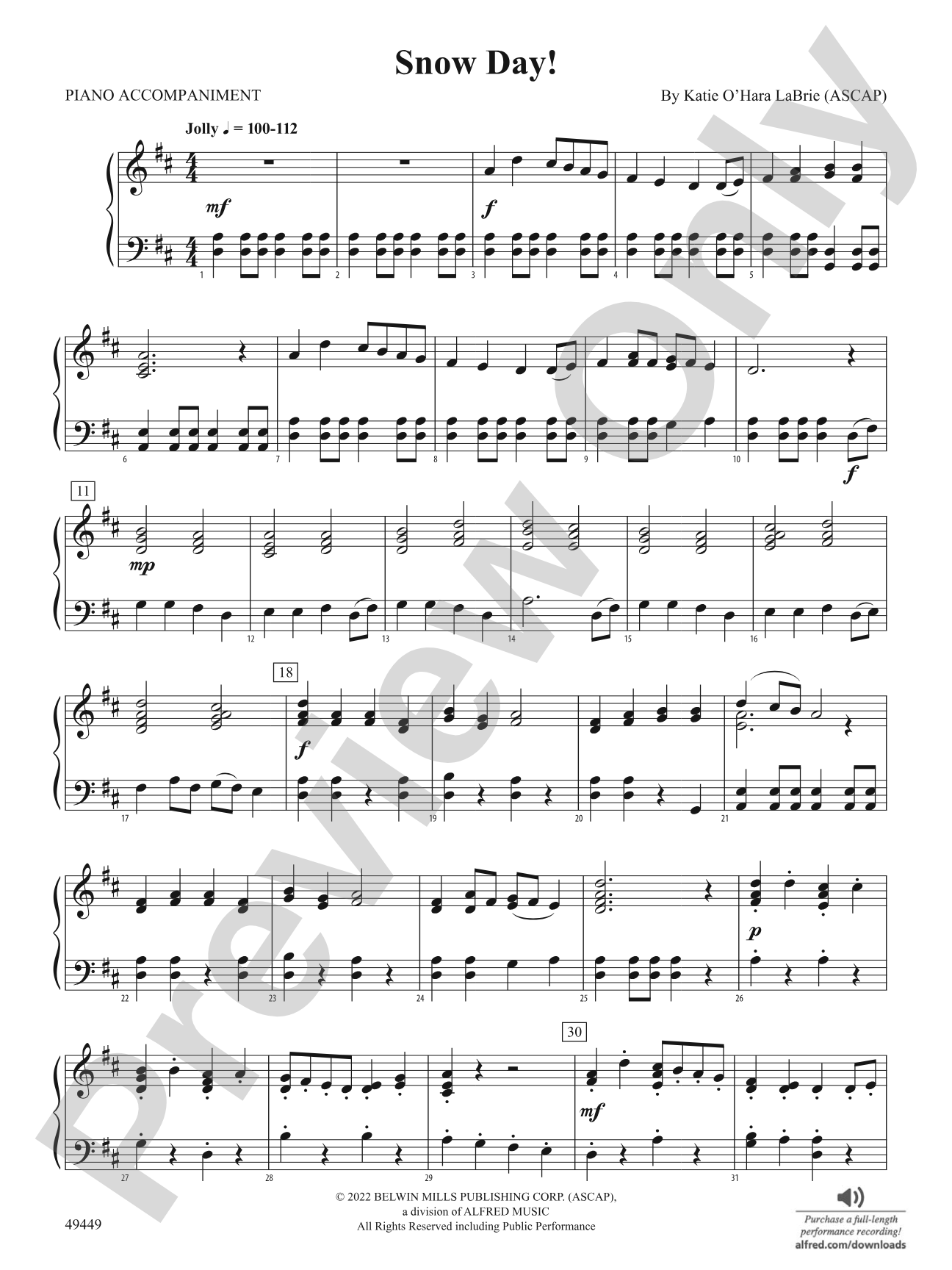

Snow Day: Piano Accompaniment
By Katie O'Hara LaBrie
Grade: 1
Item: 00-PC-0018775_K
$3.00
Pickup currently not available
Description
Waking up on a cold winter day. Sledding. Hot chocolate. It's a snow day! Written by Katie O'Hara LaBrie, Snow Day! is craftily designed only using the notes of a D major scale. This highly accessible piece, with its bright melodies and jingle bell accompaniment will delight students and audiences. (2:10) This title is available in MakeMusic Cloud.


Don't just read it, hear it, play along with it, and watch your students grow with it. In MakeMusic Cloud, Snow Day: Piano Accompaniment comes alive with professional accompaniment, adjustable tempo, and built-in practice tools that turn solo practice into real progress.
Open in the Player
Jump straight in and assign it today.
Start Your Free Trial
Open this title and explore the full library in minutes.
Sample Audio
1
Audio File
--:--
0:00
0:00
Sample Video
Additional Details
Series:
Belwin Beginning String Orchestra
Publisher:
Alfred Music
SKU:
00-PC-0018775_K
More about this title
About the Composer: Katie O'Hara LaBrie

Katie O'Hara LaBrie brings fifteen years of orchestra teaching experience from Fairfax County, Virginia to her work as a composer and conductor. She holds degrees from St. Olaf College (Bachelor of Music in Music Education) and George Mason University (Master of Music in Instrumental Conducting), where she studied with Steven Amundson and Anthony Maiello respectively.
LaBrie's compositions consistently earn recognition for their educational integrity and accessibility. Her works have been selected as J.W. Pepper Editor's Choice multiple times and performed at the Midwest Band and Orchestra Directors Clinic and American String Teachers Association Conference. In 2022, Yamaha named her one of their "40 Under 40" honorees for her impact on music education. She founded the Fairfax Chamber Players and co-created "the Big IDEA" practice method, reflecting her commitment to purposeful music instruction. She is also a cellist and lives in Northern Virginia with her family.
Why we love this
LaBrie solves a real problem for beginning string orchestras: how to program something festive that genuinely excites young players without requiring advanced technique. By limiting the piece to D major scale tones, she removes the technical barrier while keeping the melody bright and instantly recognizable. The jingle bell accompaniment and vivid imagery of sledding and hot chocolate make this something students will actually want to rehearse.
What to expect
Bright, innocent, and warmly nostalgic. The piece captures that unmistakable childhood joy of an unexpected snow day, with moments of contemplation (the quiet opening) giving way to exuberant play. The jingle bell accompaniment adds shimmer without becoming saccharine, and the overall arc feels like a story unfolding rather than a generic holiday tune.
Who it's for
Beginning string orchestras in Grades 1-2 looking for a holiday piece that builds confidence rather than frustration. Directors serving mixed-level ensembles will appreciate the accessibility without sacrifice of musical character. This works equally well for full orchestras or flexible configurations of available string players.
How to get the most out of it
- Lean into the descriptive quality of the opening. The "cold winter day" section benefits from slightly softer dynamics and a deliberate tempo; resist rushing through it.
- Balance the jingle bell accompaniment so it sparkles without overwhelming the melody line. Keep it playful rather than aggressive.
- Use the D major scale as your tuning foundation. Since the entire piece stays within those notes, intonation challenges are minimal; focus energy on rhythmic precision and ensemble blend instead.
- Encourage students to visualize the narrative arc (waking up, playing outside, warming up inside). This emotional connection often translates into more engaged phrasing and dynamics.
How to use it
This is ideal for mid-December concerts where you want a lighter, audience-friendly opener or encore. It pairs well alongside more traditional holiday carols or works as a charming contrast to weightier repertoire on the same program. The short runtime (2:10) makes it valuable for holiday pops shows where you need accessible variety.
Skills your students will build
- Reading within a single major scale (D major) with confidence
- Distinguishing melody from accompaniment roles and balancing accordingly
- Playing with rhythmic accuracy in a fast tempo without rushing
- Responding to narrative and imagery as compositional tools for musical interpretation