
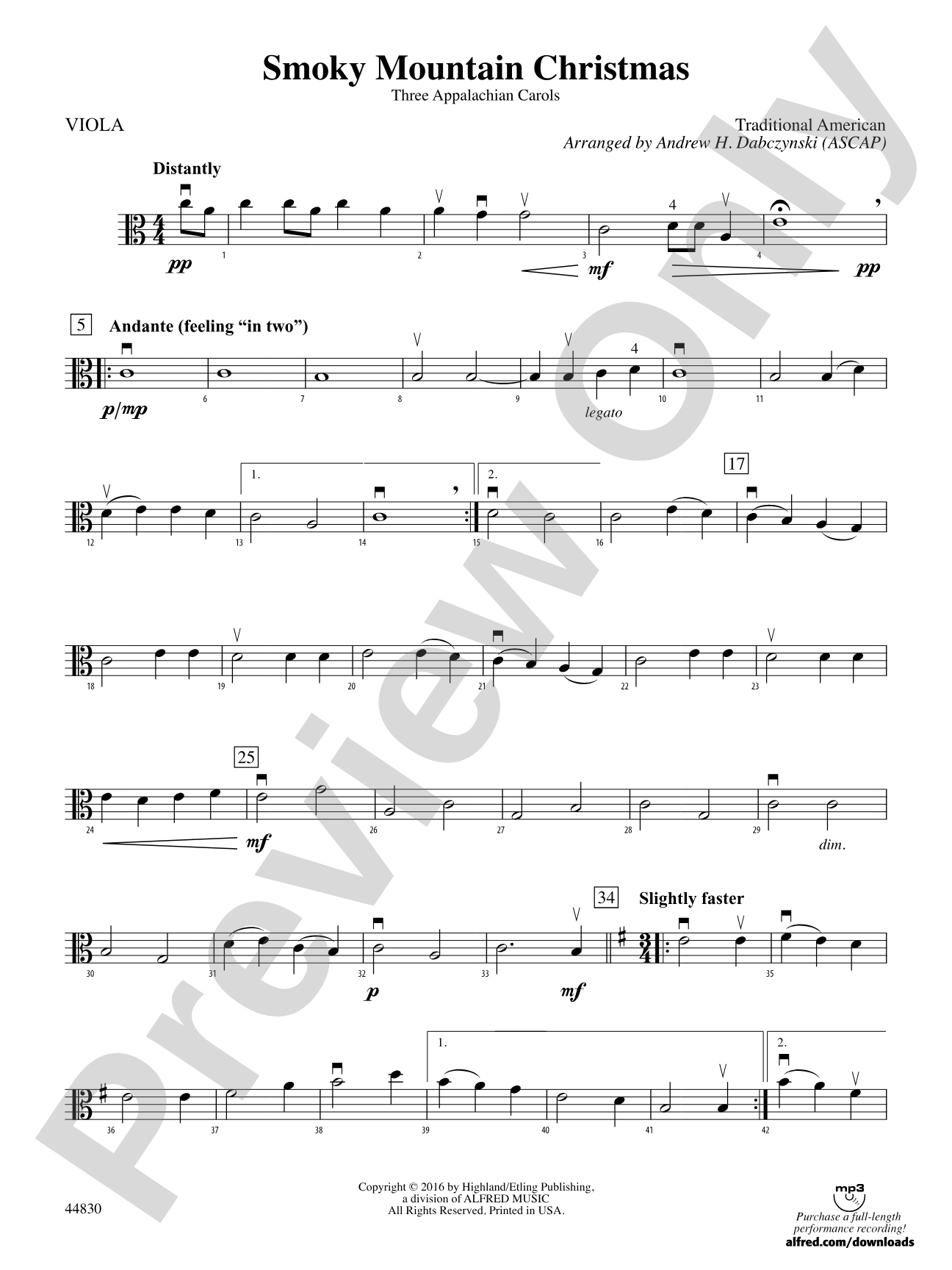

Smoky Mountain Christmas: Viola
Three Appalachian Carols
Traditional American / arr. Andrew H. Dabczynski
Grade: 2
Item: 00-PC-0017347_VA1
$7.99
Pickup currently not available
Description
Snowy hilltops, timeless family traditions, and the warmth of a hearth---the atmosphere of a Smoky Mountain Christmas is captured in this arrangement of three traditional Appalachian carols arranged by Andrew Dabcyznski. The simple modal melodies of "Star of the East" and "Babe of Bethlehem" are passed throughout the orchestra, before concluding with the stirring spiritual "Rise Up Shepherd and Follow." The keys, meters, and bowings are all playable by second-year string students, but intermediate and advanced students also will find this to be a satisfying holiday concert piece. (3:30)


Don't just read it, hear it, play along with it, and watch your students grow with it. In MakeMusic Cloud, Smoky Mountain Christmas: Viola comes alive with professional accompaniment, adjustable tempo, and built-in practice tools that turn solo practice into real progress.
Open in the Player
Jump straight in and assign it today.
Start Your Free Trial
Open this title and explore the full library in minutes.
Sample Audio
1
Audio File
--:--
0:00
0:00
Sample Video
Additional Details
Series:
Highland/Etling String Explorer
Publisher:
Alfred Music
Page Count:
140
SKU:
00-PC-0017347_VA1
More about this title
About the Arranger: Andrew H. Dabczynski

Andrew H. Dabczynski held faculty positions at Brigham Young University, where he was Emeritus Professor of Music Education and founded the BYU "New Horizons Orchestra" for adult beginning string students. His work in string pedagogy and teacher training earned him BYU's Joseph E. White Fellowship for Teaching and Learning, and Utah ASTA recognized him as "Higher Education Teacher of the Year" in 2005 and for "Outstanding Contributions to Music Education" in 2014.
Dabczynski's career spans teaching roles at the Eastman School of Music and public school positions in New York and Michigan, along with performance experience as principal violist in regional orchestras including the Rochester Philharmonic and Hartford Symphony. His deep expertise in string methods and folk traditions informed the widely used String Explorer series he co-authored, and his research in fiddling and traditional music transmission has shaped his approach to arranging accessible repertoire that honors cultural roots.
Why we love this
Dabczynski writes Grade 2 string music that doesn't condescend to young players. Three genuine Appalachian melodies unwind naturally across the orchestra, giving every section moments to carry a tune while keeping bow techniques and key centers within reach. The balance between accessibility and musical substance means your second-year students play something worth playing, and your more advanced musicians stay engaged.
What to expect
Quiet reverence mixed with gentle motion. Simple melodies drift across the orchestra like snowfall on mountain ridges, each carol building warmth through gradual layering rather than sudden intensity. "Rise Up Shepherd and Follow" arrives with quiet spiritual fervor, letting the familiar spiritual speak without orchestral bombast.
Who it's for
Grade 2 and advancing string orchestras preparing a winter concert with substance. The score works equally well for orchestras at the second-year mark and for intermediate ensembles seeking repertoire that respects both their developing skills and their musical intelligence.
How to get the most out of it
- Treat the modal character of "Star of the East" and "Babe of Bethlehem" as an opportunity to develop straight tone production. These melodies don't need vibrato to sing; focus your section on clean, sustained intonation.
- Shape the transitions between movements by letting the final measures breathe. Brief pauses create space for the spiritual message of "Rise Up Shepherd and Follow" to land.
- Listen across sections during rehearsal for balance. Modal melodies blur easily when multiple parts play simultaneously; highlight the primary voice and let accompanying lines recede slightly.
- Mark bowings consistently in rehearsal so students internalize the musical phrasing, not just the mechanics. Dabczynski's bowing choices support the narrative arc of each carol.
How to use it
Frame this as the centerpiece of a holiday concert's second half, where its sustained legit work and modal texture contrast with lighter openers. It also serves well as a standalone seasonal offering for community performances or school assemblies where younger musicians share meaningful music with families.
Skills your students will build
- Sustaining legit tone across longer phrases in modal keys
- Balancing ensemble sound when melodies pass between sections
- Reading and executing bowing patterns that support phrasing over individual strokes
- Understanding modal melody within a tonal framework
- Performing with dynamic control and spiritual restraint in slower tempos