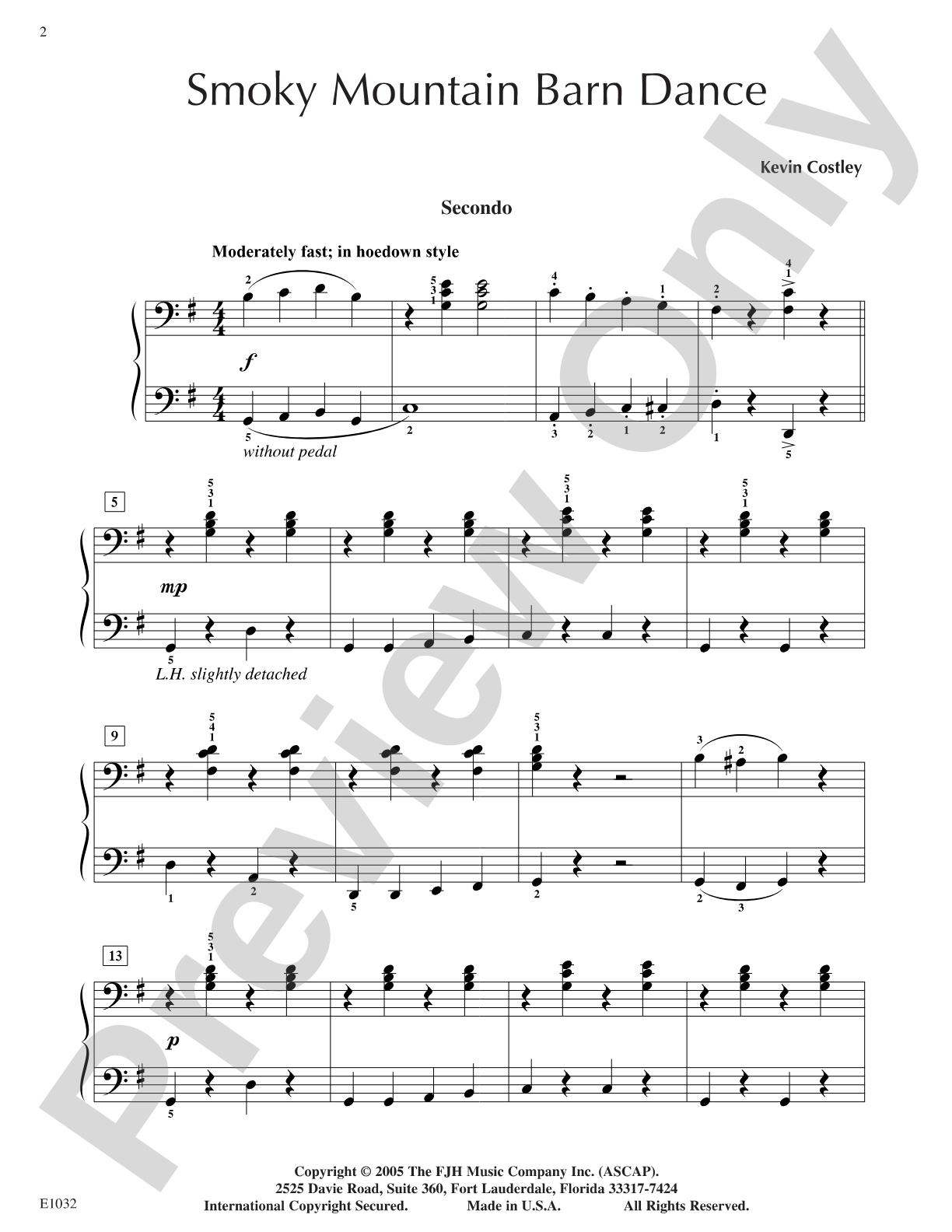
Smoky Mountain Barn Dance Sheet Music Preview

Smoky Mountain Barn Dance: Piano

By Kevin Costley

Item: 98-DE1032

Digital Download
$3.95
Description
A fun piece for four hands played in the key of G major that simulates "fiddles" in both parts. The melody in primo is in unison throughout and promotes 8va playing. Both pianists take turns playing the melody which fosters listening skills as well as giving both a sense of ensemble playing.

Smoky Mountain Barn Dance: Piano isn't in MakeMusic Cloud just yet...but it could be. Let us know you'd like to see it, and you'll help shape what comes next. In the meantime, start a free trial and dive into thousands of interactive titles your students can play along with today.

Sample Audio
No sample audio found.
Sample Video
Additional Details
Series: The FJH Piano Ensemble Series
Publisher: The FJH Music Company, Inc.
SKU: 98-DE1032

More about this title

Why we love this

The alternating melody between primo and secondo creates genuine musical dialogue rather than a lopsided duet where one player dominates. Students hear each other actively, which builds awareness of blend and timing in a way that passive accompaniment playing never will. The fiddling idiom gives both players material that feels authentic and satisfying to execute.

What to expect

Picture a barn in the Smokies with fiddles trading riffs, energy bouncing between players. The key of G major and unison writing create brightness and clarity. There's joy in the rhythmic exchanges, and the octave playing adds a folk-music sparkle that feels both playful and grounded.

Who it's for

Intermediate pianists who are ready for four-hand writing but benefit from the scaffolding of a shared melody. Pairs preparing for an ensemble concert will find this accessible without feeling simplistic. It works equally well as a teaching tool for duet awareness and as a performance piece that audiences enjoy.

How to get the most out of it

  • Lift the eighth-note figures slightly to capture that fiddle articulation, especially when the melody passes to the secondo part. The rhythmic snap matters more than speed.
  • Balance the unison playing carefully in primo. Since both hands double the melody, small dynamic choices between them create the illusion of octave separation.
  • Let the secondo player take ownership of the melody when it arrives in their staff. This isn't accompaniment time; treat the handoff as a real solo moment.
  • Work the tempo up gradually rather than starting fast. The piece rewards clear articulation over velocity.

How to use it

Slot this into a concert of American or folk-inspired works where it will feel natural and engaging for both players and listeners. It pairs well with solo piano pieces on the same program, offering variety in texture and ensemble size. Consider it as a warm-up for duet work earlier in the year or as a showcase closer once pairs have built their chemistry.

Skills your students will build

  • Listening and responding to a partner's phrasing in real time
  • Playing unison octaves with consistent touch and dynamic balance
  • Executing folk-style articulation and rhythmic clarity
  • Transferring leadership of a melody between players
  • Ensemble awareness and turn-taking in musical dialogue

You May Also Like