Smoke Gets In Your Eyes (arr. Kirby Shaw) Sheet Music Preview

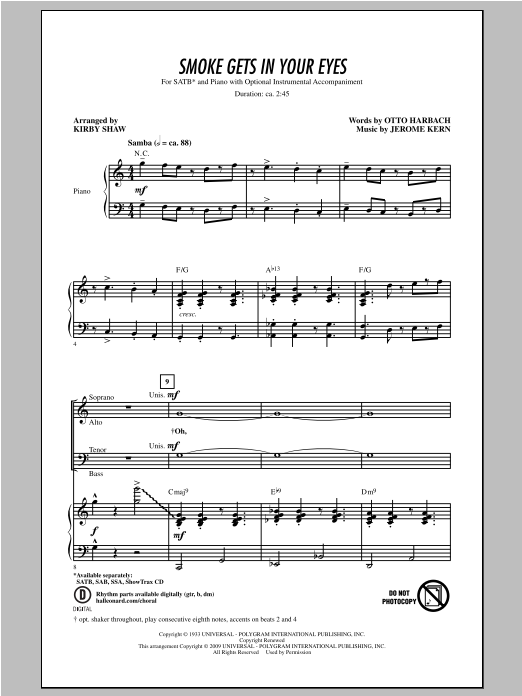
Smoke Gets In Your Eyes (arr. Kirby Shaw): SATB Choral Octavo

Arranged by Kirby Shaw

Item: 35-DS00262126

Digital Download
$2.99
Description

Smoke Gets In Your Eyes (arr. Kirby Shaw): SATB Choral Octavo isn't in MakeMusic Cloud just yet...but it could be. Let us know you'd like to see it, and you'll help shape what comes next. In the meantime, start a free trial and dive into thousands of interactive titles your students can play along with today.

Sample Audio
No sample audio found.
Sample Video
Additional Details
Publisher: Hal Leonard
Page Count: 11
SKU: 35-DS00262126

More about this title

About the Arranger: Kirby Shaw

Kirby Shaw

Kirby Shaw stands as one of the most performed choral composers and arrangers in music education, with over 2,500 works in print and nearly 20 million copies sold worldwide. His impact spans five decades and six continents, marked by teaching positions at College of the Siskiyous, Colorado State University, University of Missouri at Kansas City, and currently Southern Oregon University, where he directs the Jefferson State Choral Coalition. Shaw earned degrees in Music Education and Choral Composition from San Jose State University and a DMA in Choral Conducting from the University of Washington.

Beyond his compositional prolificacy, Shaw brings a distinctive sensibility shaped by deep jazz study with vocalists including Bobby McFerrin, Al Jarreau, and Jon Hendricks. He founded and directed acclaimed vocal jazz ensembles at multiple universities and remains an active member of the a cappella group Just 4 Kicks. His work has earned numerous ASCAP awards, and his creative reach extends to theatrical projects, including the original musical Scroogical (co-written with his wife Markita), a reimagining of Dickens' A Christmas Carol.

Why we love this

Shaw's arrangement captures the sultry, timeless quality of this standard while making it genuinely singable for mixed choirs without requiring jazz experience. The voicing is intelligent and supportive, with accessible ranges and clear harmonic movement that doesn't sacrifice sophistication. For any director looking to program a recognizable classic that will resonate with audiences and engage singers of varied levels, this delivers immediate musical payoff.

What to expect

Smoke Gets In Your Eyes carries the intimate vulnerability of a torch song, moving through lush harmonic landscapes that feel both vintage and emotionally immediate. The arrangement honors the song's lyrical heart while giving singers room to discover ensemble blend and dynamic nuance that transforms a familiar melody into a shared emotional experience.

Who it's for

Intermediate to advanced SATB choirs seeking repertoire that appeals to diverse audiences and requires solid musicianship without prohibitive ranges or technical demands. College and community choirs will find immediate programming value, as will high school groups ready to tackle material with jazz influences and vocal depth.

How to get the most out of it

  • Treat the legit vocal line with the same care you'd give a classical ballad; the arrangement supports genuine lyricism over novelty phrasing.
  • Work the backdrop voices to sit behind the melody line without dropping intensity, especially in passages where harmony carries emotional weight.
  • Let the text breathe. This song lives in its rubato moments, so build in space for singers to shape phrases rather than locking into metronomic time.
  • Balance the blend of registers carefully; uneven tenor or baritone weight will muddy the transparent harmony Shaw has written.

How to use it

This works beautifully as a concert centerpiece that bridges classical and popular sensibilities, especially in a program pairing other standards or vintage American songbook material. It's also an excellent choice for spring or end-of-year concerts where you want a piece that audiences recognize instantly but that demonstrates genuine choral artistry.

Skills your students will build

  • Balancing legit vocal technique with jazz-influenced phrasing
  • Singing sustained, blended harmony without losing individual line integrity
  • Responding to rubato and phrase-shaping in ensemble contexts
  • Navigating the tonal aesthetics of mid-century popular music

You May Also Like