
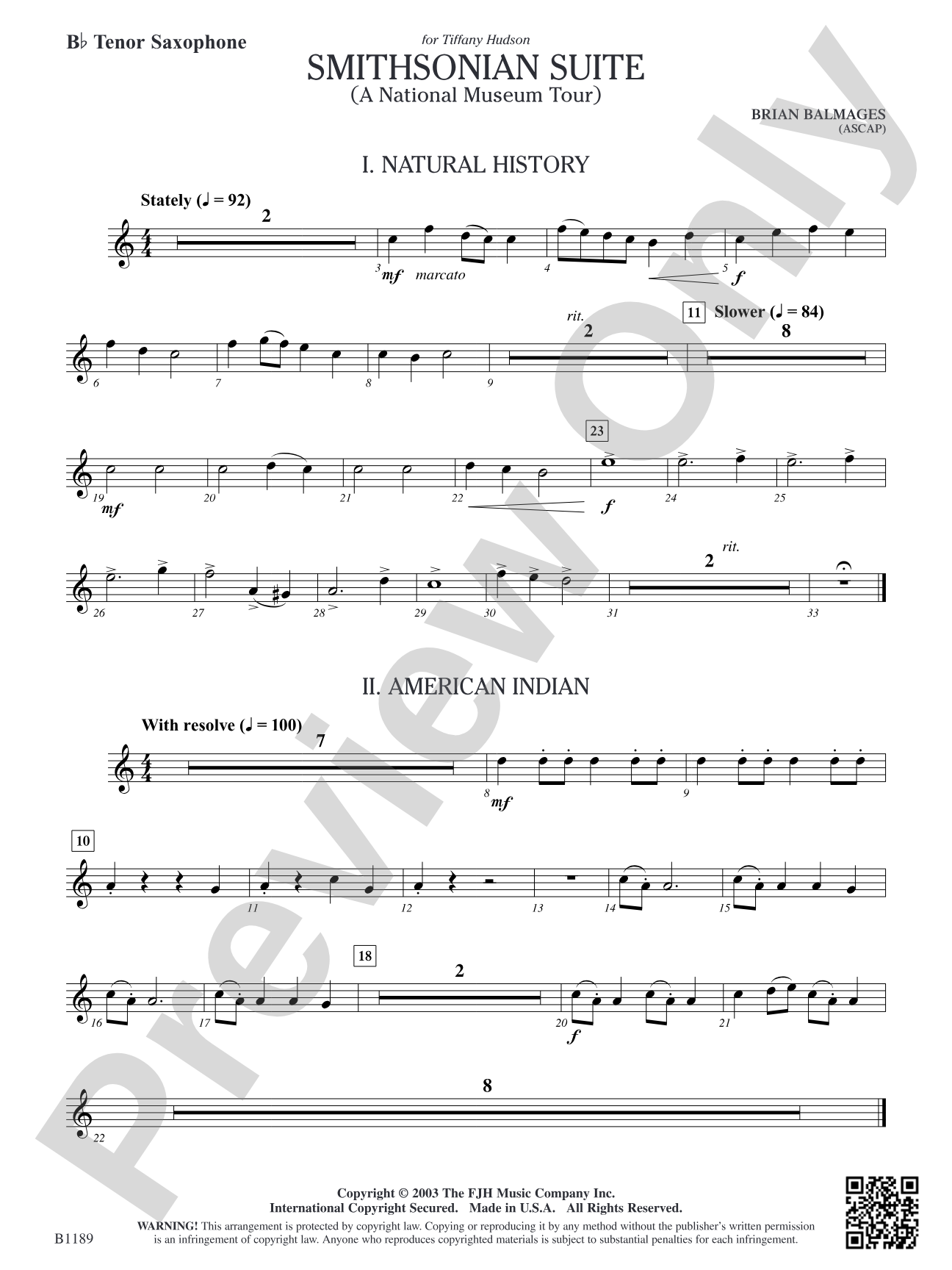

Smithsonian Suite: B-flat Tenor Saxophone
By Brian Balmages
Grade: 1
Item: 98-PC-DB1189_TX1
$7.00
Pickup currently not available
Description
This 4-movement multicultural suite provides a wealth of teaching and performance opportunities, especially at the beginning level. Each movement is based on a Smithsonian National Museum in Washington D.C. (Natural History, American Indian, African Art, and Air and Space). These movements can easily be performed separately. In addition to cross-curriculum teaching, the opening theme is slightly altered in each movement, teaching the concept of variations. Strongly consider this new work.


Smithsonian Suite: B-flat Tenor Saxophone isn't in MakeMusic Cloud just yet...but it could be. Let us know you'd like to see it, and you'll help shape what comes next. In the meantime, start a free trial and dive into thousands of interactive titles your students can play along with today.
Request This Title
Tell us you want it.
Start Your Free Trial
Explore everything that's ready to play right now.
Sample Audio
1
Audio File
--:--
0:00
0:00
Sample Video
No sample videos found.
Additional Details
Series:
FJH Beginning Band
Publisher:
The FJH Music Company, Inc.
SKU:
98-PC-DB1189_TX1
More about this title
About the Composer: Brian Balmages

Brian Balmages has built a distinguished career composing across orchestral, band, and chamber genres, with performances at venues including Carnegie Hall, the Kennedy Center, and the Sydney Opera House. He holds membership in the American Bandmasters Association and received the A. Austin Harding Award from the American School Band Directors Association. His composition Love and Light won the 2020 NBA William D. Revelli Composition Contest, and his work has been performed at the 2013 Presidential Inaugural Prayer Service.
Balmages maintains an active conducting schedule with all-state ensembles, university groups, and professional orchestras internationally. He has guest conducted at the Midwest Clinic, Western International Band Clinic, and numerous state and national conferences. He currently serves as Director of MakeMusic Publications and Digital Education for Alfred and MakeMusic, and holds degrees from James Madison University and the University of Miami.
Why we love this
The four separate movements function as self-contained concert pieces while building toward a unified suite, giving conductors real flexibility in festival planning and concert structure. Balmages deliberately integrates cross-curricular learning through the Smithsonian museums without letting the concept overwhelm the musical experience, and the recurring theme's subtle variations teach orchestration and development concepts that beginning students can actually hear and recognize.
What to expect
The suite unfolds like a guided tour through American heritage, with each movement evoking a distinct atmosphere. The writing maintains accessibility without sacrificing character, allowing young musicians to experience how orchestration and arrangement shape musical meaning.
Who it's for
Beginning concert band directors seeking repertoire that serves both performance and cross-curricular teaching. Grade 1 ensembles will find music that sits comfortably under their technical range while still offering genuine musical substance and programming variety.
How to get the most out of it
- Shape the opening theme distinctly in each movement so the variations become audible; small changes in articulation and dynamics across movements will make the concept land for the ensemble and audience alike.
- Use the conductor score to map the museum transitions clearly, helping students understand that each movement tells a different story despite the shared melodic material.
- Consider performing individual movements in sectional rehearsals to isolate the unique character of each museum before assembling the full suite.
How to use it
Program the entire suite on a concert celebrating American culture or community heritage. Alternatively, use individual movements in festival performances or as standalone contest selections, giving your ensemble multiple entry points throughout the season without requiring the same set of parts each time.
Skills your students will build
- Recognizing and performing melodic variations across different orchestrations
- Balancing technical demands with expressive playing at Grade 1 level
- Reading and performing music organized around thematic development
- Ensemble coordination across multiple independent movements
- Connecting musical content to non-musical subjects (museums, history, culture)