
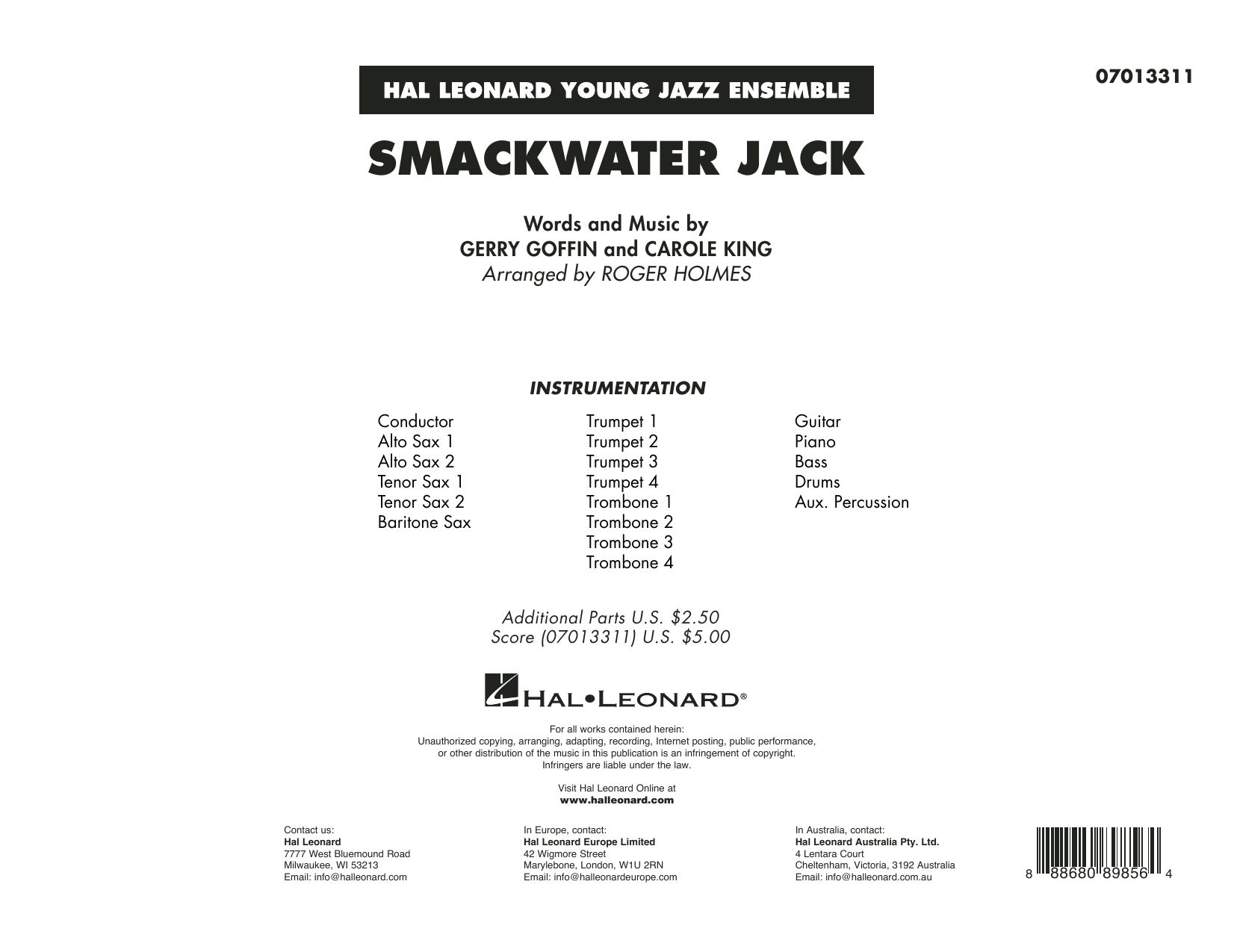

Smackwater Jack (arr. Roger Holmes): Jazz Ensemble Conductor Score & Parts
As performed by Carole King / Arranged by Roger Holmes
Grade: 3
Item: 35-PK00431994
$45.00
Pickup currently not available
Buy Extra Parts (Digital PDF Download)
Parts Added to Cart!
Description
Included on Carole King's landmark album "Tapestry" from 1971, this churnin' tune features a sultry shuffle groove at a moderate tempo. Solid scoring for the entire ensemble along with the spicy riffs help make this one particularly fun.


Smackwater Jack (arr. Roger Holmes): Jazz Ensemble Conductor Score & Parts isn't in MakeMusic Cloud just yet...but it could be. Let us know you'd like to see it, and you'll help shape what comes next. In the meantime, start a free trial and dive into thousands of interactive titles your students can play along with today.
Request This Title
Tell us you want it.
Start Your Free Trial
Explore everything that's ready to play right now.
Sample Audio
No sample audio found.
Sample Video
No sample videos found.
Additional Details
Publisher:
Hal Leonard
SKU:
35-PK00431994
More about this title
About the Artist: Carole King
Carole King stands among the most consequential songwriters in American popular music, with a catalog that spans decades and genres. Her 1971 album "Tapestry" remains one of the best-selling albums of all time, showcasing her gift for crafting songs that balance sophistication with accessibility. For music educators, King's work offers rich material for exploring how strong melodic writing and harmonic depth can thrive within folk, pop, and rock contexts.
Beyond her own recordings, King's compositions have become standards in music education, appearing across ensemble contexts and curricula. Her ability to write memorable hooks without sacrificing musical substance makes her songs particularly valuable for teaching students how commercial success and artistic integrity need not be in tension.
Why we love this
Roger Holmes has given "Smackwater Jack" the kind of ensemble treatment that lets every section participate in the groove without oversimplifying the original's character. The shuffle feel and riff-driven texture give students something immediately enjoyable to play, while the scoring complexity ensures they're building real musicianship rather than coasting on a recognizable tune. This arrangement sits right at that Grade 3 sweet spot where groups feel genuinely accomplished.
What to expect
A groove that settles in immediately and carries you forward with understated confidence. The shuffle rhythm has a lazy, sultry quality, but underneath runs a current of energy from the riffs that keeps the ensemble engaged and moving. This is music that rewards tightness and ensemble unity rather than individual flash.
Who it's for
Jazz ensemble directors and teachers looking for Grade 3 material that connects students to recognizable popular music from a landmark recording. This works particularly well for groups ready to commit to ensemble blend and rhythmic accuracy without needing virtuoso soloists or complex harmonic reharmonization.
How to get the most out of it
- Establish the shuffle pocket early in rehearsal by isolating the rhythm section for several measures. The groove is the foundation; everything else locks onto it.
- Balance the riffs across different instrumental voices so they sit as a unified rhythmic texture rather than isolated lines competing for attention.
- Keep the articulation clean and consistent within each section. The "churnin'" quality comes from precision, not from pushing the tempo or playing with too much weight.
- Let the ensemble breathe where the original does. Rests between phrases are part of the groove's character, not dead space to fill.
How to use it
Pair this with other funk and rock standards to build a concert program that shows your ensemble's range in the contemporary idiom. It programs especially well as a closer in sets that mix genres, where its infectious groove can send audiences out with momentum. For younger ensembles, it serves as an excellent entry point into shuffle articulation and collective riff work.
Skills your students will build
- Shuffle rhythm feel and articulation
- Riff-based ensemble coordination across multiple sections
- Dynamics control in groove-based writing
- Balance between individual lines and unified textural goals
- Listening for lock and pocket in a rhythm section context