
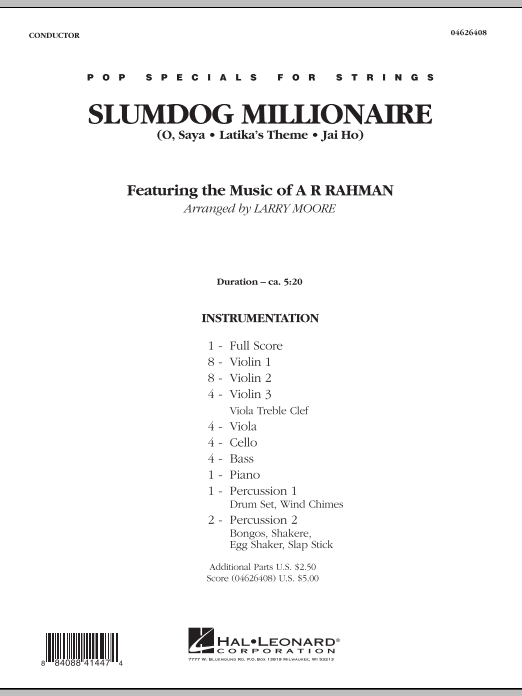

Slumdog Millionaire: String Orchestra Conductor Score & Parts
By A.R. Rahman / Arranged by Larry Moore
Grade: 3-4
Item: 35-PK00133334
$50.00
Pickup currently not available
Buy Extra Parts (Digital PDF Download)
| Product | Price | Quantity |
|---|---|---|
| Slumdog Millionaire - Full Score | $6.00 | |
| Slumdog Millionaire - Violin 1 | $7.00 | |
| Slumdog Millionaire - Violin 2 | $7.00 | |
| Slumdog Millionaire - Violin 3 (Viola Treble Clef) | $7.00 | |
| Slumdog Millionaire - Viola | $7.00 | |
| Slumdog Millionaire - Cello | $7.00 | |
| Slumdog Millionaire - Bass | $7.00 | |
| Slumdog Millionaire - Piano | $7.00 | |
| Slumdog Millionaire - Percussion 1 | $7.00 | |
| Slumdog Millionaire - Percussion 2 | $7.00 |
Parts Added to Cart!
Description
The Oscar-winning film and music score captured the attention of the entertainment world this year, bringing a new and energetic style of popular music. A.R. Rahman's writing is infectious and engaging and makes a terrific choice for pop programming. Includes: "O Saya," "Latika's Theme" and "Jai Ho." Dur: 5:20


Slumdog Millionaire: String Orchestra Conductor Score & Parts isn't in MakeMusic Cloud just yet...but it could be. Let us know you'd like to see it, and you'll help shape what comes next. In the meantime, start a free trial and dive into thousands of interactive titles your students can play along with today.
Request This Title
Tell us you want it.
Start Your Free Trial
Explore everything that's ready to play right now.
Sample Audio
No sample audio found.
Sample Video
No sample videos found.
Additional Details
Publisher:
Hal Leonard
SKU:
35-PK00133334
More about this title
About the Composer: A.R. Rahman
A.R. Rahman is an Indian composer and music producer whose work has fundamentally shaped contemporary film music across multiple industries. His approach blends traditional Indian classical music with Western orchestral sensibilities, electronic production, and accessible melodic writing. Rahman won the Academy Award for Best Original Score for Slumdog Millionaire in 2009, along with a Golden Globe and multiple BAFTA nominations, bringing his distinctive compositional voice to international audiences.
In educational settings, Rahman's music offers students a direct encounter with how boundary-crossing compositional thinking sounds in real-world contexts. His scores demonstrate sophisticated harmonic and rhythmic concepts without sacrificing immediate engagement, making him a valuable model for young musicians learning how popular and classical traditions can coexist.
Why we love this
Rahman's orchestration sits in a sweet spot between contemporary energy and orchestral substance. This arrangement captures the infectious drive of the film score while remaining accessible for Grade 3-4 ensembles, giving your students repertoire that feels genuinely current rather than diluted.
What to expect
Propulsive and joyful, with moments of genuine lyrical warmth. The writing pulses with rhythmic intention and colorful orchestral layers that create texture without overcomplication. You hear both the swagger of popular music and the sophistication of concert scoring.
Who it's for
Directors programming film music in concert settings will find three substantial movements that work beautifully as a standalone suite or as part of a broader thematic program. String orchestras at the intermediate level gain exposure to contemporary scoring techniques and cross-cultural musical vocabulary without technical barriers.
How to get the most out of it
- Keep the rhythmic vitality propulsive without rushing. These grooves need definition and precision rather than aggressive tempo.
- Let the melodic lines breathe through the orchestration. The writing often layers simple, memorable themes; resist the urge to blend them into uniformity.
- Pay attention to the character shifts between movements. Each movement carries distinct energy, and the transitions should feel intentional rather than abrupt.
- Balance the lower strings carefully. The foundation here carries much of the rhythmic and harmonic interest; make sure second violins and violas lock in rather than disappear.
How to use it
Consider pairing this with other film music to highlight how composers approach orchestration across different genres and traditions. It also serves as a bridge into discussions about world music and contemporary composition without requiring specialized background knowledge from your audience.
Skills your students will build
- Maintaining rhythmic precision in syncopated and groove-based passages
- Balancing layered melodic material within an ensemble texture
- Executing stylistic shifts between contrasting sections
- Reading contemporary orchestration that draws from multiple musical traditions