
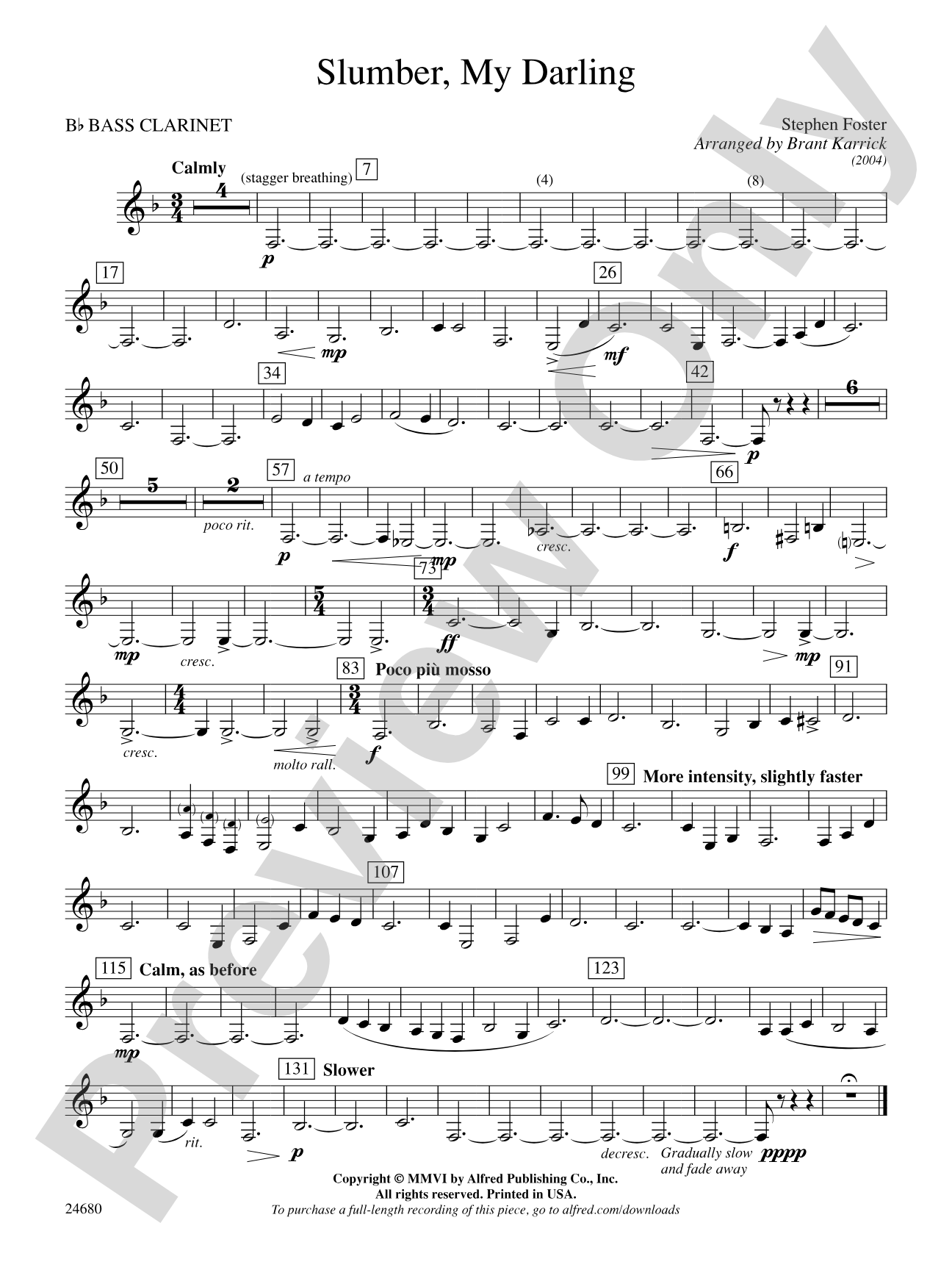

Slumber, My Darling: B-flat Bass Clarinet
By Brant Karrick
Grade: 3 (Medium)
Item: 00-PC-0000847_CBC
$5.99
Pickup currently not available
Description
With music and lyrics both composed by Stephen Foster in 1862 its elegantly simple and lyrical melody allow for a variety of colors and textures including low woodwinds, predominant melodic material played by low brass and low woodwinds, solo voices, and flowing counterpoint. The contrasting interlude includes short quotes of other Foster songs and should carry the listener, not to sleep, but into a realm of exuberance and gratitude.


Don't just read it, hear it, play along with it, and watch your students grow with it. In MakeMusic Cloud, Slumber, My Darling: B-flat Bass Clarinet comes alive with professional accompaniment, adjustable tempo, and built-in practice tools that turn solo practice into real progress.
Open in the Player
Jump straight in and assign it today.
Start Your Free Trial
Open this title and explore the full library in minutes.
Sample Audio
1
Audio File
--:--
0:00
0:00
Sample Video
No sample videos found.
Additional Details
Series:
Alfred Concert Band
Publisher:
Alfred Music
Page Count:
190
SKU:
00-PC-0000847_CBC
More about this title
About the Composer: Brant Karrick

Brant Karrick has shaped band programs across three decades as a conductor, educator, and composer. Since 2003, he has served as Director of Bands at Northern Kentucky University, where he oversees the full spectrum of band ensembles and teaches conducting, instrumental methods, and music theory. His career also includes nine years at the University of Toledo and seven years directing bands in Kentucky public schools, alongside extensive work as a guest conductor, clinician, and adjudicator.
Karrick earned his Ph.D. in music education from Louisiana State University (1994), a Master of Arts in education from Western Kentucky University (1984), and a Bachelor of Music Education from the University of Louisville (1982). His compositions and arrangements have been performed internationally across North America, Europe, South Africa, South America, Asia, and Australia. He is an active member of NAFME, ASCAP, and the College Band Directors National Association.
Why we love this
Karrick's approach to this Foster classic respects the timeless simplicity of the original melody while creating rich orchestral possibilities that keep student musicians engaged. The Grade 3 difficulty level never condescends; instead, it prioritizes clear voice leading and authentic color changes that challenge young players to listen across the ensemble. Programming this piece gives bands a genuinely lyrical work that stands apart from the typical march-and-fanfare concert repertoire.
What to expect
Hushed and intimate in its opening, with the melody carried gently by lower voices in warm, blended tones. The interlude arrives like a sudden window opening onto sunlight and remembrance, filled with allusions and gratitude, before settling back into the calm reverence of the main theme.
Who it's for
Concert bands at the intermediate to early advanced level seeking repertoire that develops lyrical playing and ensemble listening. Directors looking for a piece that challenges students to balance melody, harmony, and counterpoint without overwhelming them with technical demands.
How to get the most out of it
- Balance the flowing counterpoint by rehearsing voices separately, then layering them so the Foster melody remains audible above supporting figures rather than buried within them.
- Shape the contrasting interlude as a moment of genuine exuberance; the Foster song quotations should feel like warm reminiscences, not detours from the main arc.
- Let low woodwinds and low brass establish the harmonic foundation with a warm, singing tone that honors the piece's lyrical origins and allows brighter colors above them to emerge naturally.
- Attend to dynamics and color shifts as compositional punctuation; each textural change should feel intentional and give the band a moment to listen to itself.
How to use it
Pair this with a contrasting march or festive overture to showcase the band's range of character and control. It works particularly well as a concert opener that establishes an elegant, thoughtful tone for the evening, or as a second piece after a lighter work.
Skills your students will build
- Balance and blend in sustained, lyrical passages
- Layering independent melodic lines while maintaining transparency
- Reading and interpreting color and texture changes as structural markers
- Phrasing in low register sections (low brass and low woodwinds)
- Listening across ensemble voices to identify the principal melody