
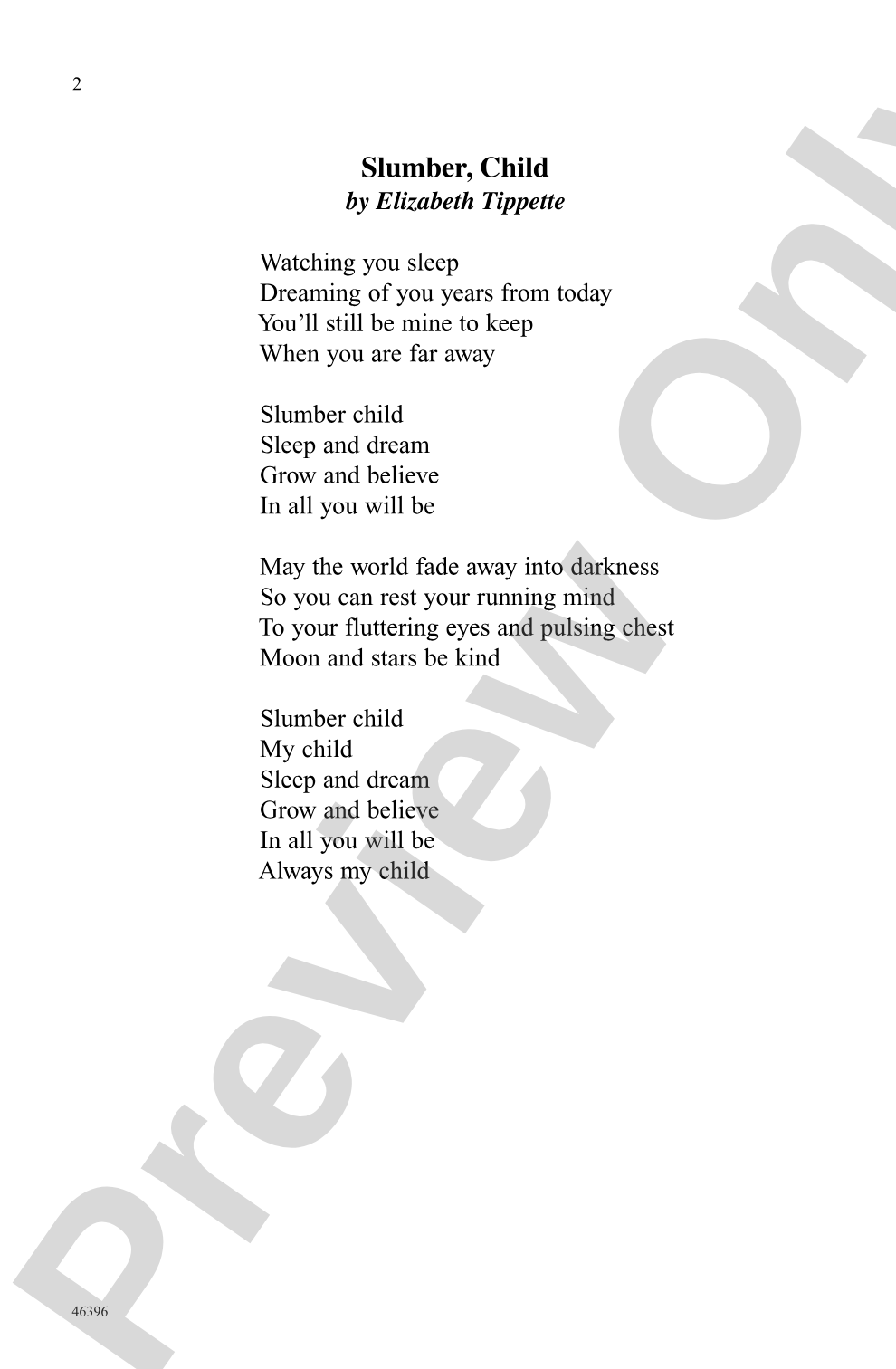
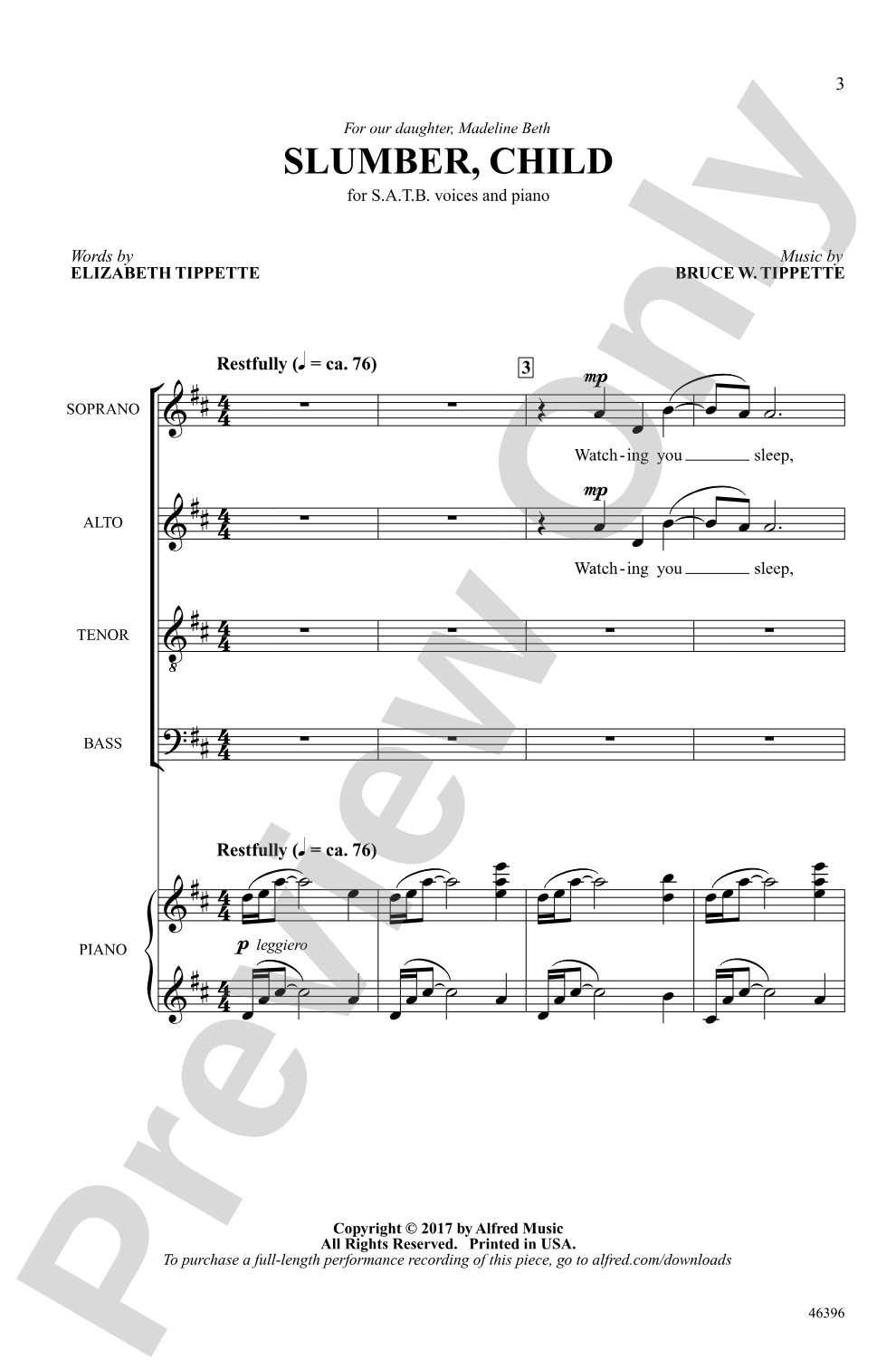
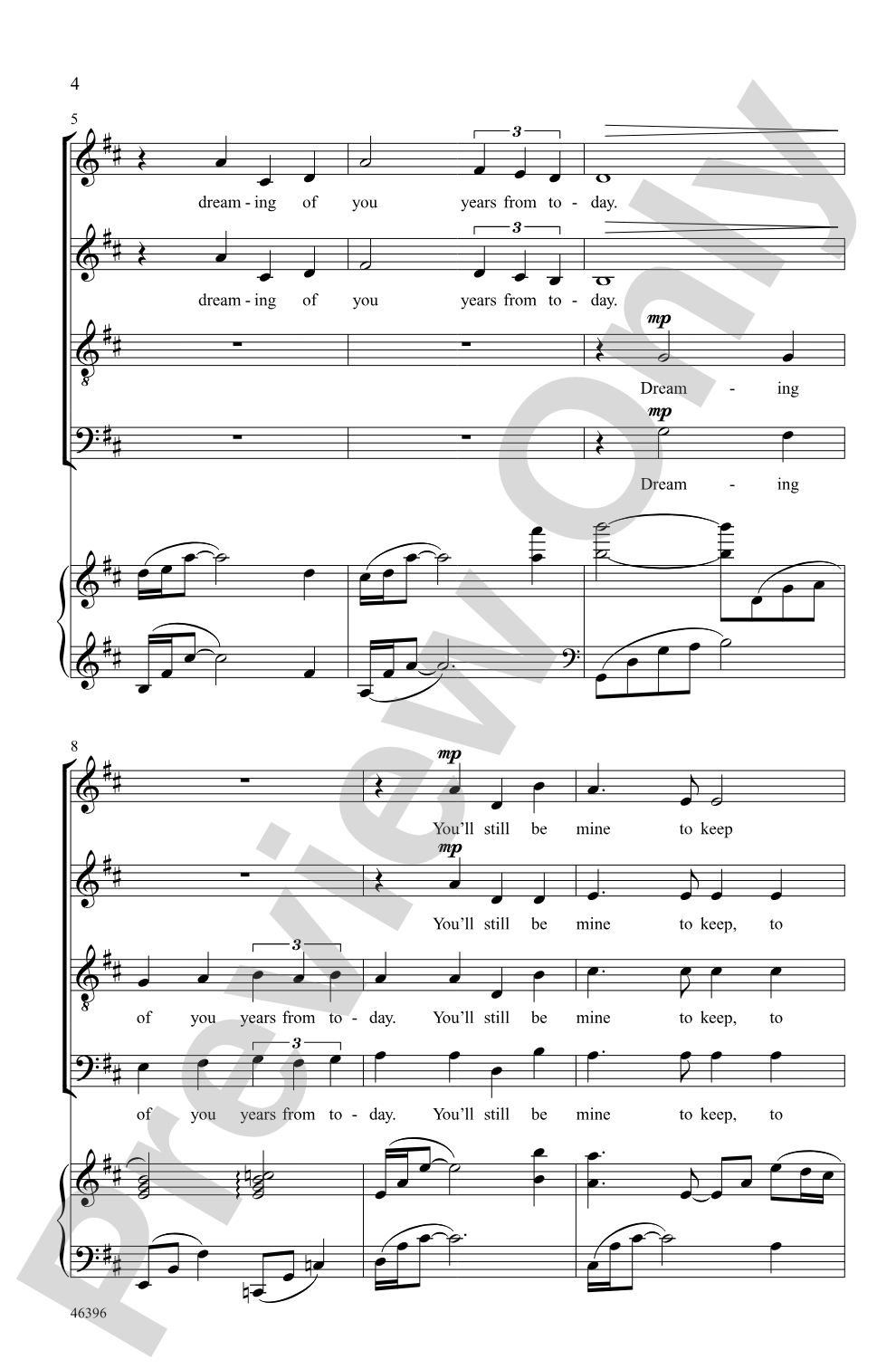

Slumber, Child: SATB Choral Octavo
Words by Elizabeth Tippette, music by Bruce W. Tippette
Item: 00-PO-0005639
$2.00
Minimum order quantity: 20 copies
Pickup currently not available
Related Items
Slumber, Child: SATB Choral Octavo |
$2.00
|
View |
Description
Written in honor of their newborn child, this gorgeous original lullaby is beautifully rich and moving. "Slumber child, sleep and dream. Grow and believe in all you will be."


Slumber, Child: SATB Choral Octavo isn't in MakeMusic Cloud just yet...but it could be. Let us know you'd like to see it, and you'll help shape what comes next. In the meantime, start a free trial and dive into thousands of interactive titles your students can play along with today.
Request This Title
Tell us you want it.
Start Your Free Trial
Explore everything that's ready to play right now.
Sample Audio
1
Audio File
--:--
0:00
0:00
Sample Video
Additional Details
Series:
Lawson-Gould
Publisher:
Alfred Music
Page Count:
16
SKU:
00-PO-0005639
More about this title
About the Composer: Bruce W. Tippette

Bruce W. Tippette is a composer grounded in both classical training and practical music-making across multiple genres. He earned his Master of Music in composition from the University of North Carolina School of the Arts and his Bachelor of Music from Appalachian State University, where he studied composition, theory, and music education. His concert works span orchestral, choral, and instrumental idioms, and he has received commissions from ensembles across the United States and internationally.
Beyond concert music, Tippette has composed for choreography, film, and theatrical works including a children's musical co-written with a collaborator. His orchestral piece Unconquered won the 2012 Mary Starling Composition Competition and has been performed multiple times by the Winston-Salem Symphony. In 2012, 2013, and 2014, he was selected to compose works as part of an experimental collaboration between Cirque du Soleil and UNCSA. As an educator and performer, he teaches composition, theory, piano, and voice at the Community Music School of UNCSA and serves as Youth Music and Handbell Director at Augsburg Lutheran Church.
Why we love this
Tippette has written a lullaby that feels intimate without being sentimental, with harmonic depth that rewards careful listening from both singers and audience. The text carries real emotion (born from his own experience as a new parent), and that authenticity translates into music that connects people rather than manipulating them. It's the kind of piece that closes a concert beautifully or sits meaningfully in a program about family, growth, or new beginnings.
What to expect
Warm, enveloping, and deeply tender. The harmony is rich enough to feel contemporary but grounded in traditional voice-leading; it wraps around the listener like a lullaby wraps around a child. There's an underlying confidence in the composition that prevents sentimentality, allowing genuine emotion to emerge.
Who it's for
Choirs with solid intonation skills and comfort in four-part writing will find this piece accessible and rewarding. It works equally well for high school, college, and adult community choirs seeking repertoire with substance and heart. Directors programming a concert around themes of new life, hope, or introspection will find this a natural fit.
How to get the most out of it
- Shape the legit line through the sustained chords; this piece lives in the spaces between notes as much as in the notes themselves.
- Balance the inner voices with care so that harmonic color emerges naturally without overpowering the melodic line.
- Allow the text "Slumber child, sleep and dream" to breathe; resist the urge to push the tempo forward during gentle passages.
- Use the full 16 pages as scaffolding for interpretive choices; rehearse the piece as written first before considering any expressive liberties.
How to use it
Position this as a quieter moment within a longer concert, perhaps following more dramatic or energetic work to provide contrast and reflection. It also pairs beautifully with other lullabies or family-themed repertoire in a thematic program. The piece translates well to festival or contest contexts where its musicality and text resonate with adjudicators and audiences alike.
Skills your students will build
- Sustaining tone quality across longer melodic phrases
- Blending four-part harmony with attention to dynamic balance and color
- Singing with text that carries emotional weight without oversinging
- Understanding how harmonic movement shapes musical narrative