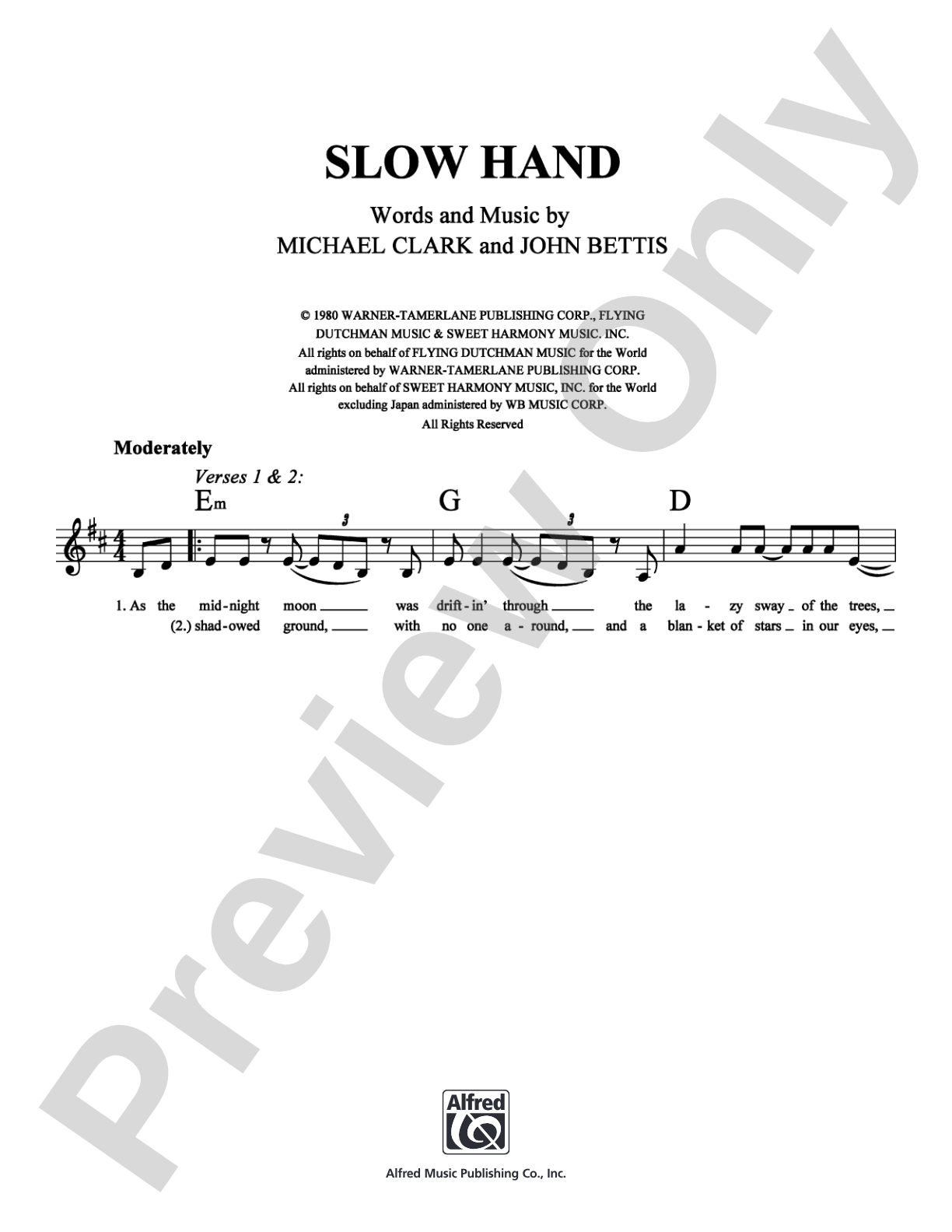
Slow Hand: Lead Sheet Digital Sheet Music

Slow Hand: Lead Sheet Digital Sheet Music

John Bettis, Conway Twitty, Michael Clark

Item: 00-PS-0008727

Digital Download
$1.99
Description

Slow Hand: Lead Sheet Digital Sheet Music isn't in MakeMusic Cloud just yet...but it could be. Let us know you'd like to see it, and you'll help shape what comes next. In the meantime, start a free trial and dive into thousands of interactive titles your students can play along with today.

Sample Audio
No sample audio found.
Sample Video
Additional Details
SKU: 00-PS-0008727

More about this title

About the Artist: Conway Twitty

Conway Twitty (1933-1993) was a country music virtuoso who shaped the genre across four decades with his distinctive baritone and emotionally direct songwriting. His influence spans rock and roll through classic country, making him a crucial figure in understanding how popular music crossed genre lines in the latter half of the 20th century.

Why we love this

This lead sheet captures one of country music's most recognizable slow ballads, offering students and educators a chance to explore how restraint and phrasing create emotional impact. The melody's accessibility combined with its sophisticated emotional arc makes it ideal for teaching vocal interpretation and understanding how country songwriting prioritizes lyrical storytelling.

What to expect

Patient and yearning, with a steady pulse that never rushes toward resolution. The melody sits comfortably in a conversational range, allowing singers to focus on emotional nuance rather than technical display.

Who it's for

Vocalists working on country repertoire, jazz singers exploring classic popular standards, and students learning to interpret lead sheets in real-time collaboration with accompanists. This piece works equally well for classroom listening and analysis or as a performance vehicle for intermediate to advanced singers.

How to get the most out of it

  • Pay attention to where the melody breathes; this song rewards singers who resist rushing and let the phrasing mirror natural speech patterns.
  • Experiment with dynamics across the verse and chorus to reveal how the tension builds gradually rather than through sudden changes.
  • Use the lead sheet's chord changes as a blueprint for accompaniment choices; a sparse arrangement often serves this melody better than an overstuffed one.

How to use it

Include this in a country music history unit or a program exploring slow ballads across genres. It pairs naturally with discussions of how country songwriting influenced popular music, and its accessibility makes it a strong choice for student showcases or informal performance settings.

Skills your students will build

  • Reading and interpreting lead sheet notation
  • Phrasing and breath placement in slow tempos
  • Accompanying from chord symbols
  • Connecting lyrical content to melodic shape
  • Collaborative listening between vocalist and accompanist

You May Also Like