
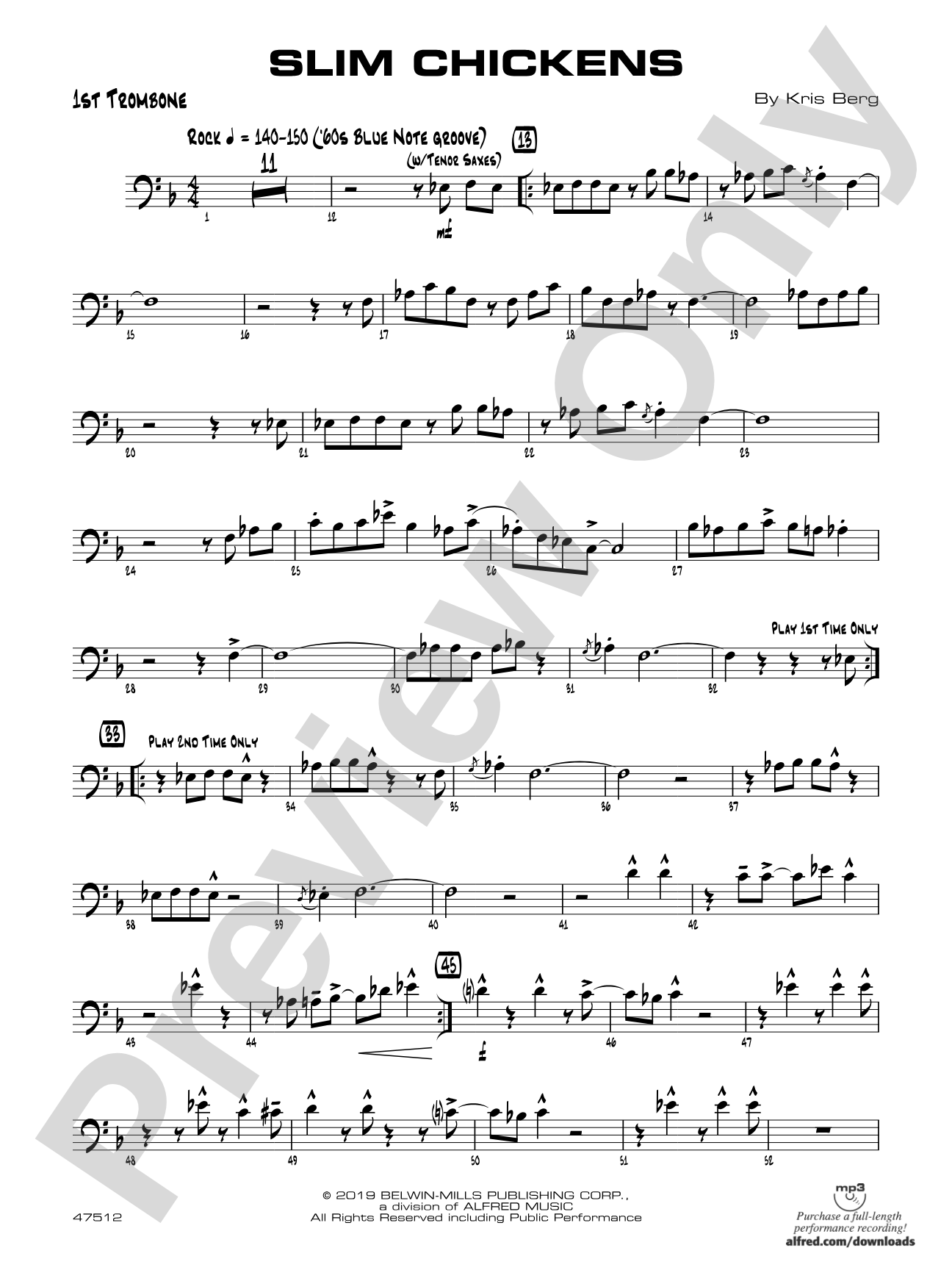

Slim Chickens: 1st Trombone
By Kris Berg
Grade: 2.5 (Medium Easy)
Item: 00-PC-0018021_TN1
$3.00
Pickup currently not available
Description
This chart is very accessible for young players with lead trumpet range to written G on top of the staff. It includes written-out suggested solos for tenor 1 and trombone 1 with background figures to support the soloists. It's a toe-tapper played at around 148 BPM with some nice bari sax parts, a sax soli, and full-sounding ensemble sections.


Don't just read it, hear it, play along with it, and watch your students grow with it. In MakeMusic Cloud, Slim Chickens: 1st Trombone comes alive with professional accompaniment, adjustable tempo, and built-in practice tools that turn solo practice into real progress.
Open in the Player
Jump straight in and assign it today.
Start Your Free Trial
Open this title and explore the full library in minutes.
Sample Audio
1
Audio File
--:--
0:00
0:00
Sample Video
Additional Details
Series:
Young Jazz Ensemble
Publisher:
Alfred Music
Page Count:
98
SKU:
00-PC-0018021_TN1
More about this title
About the Composer: Kris Berg
Kris Berg directs the jazz program at Collin County Community College in Texas and holds degrees in jazz studies from the University of North Texas. His ensembles have earned multiple invitations to perform at the Montreux Jazz Festival, and he founded both the Collin Jazz Fest and the Texas All-Star Jazz Camp. Berg's arrangements and compositions have circulated internationally among professional and student musicians.
As a prolific composer for Belwin Jazz, Berg has built a catalog of big band charts that balance accessibility with musicianship. He authored the instructional resource Bass Lines in Minutes and maintains an active schedule as a clinician and artist for Yamaha Corporation. His performance credits span work with accomplished musicians including Kurt Elling, Randy Brecker, Bob Mintzer, and Clark Terry.
Why we love this
Berg writes for young ensembles without compromising the funk and swing that make jazz worth playing. The balance here is masterful: lead trumpet stays accessible while tenor and trombone soloists get written-out lines that sound sophisticated, not limiting. A piece this fun to conduct, this satisfying for players to execute, and this appropriate for contest programming deserves a spot in your folder.
What to expect
Infectious and propulsive. The funk-inflected groove and bouncing tempo make this a toe-tapper that audiences recognize immediately as real jazz, not a watered-down approximation. Underneath the accessibility lives genuine swing and personality.
Who it's for
Young jazz ensembles and developing players ready for a genuine swing-funk groove. The accessible range and structured solos make this approachable for middle school and early high school ensembles, while the musicality and authentic feel satisfy musicians who want substance alongside accessibility.
How to get the most out of it
- Let the rhythm section lock in early. The groove at 148 BPM depends on confident comping and a steady walking bass line; spend rehearsal time here before adding horns.
- Shape the bari sax section writing so it anchors the bottom of the sound without overshadowing the soloists. This part is crucial to the full ensemble sound.
- Take the written-out solos as models, not restrictions. The tenor and trombone lines give newer soloists a pathway, but encourage players to develop variations once they own the head.
- Balance the sax soli passage carefully so each voice cuts without anyone pushing. Young players often cover for their neighbors; isolation rehearsals with section recordings help.
How to use it
Program this as an opener or closer for a jazz concert; the energy and immediate appeal work equally well at either end. It's also well-suited for festival and contest settings where you need a piece that demonstrates ensemble cohesion and musicality without requiring advanced players to execute extreme ranges or complex harmonies.
Skills your students will build
- Funk and swing groove phrasing at moderate tempo
- Reading and executing written jazz solos with background figures
- Balanced ensemble playing (sax soli, full sections, and soloist support)
- Comping and walking bass lines appropriate to the style
- Range command in the middle register (lead trumpet to written G)