

Sleigh Ride - Piano Duet (1 Piano, 4 Hands): Piano Duets & Four Hands
By Leroy Anderson / arr. Michael Edwards
Level: Late Intermediate
Item: 00-PB-0000689
$5.99
Pickup currently not available
Description
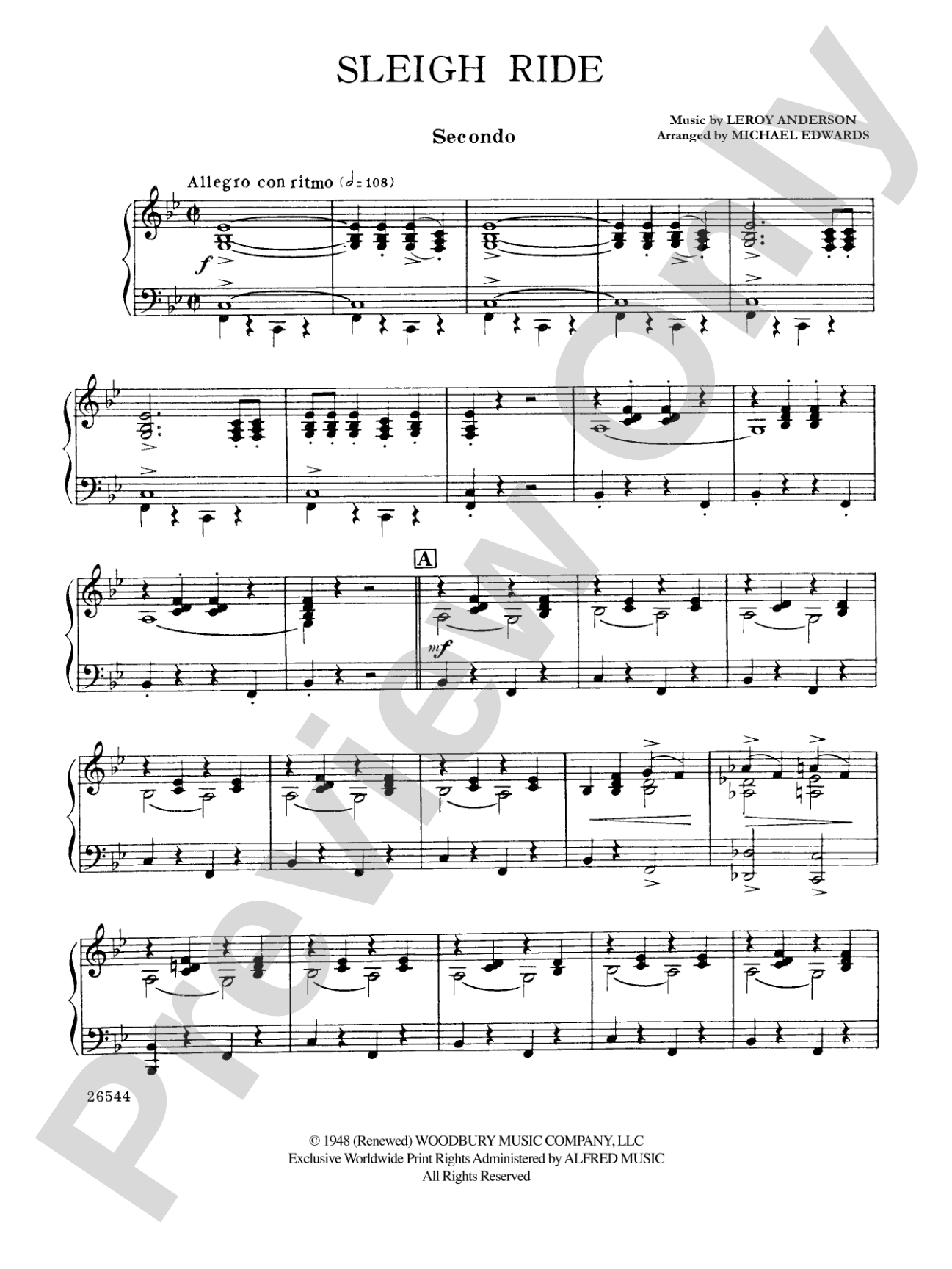
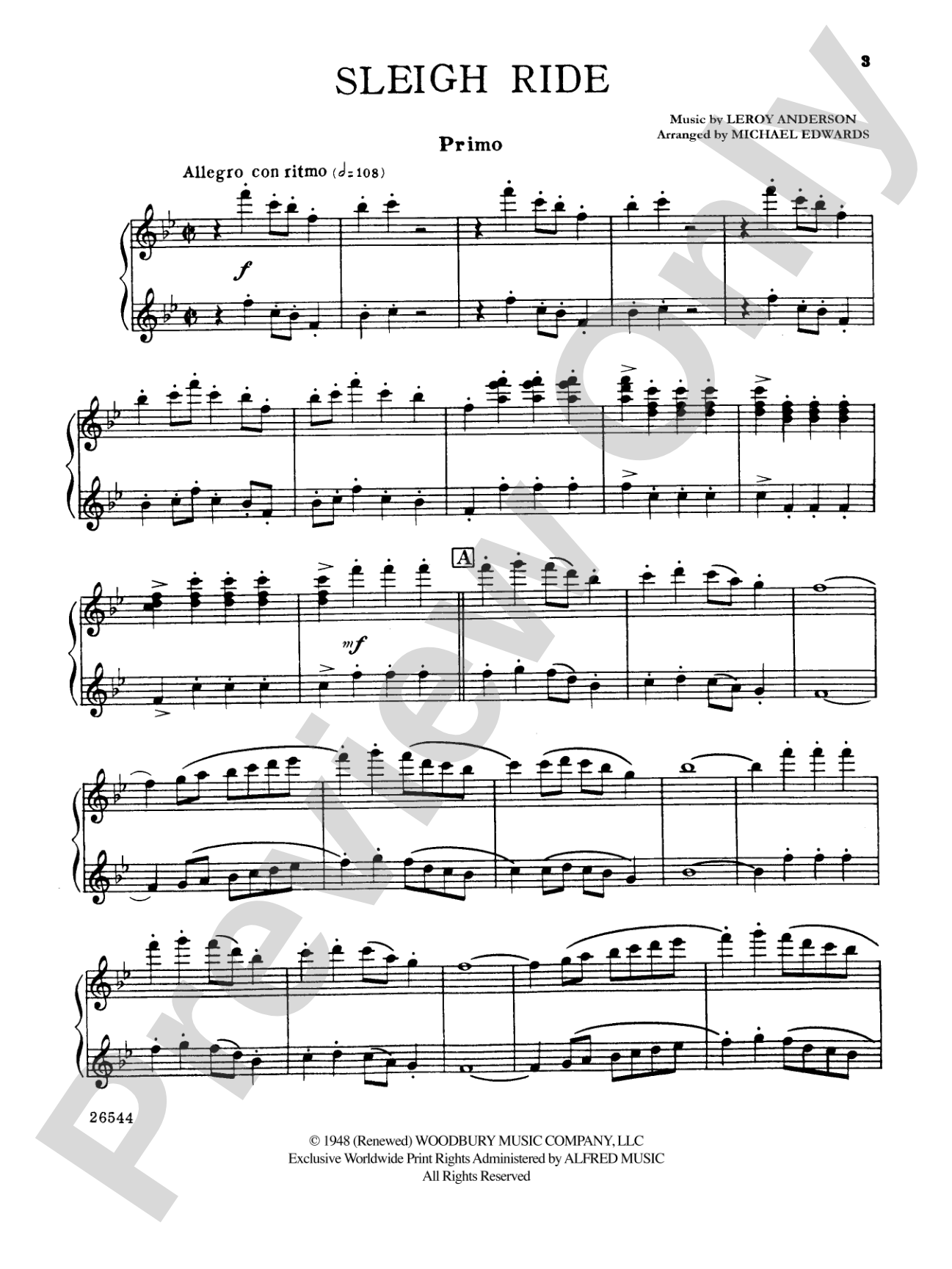
By arranging this famous Leroy Anderson piece as a duet, the sound is full and rich, while also being very playable for two late intermediate level artists. The Secondo part will be basically accompanimental, but with great counter-melodies, rhythms, and accents. The Primo part will carry the melody, sometimes with the melody doubled in the hands, and sometimes with chords. A Federation Festivals 2016-2020 selection. A Federation Festivals 2020-2024 selection.


Sleigh Ride - Piano Duet (1 Piano, 4 Hands): Piano Duets & Four Hands isn't in MakeMusic Cloud just yet...but it could be. Let us know you'd like to see it, and you'll help shape what comes next. In the meantime, start a free trial and dive into thousands of interactive titles your students can play along with today.
Request This Title
Tell us you want it.
Start Your Free Trial
Explore everything that's ready to play right now.
Sample Audio
No sample audio found.
Sample Video
No sample videos found.
Additional Details
Publisher:
Alfred Music
Page Count:
12
SKU:
00-PB-0000689
More about this title
About the Composer: Leroy Anderson
Leroy Anderson (1908, 1975) was an American composer and conductor whose gift for melody and orchestration made him one of the most performed classical composers of his era. Though he studied composition at Harvard and served as assistant conductor of the Boston Pops, Anderson never pursued a traditional concert music career. Instead, he became famous for writing light, witty orchestral pieces that audiences loved and that conductors programmed constantly because they worked so reliably in live performance.
Anderson's catalog includes over 150 compositions, many of them miniatures with clever titles and instantly recognizable tunes. Pieces like Plink, Plank, Plunk and Fiddle Faddle showcase his ability to write memorable music that sits comfortably for musicians of all levels. For music educators, Anderson's work remains invaluable: his compositions teach orchestration through simplicity, demonstrate how strong melodic writing carries an entire piece, and prove that music can be both genuinely fun and musically substantial.
Why we love this
Michael Edwards has preserved everything that makes Sleigh Ride delightful while writing parts that feel genuinely pianistic. The Secondo has real work to do, counter-melodies and rhythmic accents keep the accompanist engaged rather than relegated to block chords, while the Primo carries the beloved tune with enough flexibility to breathe naturally. It's a duet where both players matter, and both parts reward careful playing.
What to expect
Crisp winter air, jingling bells, and genuine cheerfulness without a trace of sentimentality. The arrangement captures the original's propulsive energy and cleverness: there's rhythmic sophistication beneath the tuneful surface, unexpected harmonic colors, and moments of pure rhythmic fun that feel fresh each time through.
Who it's for
Late intermediate pianists looking for a duet that sounds polished and holiday-appropriate without requiring advanced technique. Pairs beautifully for students at the same level who need ensemble experience, and works equally well for a teacher-student partnership where the more advanced player takes the Primo.
How to get the most out of it
- Balance the Primo melody so it sings over the Secondo's rhythmic foundation; many pianists play this duet too heavily in the bass. The Secondo's accents should land cleanly without overwhelming the line above.
- Mark out the counter-melodies in the Secondo part during rehearsal. These aren't just filler, and bringing them forward slightly will add the full, rich texture the arrangement promises.
- Coordinate the doubled melody passages in the Primo so both hands feel like a single voice rather than a unison that lands imprecisely. Subtle pedal work helps here.
- Use the Federation Festivals recording as a reference, but encourage each duo to find their own tempo within the work's character. Sleigh Ride can drag or gallop depending on the partnership's instincts.
How to use it
This works as a winter concert opener or closer depending on program flow. It could anchor a four-hands showcase alongside other duets, or stand alone as a crowd-pleasing interlude in a longer recital. The 12-page length makes it substantial enough to deserve concert programming while remaining accessible for late-season performance after time away from school.
Skills your students will build
- Coordinating melodic and accompaniment roles across two players
- Executing counter-melodies with clarity and independence
- Balancing texture in music where both hands of each player serve different functions
- Reading and executing articulation and accent markings precisely
- Managing tempo consistency and stylistic agreement in a partnership
- Interpreting rubato and lyrical phrasing while maintaining rhythmic cohesion