Sleepers Wake: Timpani Sheet Music Preview

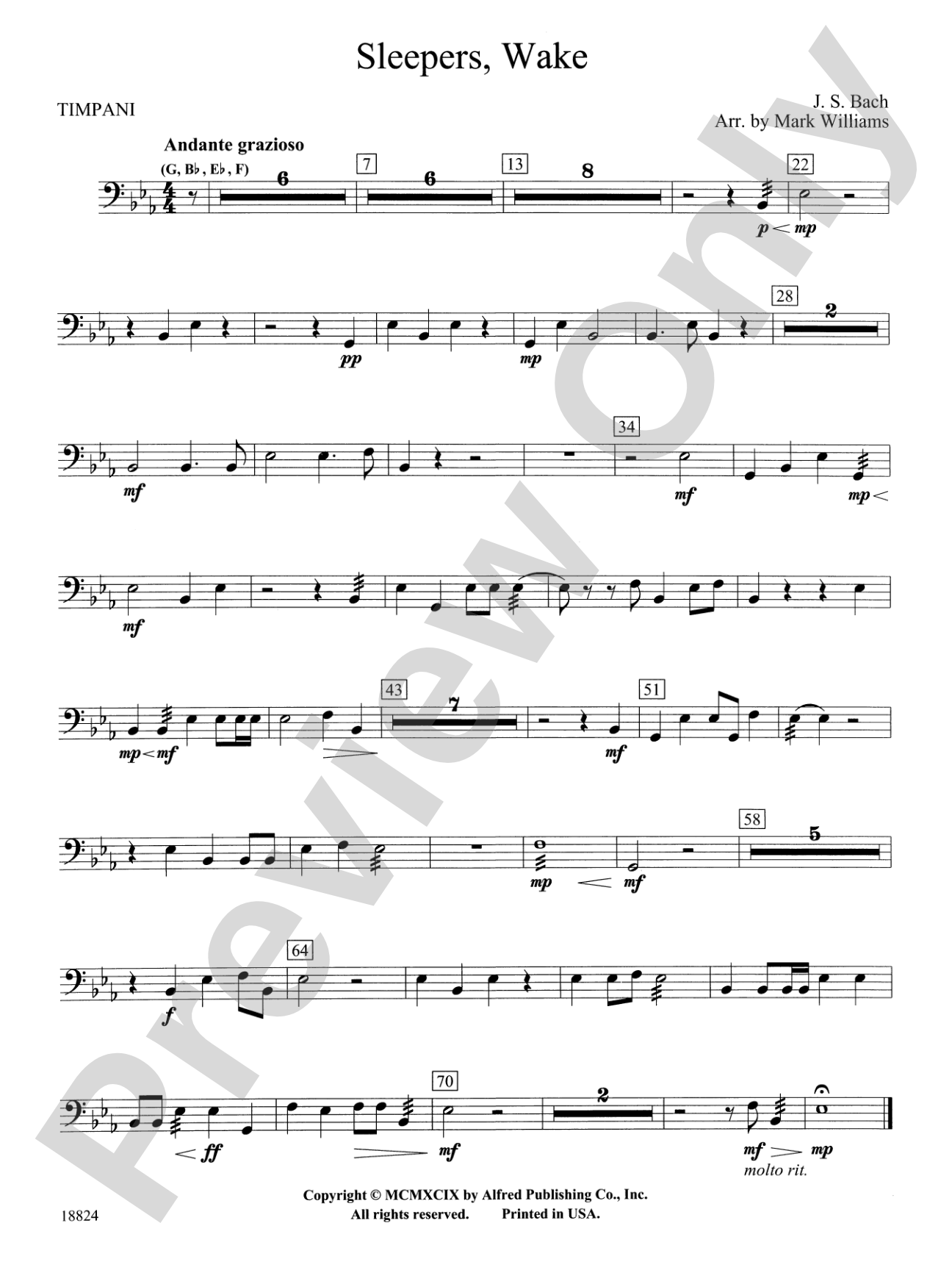
Sleepers Wake: Timpani

By Johann Sebastian Bach / arr. Mark Williams

Grade: 3 (Medium)

Item: 00-PC-0000290_TMP

Digital Download
$3.00
Description
Treat your band and your audience to this beautifully crafted arrangement of one of J. S. Bach's grandest achievements. Based on a hymn tune by Philie Nicolai, this glorious work adds inventive counterpoint to produce one of the most memorable short works of the Baroque period. Now your Grade 4 band can take advantage of this excellent introduction to the works of Bach!

Don't just read it, hear it, play along with it, and watch your students grow with it. In MakeMusic Cloud, Sleepers Wake: Timpani comes alive with professional accompaniment, adjustable tempo, and built-in practice tools that turn solo practice into real progress.

Sample Audio
0:00
0:00
Sample Video
Additional Details
Series: Alfred Concert Band
Publisher: Alfred Music
Page Count: 212
SKU: 00-PC-0000290_TMP

More about this title

About the Composer: Johann Sebastian Bach

Johann Sebastian Bach (1685-1750) stands as one of history's most prolific and technically inventive composers. His output spans every major genre of his era except opera, and his mastery of counterpoint, fugal writing, and harmonic architecture set a standard that composers still study today. Bach's church cantatas, keyboard works, and instrumental ensembles reveal a mind equally at home with mathematical rigor and profound emotional expression.

Why we love this

Mark Williams's arrangement preserves the architectural integrity of Bach's original while opening this masterwork to ensembles that might otherwise never tackle it. The orchestration sits comfortably in the Grade 3 range, letting your students engage with genuine Baroque counterpoint and craftsmanship instead of simplified substitutes. Programming this signals to your audience (and your band) that you're serious about repertoire depth.

What to expect

Stately and processional, with an underlying sense of purpose. The hymn tune carries a quiet dignity, while the surrounding counterpoint adds layers of texture and movement. There's an elegance here that feels both historical and immediately alive.

Who it's for

Concert bands working at the Grade 3 level who want to expand their repertoire beyond contemporary compositions. This is ideal for directors seeking to build students' familiarity with the Baroque era and equip them with experience reading counterpoint in an ensemble setting. It also works beautifully for bands preparing for contest or festival performance.

How to get the most out of it

  • Bring out the dialogue between the hymn tune and the instrumental countermelodies. These voices should converse, not compete. Balance here transforms a good performance into a memorable one.
  • Set a steady, unhurried tempo. Bach's counterpoint demands clarity, and rushing muddies the intricate voice leading that makes this arrangement work.
  • Articulate cleanly and uniformly across sections. Baroque style thrives on precision, and your band's attack and release will define the character of every entrance.
  • Use the full dynamic range. This piece moves between intimate moments and grand affirmations. Resist the urge to play everything in a comfortable middle ground.

How to use it

Include this on a concert celebrating composers across eras, pairing it with a more contemporary work to show how Baroque principles of balance and voice independence still matter in modern music. It also serves as an excellent festival or contest selection, offering judges a chance to hear your band's musicianship applied to genuine masterwork material.

Skills your students will build

  • Reading and performing counterpoint in an ensemble setting
  • Maintaining independence of voice lines while listening to others
  • Recognizing and balancing multiple melodic strands simultaneously
  • Understanding the hymn tune as a structural foundation in Baroque music
  • Executing clean articulation and precise attacks required by Baroque style
  • Managing sustained passages and long-line phrasing across a full ensemble

You May Also Like