
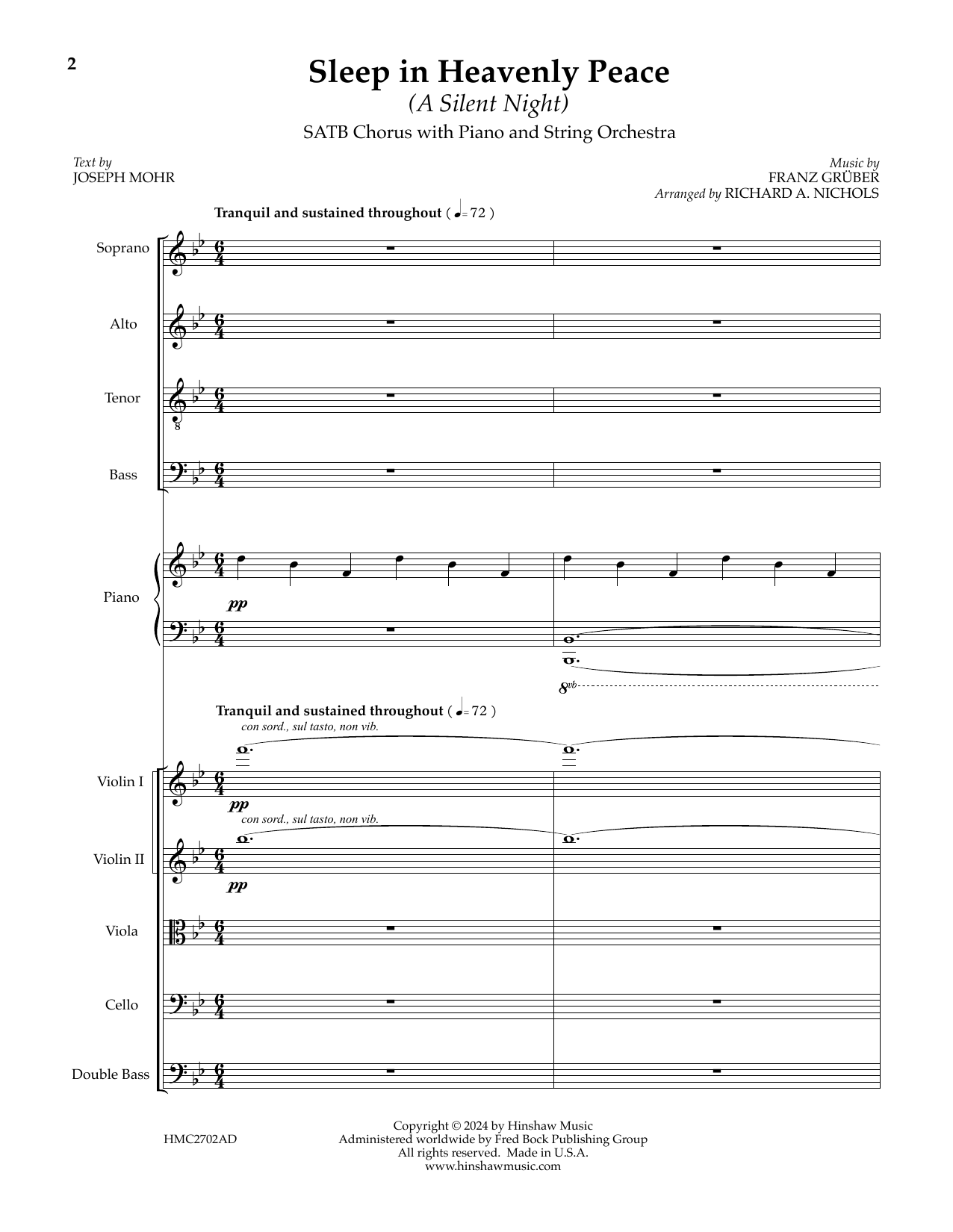

Sleep In Heavenly Peace (A Silent Night): Choral Instrumental Pak
By Franz Grüber / By Joseph Mohr / Arranged by Richard A. Nichols
Item: 35-PK01530434
$50.00
Pickup currently not available
Buy Extra Parts (Digital PDF Download)
Parts Added to Cart!
Description
A placid accompaniment figure reminiscent of falling snow opens this setting, providing a serene sound world for the beloved SILENT NIGHT, HOLY NIGHT. As the upper voices disappear with the first verse, the lower voices enter above a slightly more stirring accompaniment pattern. The third verse opens the heavens to reveal the radiant beams in rapturous glory before returning us to the tranquil opening night scene. The optional string orchestra adds depth and texture to the backdrop, offering a meaningful expression to any concert.


Sleep In Heavenly Peace (A Silent Night): Choral Instrumental Pak isn't in MakeMusic Cloud just yet...but it could be. Let us know you'd like to see it, and you'll help shape what comes next. In the meantime, start a free trial and dive into thousands of interactive titles your students can play along with today.
Request This Title
Tell us you want it.
Start Your Free Trial
Explore everything that's ready to play right now.
Sample Audio
No sample audio found.
Sample Video
No sample videos found.
Additional Details
Publisher:
Hal Leonard
SKU:
35-PK01530434
More about this title
About the Composer: Franz Grüber
Franz Grüber (1787–1863) was an Austrian organist and composer whose single most enduring work has become synonymous with Christmas itself. He composed the melody for "Silent Night" in 1818 at the request of his pastor, Joseph Mohr, who had written the poem two years earlier. Grüber's gift was his ability to craft a tune of disarming simplicity that carries profound emotional weight, one that has since been translated into nearly every language and performed in contexts ranging from candlelit churches to concert halls worldwide.
As an educator, Grüber worked as a schoolmaster and church musician in the Austrian Alps, roles that shaped his understanding of how music could serve both spiritual life and community. His legacy rests almost entirely on this single carol, a testament to how one clear melodic idea, when paired with genuine sincerity, can transcend its era and touch generations of musicians and listeners.
Why we love this
Richard Nichols' arrangement honors the carol's intimacy while giving it genuine harmonic and textural sophistication. The opening snow-like accompaniment figure immediately signals this is not a conventional carol setting; it invites singers and audiences into contemplation rather than festivity. Programming this allows you to offer something reverent and musically substantive without requiring an enormous ensemble.
What to expect
You float through crystalline silence before descent into something deeper and more grounded. The harmonies feel both timeless and intimate, as if you are singing in a small chapel lit only by candlelight. The third verse opens into something luminous before settling back into that hushed, private beauty.
Who it's for
This arrangement serves choirs seeking a Christmas offering with musical substance. It works for mixed ensembles of moderate ability and flexibility, whether you need keyboard only or have strings available. It suits directors who want to move beyond conventional carols without abandoning this beloved tune.
How to get the most out of it
- Balance the accompaniment carefully during the first verse so the ethereal figuration stays beneath the soprano line without disappearing entirely; this sets the serene mood Nichols has crafted
- Shape the moment when upper voices drop away before the second verse as intentional silence rather than absence; let that textural shift breathe
- If using the optional string orchestra, rehearse the transition from keyboard to strings in the third verse so it feels like a gentle expansion rather than a sudden change
- Let lower voices sing with warmth and presence during their featured section; they are not accompaniment at that moment but the carriers of the melody
How to use it
This pairs beautifully with more energetic or congregational carols on a Christmas concert, providing a moment of genuine repose rather than transition. Its length and mood make it equally fitting as a concert opener that sets a reverent tone or as the closing piece that leaves the audience in quiet reflection. Consider programming it when you have strings available and want to showcase the fuller orchestration Nichols provides.
Skills your students will build
- Singing with sustained legit tone over moving accompaniment figures
- Balancing ensemble when voice parts drop out mid-piece
- Responding to textural changes (keyboard to orchestral texture) as a group
- Managing harmonic sensitivity in what sounds simple but contains colorful voice leading