
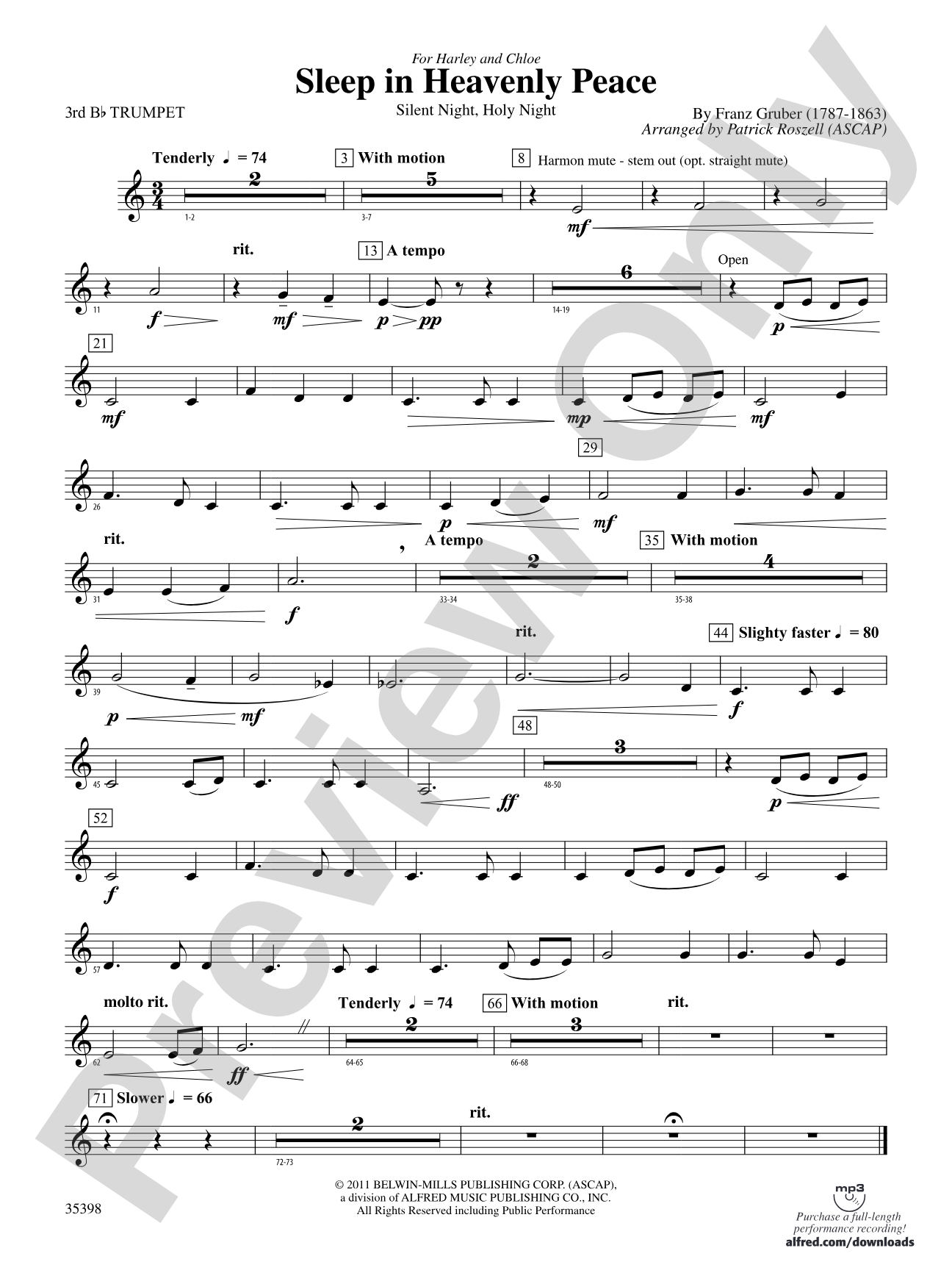

Sleep in Heavenly Peace: 3rd B-flat Trumpet
Silent Night, Holy Night
By Franz Gruber / arr. Patrick Roszell
Grade: 3 (Medium Easy)
Item: 00-PC-0014943_T3
$3.00
Pickup currently not available
Description
Composed by Joseph Mohr and Franz Gruber on December 24, 1818, this simple carol is known and beloved throughout the world. Arranger Patrick Roszell has given this classic melody a new harmonic treatment that is both beautiful and lush. This setting is assured to uplift both your students and audience.


Don't just read it, hear it, play along with it, and watch your students grow with it. In MakeMusic Cloud, Sleep in Heavenly Peace: 3rd B-flat Trumpet comes alive with professional accompaniment, adjustable tempo, and built-in practice tools that turn solo practice into real progress.
Open in the Player
Jump straight in and assign it today.
Start Your Free Trial
Open this title and explore the full library in minutes.
Sample Audio
1
Audio File
--:--
0:00
0:00
Sample Video
No sample videos found.
Additional Details
Series:
Belwin Concert Band
Publisher:
Alfred Music
Page Count:
122
SKU:
00-PC-0014943_T3
More about this title
About the Composer: Franz Gruber
Franz Gruber (1787-1863) was an Austrian organist and composer whose musical legacy rests almost entirely on a single work. On Christmas Eve 1818, he composed the melody for "Stille Nacht" (Silent Night) after the local priest Joseph Mohr handed him a poem written two years earlier. The carol was first performed that evening in a small chapel in Oberndorf, Austria, accompanied by guitar rather than organ.
Gruber spent most of his life as a schoolmaster and organist in the Salzburg region, composing primarily for church services. Though he wrote other sacred works and songs, none achieved recognition beyond his community. "Silent Night" eventually spread across Europe and the world, becoming one of the most translated and performed songs in existence. Gruber witnessed its growing fame late in his life but remained a humble, relatively obscure figure outside musical circles.
Why we love this
Patrick Roszell's arrangement respects the carol's essential simplicity while adding harmonic color that engages a full concert band without overwhelming the melody's quiet beauty. The Grade 3 setting makes this accessible to most high school and developing middle school bands, creating a legitimate performance opportunity rather than a token holiday filler. A lush, well-crafted arrangement of the world's most recognizable carol will resonate powerfully with any audience.
What to expect
The piece unfolds with serene dignity, the familiar melody appearing clear and centered while warm harmonies bloom around it like candlelight. There is reverence without heaviness, tradition without stiffness; Roszell's arrangement feels both deeply familiar and thoughtfully reimagined.
Who it's for
Conductors seeking a concert band arrangement that honors a beloved carol while offering musical substance for players will find this setting particularly valuable. High school bands, college wind ensembles, and strong middle school bands can all perform this with confidence and achieve an affecting result.
How to get the most out of it
- Balance the melody carefully across sections; this carol loses its magic if any part overshadows the tune. Let woodwinds carry the primary voice while horns and lower brass provide rich but transparent support.
- Maintain steady, unhurried pacing throughout. Resist the temptation to rush; this piece needs space and breath to feel peaceful rather than sentimental.
- Shape each phrase with gentle dynamic contours rather than rigid dynamics. Listen for how Roszell's harmonies suggest natural peaks and valleys within the melody.
- Use soft articulation in supporting parts. Tonguing should be almost imperceptible; this arrangement benefits from smooth, connected accompaniment.
How to use it
This works beautifully as a closing piece in a winter or holiday concert, allowing audiences to leave feeling contemplative and uplifted. It pairs well with instrumental arrangements of other carols or with non-holiday concert music, serving as a program anchor without requiring thematic unity around Christmas.
Skills your students will build
- Balancing melody and harmony in ensemble textures
- Shaping sustained phrases with dynamic control
- Maintaining steady pulse while playing expressively
- Transparent accompaniment and supportive voicing
- Blending across sections in a full band setting