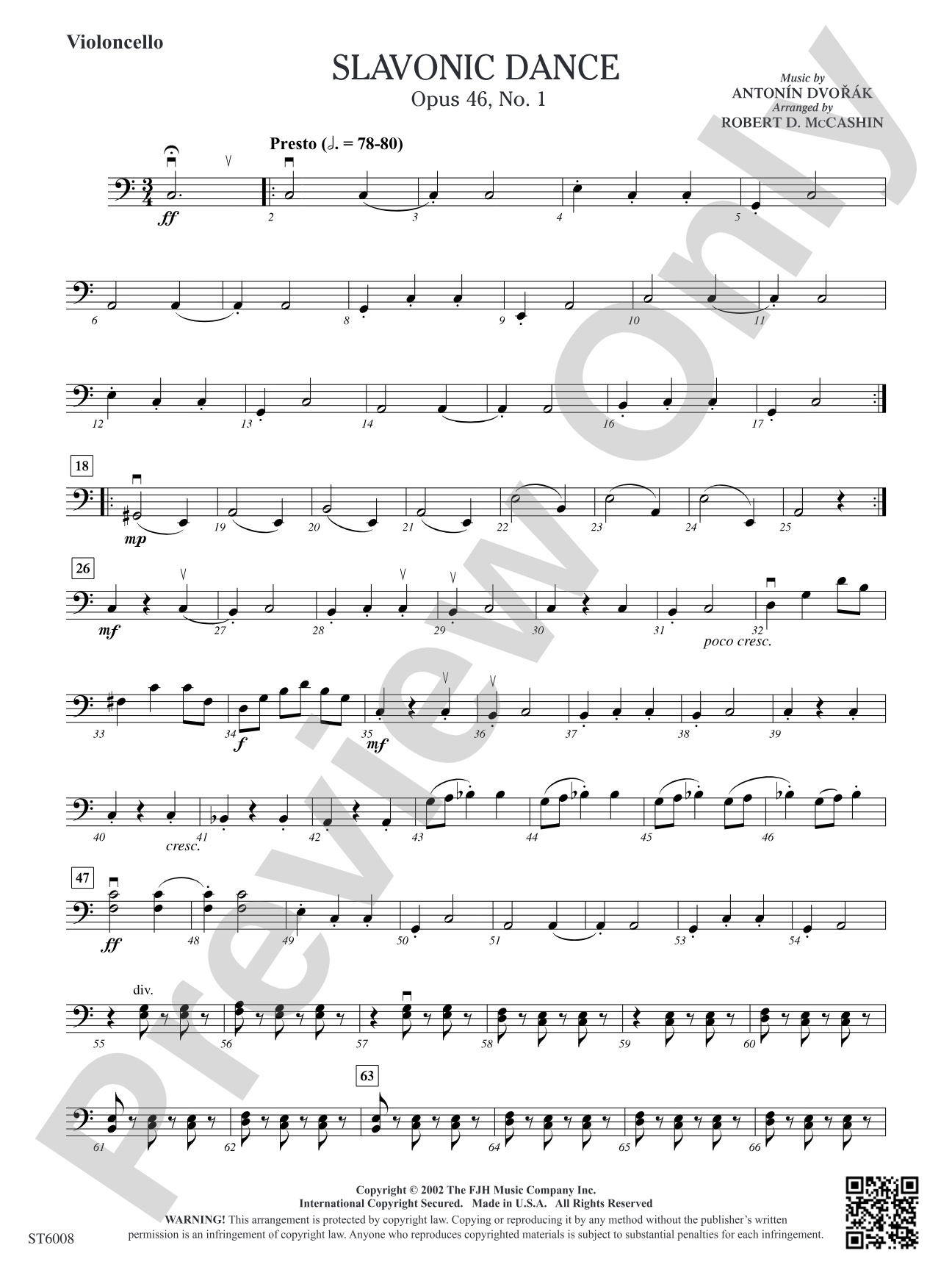
Slavonic Dance, Opus 46, No. 1: Violoncello Sheet Music Preview

Slavonic Dance, Opus 46, No. 1: Violoncello

By Antonín Dvorák / arr. Robert D. McCashin

Grade: 3

Item: 98-PC-DST6008_VC1

Digital Download
$7.00
Description
This well-crafted adaptation remains true to Dvorák's original intent. The expertise of educator and violinist Robert D. McCashin makes this grade 3 a very sound pedagogical work. A wonderful way to introduce the string orchestra to the symphonic repertoire!

Don't just read it, hear it, play along with it, and watch your students grow with it. In MakeMusic Cloud, Slavonic Dance, Opus 46, No. 1: Violoncello comes alive with professional accompaniment, adjustable tempo, and built-in practice tools that turn solo practice into real progress.

Sample Audio
0:00
0:00
Sample Video
Additional Details
Series: FJH String Orchestra
Publisher: The FJH Music Company, Inc.
SKU: 98-PC-DST6008_VC1

More about this title

About the Composer: Antonín Dvorák

Antonín Dvorák (1841-1904) was a Czech composer who bridged the Romantic era and the modern orchestral tradition. His gift for melody and orchestration made him one of the most performed composers of his time, and his works remain central to the concert repertoire. Dvorák's string music, in particular, shows his mastery of the medium; his Slavonic Dances rank among the most beloved character pieces for string ensemble, celebrated for their rhythmic vitality and deeply personal voice.

Why we love this

McCashin's arrangement honors the architecture and melodic sweep of Dvorák's original while calibrating the technical demands for developing string players. The piece gives student ensembles genuine access to a major orchestral voice without sacrificing musical substance. It's a celebration, not a simplification.

What to expect

This dance pulses with Slavic energy: rhythmic, spirited, and infused with folk flavor without ever sounding quaint. The melody carries genuine warmth, and the harmonic shifts give the piece an inviting depth. It's music that feels alive on the stand and in the ears.

Who it's for

String orchestra directors who want to introduce their students to the symphonic literature with an arrangement that respects both the music and the ensemble's current abilities. It works equally well for grade 3 groups with solid fundamentals and for advanced grade 2 ensembles ready for a musical stretch.

How to get the most out of it

  • Shape the melodic line with careful attention to dynamics; Dvorák's melodies sing, and they need breathing room and direction even at this grade level.
  • Balance the rhythmic drive of the dance character with lyrical phrasing in the contrasting sections. The pulse should feel buoyant, not rushed.
  • Use the dialogue between sections (first violins, second violins, violas, cellos) to create forward momentum. Each voice group has something to say.
  • Support intonation work with listening to a reference recording. Hearing the piece's harmonic richness helps students understand where their tuning matters most.

How to use it

Open a spring concert with this piece to set a buoyant, sophisticated tone that engages both audience and players. It also sits comfortably alongside other character pieces or light orchestral repertoire, offering contrast to heavier works in the program. Its concert and festival-ready quality makes it a natural choice for student competitions.

Skills your students will build

  • Reading mixed articulations (staccato, sustained, accented) within a continuous melodic context
  • Balancing sectional sonority while maintaining individual intonation across multiple string parts
  • Interpreting rhythmic character and dance-like pulse in a non-march context
  • Responding to longer musical phrases and harmonic progression
  • Coordinating ensemble releases and ensemble attacks across a full string section

You May Also Like