
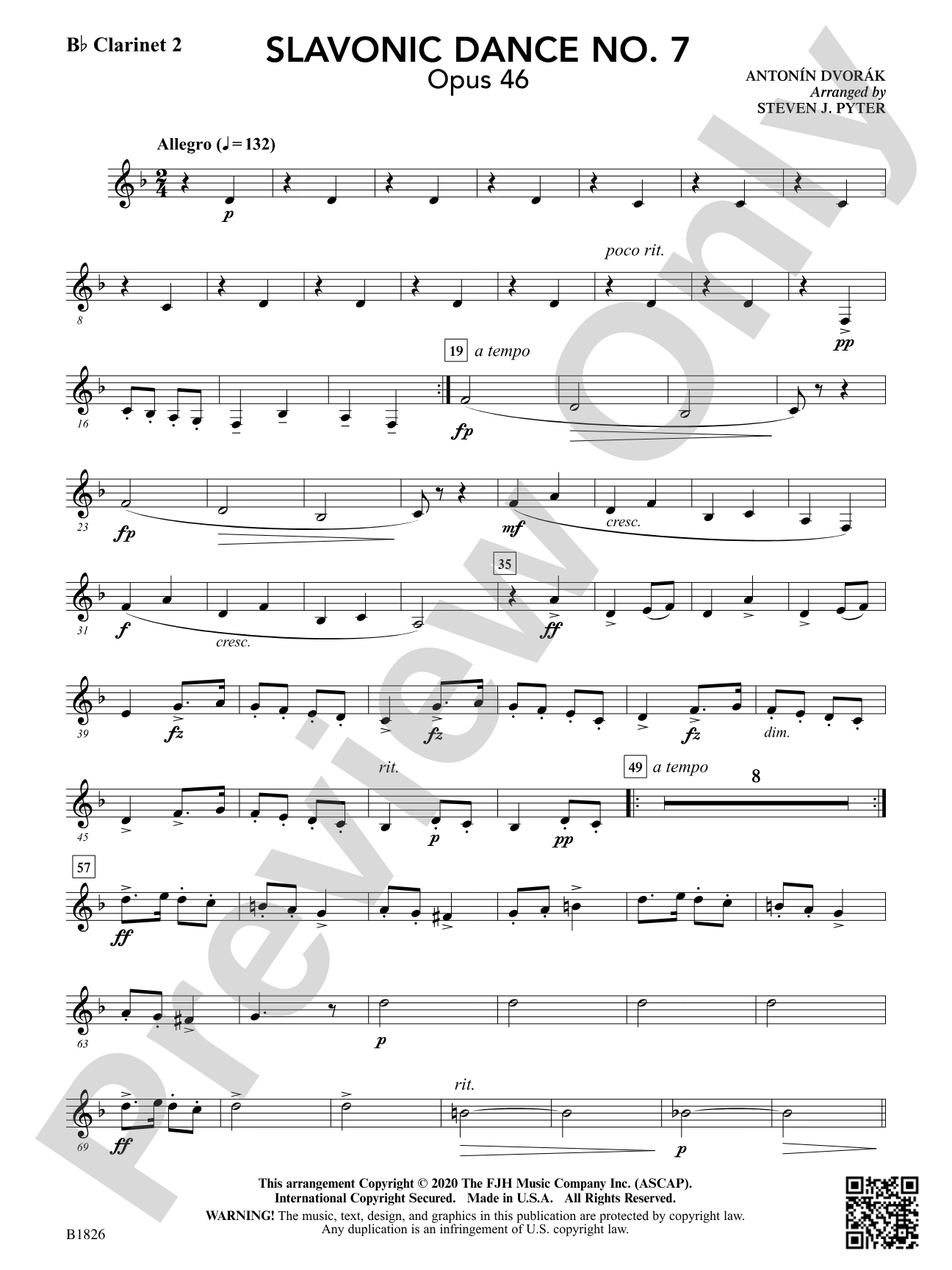

Slavonic Dance No. 7 (Opus 46): B-flat Clarinet 2
By Antonín Dvorák / arr. Steven J. Pyter
Grade: 4
Item: 98-PC-DB1826_C2
$7.00
Pickup currently not available
Description
This stunning arrangement brings the wildly popular music of Dvorák to the concert band repertoire. Inspired by the folk music of his native Slavic region, the piece is based on a simple melody that interacts with delicately orchestrated passages and massive, powerful statements. Functional as an opener, closer, or classical work within a program, this work has unlimited potential!


Slavonic Dance No. 7 (Opus 46): B-flat Clarinet 2 isn't in MakeMusic Cloud just yet...but it could be. Let us know you'd like to see it, and you'll help shape what comes next. In the meantime, start a free trial and dive into thousands of interactive titles your students can play along with today.
Request This Title
Tell us you want it.
Start Your Free Trial
Explore everything that's ready to play right now.
Sample Audio
1
Audio File
--:--
0:00
0:00
Sample Video
No sample videos found.
Additional Details
Series:
FJH Symphonic Band
Publisher:
The FJH Music Company, Inc.
SKU:
98-PC-DB1826_C2
More about this title
About the Composer: Antonín Dvorák
Antonín Dvorák (1841-1904) stands among the most performed composers of the Romantic era, and his Slavonic Dances remain cornerstones of the orchestral repertoire. Born in Bohemia, Dvorák drew deeply from the musical traditions of his homeland, transforming folk melodies and rhythmic patterns into works of international significance. His ability to honor vernacular sources while achieving sophisticated compositional architecture made him a bridge between nationalist music and universal concert hall appeal.
For music educators, Dvorák's output offers remarkable pedagogical value. His melodies are inherently singable and memorable, his orchestrations demonstrate clear voice leading, and his structural clarity rewards repeated listening. The Slavonic Dances in particular showcase how a simple folk idea can sustain an entire composition through skillful variation and orchestral color.
Why we love this
Steven Pyter's arrangement preserves the character-driven contrast that makes the original so engaging: simple folk melody meets sophisticated orchestration, quiet passages yield to powerful climaxes. At Grade 4, this is genuinely playable by developing bands without sacrificing the work's emotional impact or structural integrity. Most programs need a solid classical work that doesn't require virtuoso soloists or extreme technical demands, and this delivers exactly that.
What to expect
Rooted and earthy, with the character of folk celebration. The melody carries warmth and directness; it feels familiar even on first hearing. When the orchestration swells, the piece gains grandeur and ceremonial weight, yet never loses connection to its simple, human origins.
Who it's for
Concert bands at the Grade 4 level who want to program substantive classical music without the technical complexity of advanced transcriptions. Directors looking to deepen students' awareness of non-Germanic European traditions will find Dvorák's Slavic nationalism both accessible and artistically rewarding.
How to get the most out of it
- Balance the folk melody against the accompanying voices so the tune sings clearly over the harmonic foundation. Young players tend to equalize dynamics across sections; mark your parts to establish a clear hierarchy.
- Shape the quiet passages with attention to line and direction rather than relying on volume alone. These moments build anticipation for the powerful statements that follow.
- Lock the rhythmic foundation in the low reeds and low brass before full rehearsals. The piece's forward momentum depends on a steady, grounded pulse underneath the melodic activity.
- Mark breath points in the melody sections during early rehearsals. Dvorák's phrasing often spans multiple measures, and younger musicians need guidance to understand where to breathe without breaking the line.
How to use it
This works equally well as a concert opener (its character sets a welcoming, accessible tone) or as a substantial classical work in the body of your program. Pair it with other Romantic-era arrangements or with contemporary works to show stylistic breadth across your season.
Skills your students will build
- Balancing melody and accompaniment in homophonic textures
- Shaping longer phrases across multiple measures while maintaining steady pulse
- Reading and executing sudden dynamic shifts from piano to forte
- Understanding folk-derived melodies and their role in nationalist composition
- Responding to clear sectional structure and how repeated material can be varied through orchestration