Slavonic Dance No. 4 (Op. 46): String Bass Sheet Music Preview

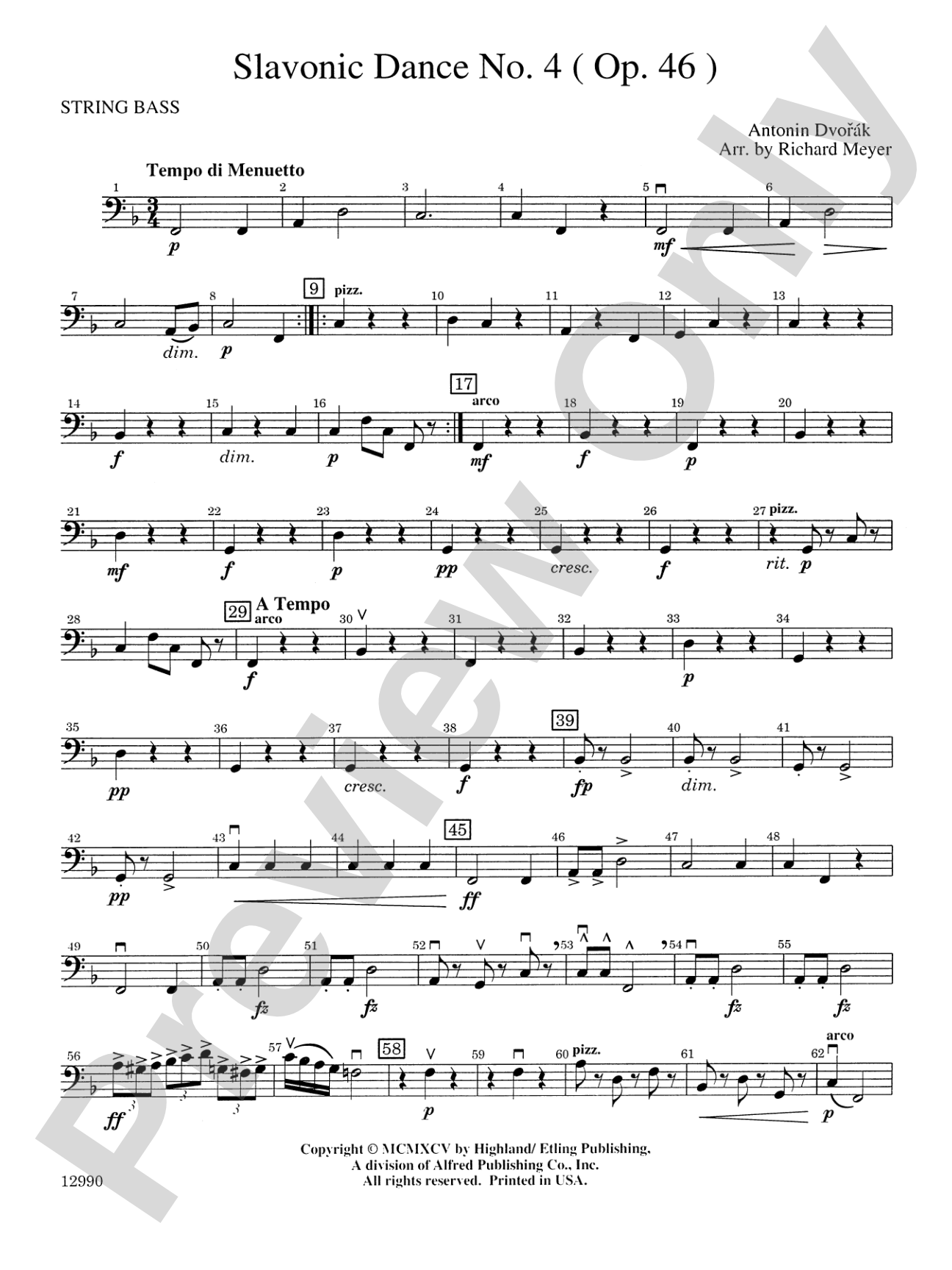
Slavonic Dance No. 4 (Op. 46): String Bass

By Antonín Dvorák / arr. Richard Meyer

Grade: 3

Item: 00-PC-0000141_SB

Digital Download
$3.00
Description
This new arrangement from Richard Meyer is fairly challenging but very gratifying. All the textures and concepts of Dvorák's original have been carefully maintained, while making the work more accessible to school groups. Scored for strings, woodwinds, brass in pairs, and percussion, this transcription is full of charm and style, and will make an excellent addition to your full orchestra library. (Grade 3)

Don't just read it, hear it, play along with it, and watch your students grow with it. In MakeMusic Cloud, Slavonic Dance No. 4 (Op. 46): String Bass comes alive with professional accompaniment, adjustable tempo, and built-in practice tools that turn solo practice into real progress.

Sample Audio
No sample audio found.
Sample Video
Additional Details
Series: Highland/Etling Full Orchestra
Publisher: Alfred Music
Page Count: 96
SKU: 00-PC-0000141_SB

More about this title

About the Composer: Antonin Dvorák

Antonín Dvořák (1841-1904) stands as one of the great musical voices of the Romantic era, a composer who drew deeply from Czech folk traditions while mastering the large forms of the European symphonic tradition. His prolific output across every genre demonstrates a gift for melody and orchestration that resonates across centuries; his works remain staples of orchestral repertoire precisely because they balance technical sophistication with genuine emotional warmth.

Why we love this

Richard Meyer's arrangement preserves the infectious energy and colorful orchestration of Dvořák's original while bringing it within reach of developing orchestras. At Grade 3, students work with authentic material and genuine compositional voice rather than simplified versions that strip away the character that makes this piece so rewarding to conduct and perform.

What to expect

A spirited, folk-inflected dance that moves with buoyant energy and Bohemian warmth. The orchestration shimmers with color; moment to moment you hear the exchange of ideas between strings and woodwinds, with brass providing punctuation and support that feels inevitable rather than imposed.

Who it's for

Conductors looking to program mature Romantic-era repertoire with orchestras that are building technical facility and musical confidence. This works equally well for ensembles preparing for festival competition or concert performance, since the music itself makes the case for why it deserves serious rehearsal time.

How to get the most out of it

  • Balance the characteristic syncopated rhythms in the main theme across your string and woodwind sections; these need clarity without sounding mechanical.
  • Pay special attention to the articulation of the brass pairs—their punctuating figures should snap precisely without overwhelming the lighter textures around them.
  • Allow the natural rubato that lives in the phrase shapes rather than locking into a metronomic pulse; this dance should breathe and sway.
  • Use the percussion strategically to enhance the folk-dance quality; timpani rolls and triangle work best when they serve the melodic line, not compete with it.

How to use it

Program this as a contrasting centerpiece within a larger orchestra concert, perhaps bracketed by a more introspective opening work and a rousing finale. It fits naturally alongside other Romantic-era arrangements or as a bridge between classical and contemporary pieces, and its five-minute arc moves fast enough to hold audience attention without fatigue.

Skills your students will build

  • Reading and executing syncopated rhythmic patterns across multiple instrumental families
  • Balancing sustained melodic lines with accompanying figures in orchestral textures
  • Coordinating articulation and dynamics across mixed instrumental groupings (strings, woodwinds, brass)
  • Responding to rubato and phrase-shape direction from the conductor in Romantic-era style
  • Maintaining ensemble integrity in music that features folk-influenced rhythmic character

You May Also Like