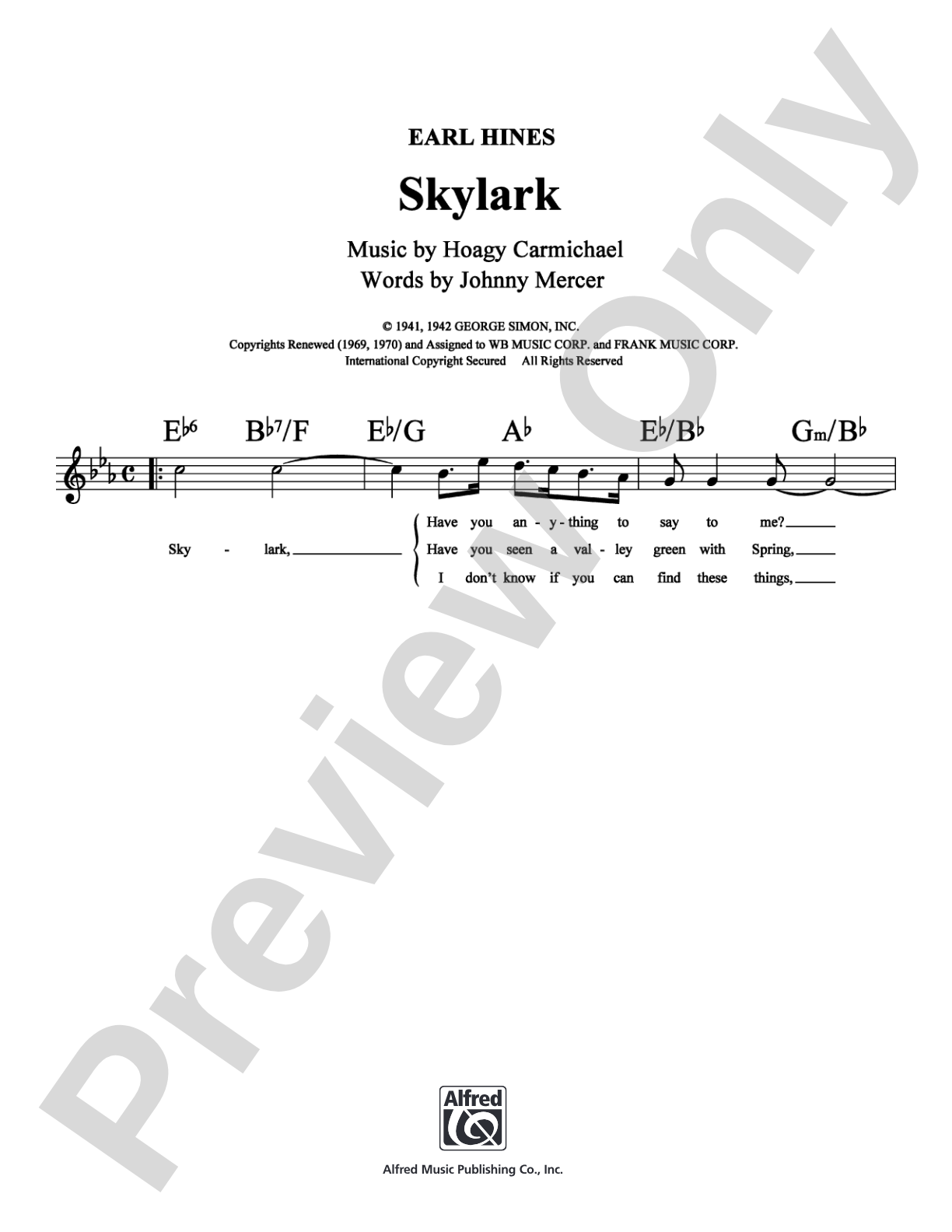
Skylark: Lead Sheet Digital Sheet Music

Skylark: Lead Sheet Digital Sheet Music

Hoagy Carmichael, Glenn Miller, Earl Hines

Item: 00-PS-0006984

Digital Download
$1.99
Description

Skylark: Lead Sheet Digital Sheet Music isn't in MakeMusic Cloud just yet...but it could be. Let us know you'd like to see it, and you'll help shape what comes next. In the meantime, start a free trial and dive into thousands of interactive titles your students can play along with today.

Sample Audio
No sample audio found.
Sample Video
Additional Details
SKU: 00-PS-0006984

More about this title

About the Artist: Glenn Miller

Glenn Miller led one of the most commercially successful big bands of the 1930s and 1940s, pioneering a clean, smooth sound that defined the swing era. His orchestra's distinctive blend of reeds and brass became instantly recognizable on radio broadcasts and in dance halls across America, making him a central figure in American popular music during that decade.

Why we love this

Skylark is a masterclass in melody and harmony that works beautifully for jazz ensembles, vocalists, and small combos exploring the Great American Songbook. The lead sheet format gives players the freedom to interpret and arrange this standard while maintaining the sophisticated harmonic movement that makes it enduringly rewarding to perform.

What to expect

Skylark unfolds with elegant restraint, its melody floating above rich harmonic changes that invite both straightforward interpretation and sophisticated improvisation. The tune carries a reflective, almost wistful quality that rewards careful phrasing and attentive listening from both performers and audience.

Who it's for

Jazz musicians, vocalists, and bandleaders seeking a reliable standard for their book will find this lead sheet invaluable. It works equally well for classroom exploration of jazz harmony, small group arrangements, or preparing repertoire for jam sessions and casual performance contexts.

How to get the most out of it

  • Pay close attention to the melody's contour and phrasing; the notes often sit in the middle register, so let them breathe rather than rushing through passages.
  • Use the harmonic changes as a guide for soloing or comping, but remember that the beauty of this tune lies in its vocal quality, even when played instrumentally.
  • Balance the melody line with accompaniment so the song's lyrical nature shines through without overselling any single voice.

How to use it

Pair this with other Tin Pan Alley standards in a jazz set or cabaret-style program to showcase players' interpretive choices and arrangement skills. It also serves as excellent repertoire for students learning jazz harmony and melodic embellishment, offering clear harmonic structure without excessive complexity.

Skills your students will build

  • Reading and interpreting lead sheet notation
  • Understanding jazz harmony and chord substitution
  • Improvisation over standard changes
  • Phrasing melodic lines with lyrical expression
  • Collaboration between melody and accompaniment voices

You May Also Like