
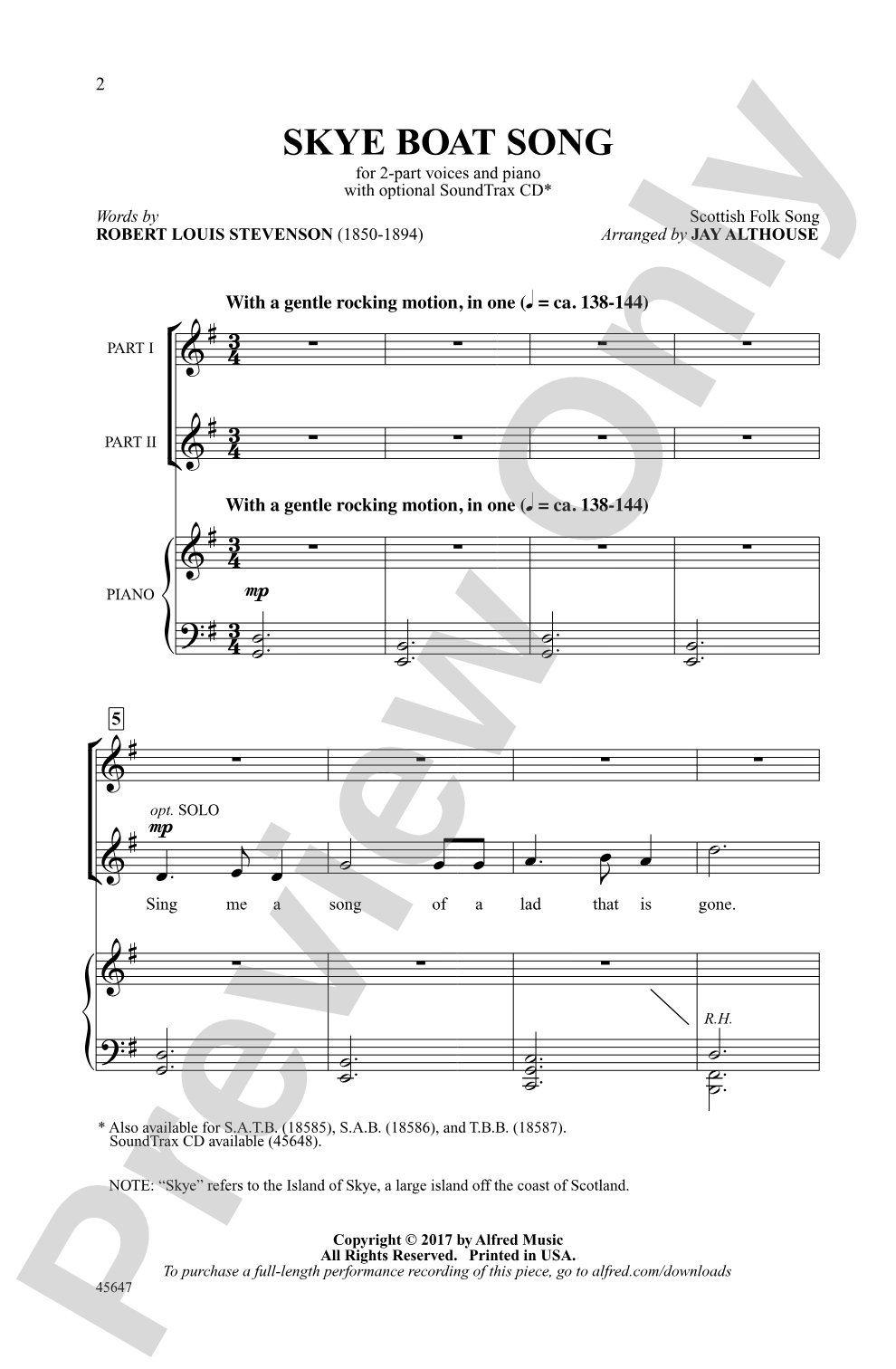
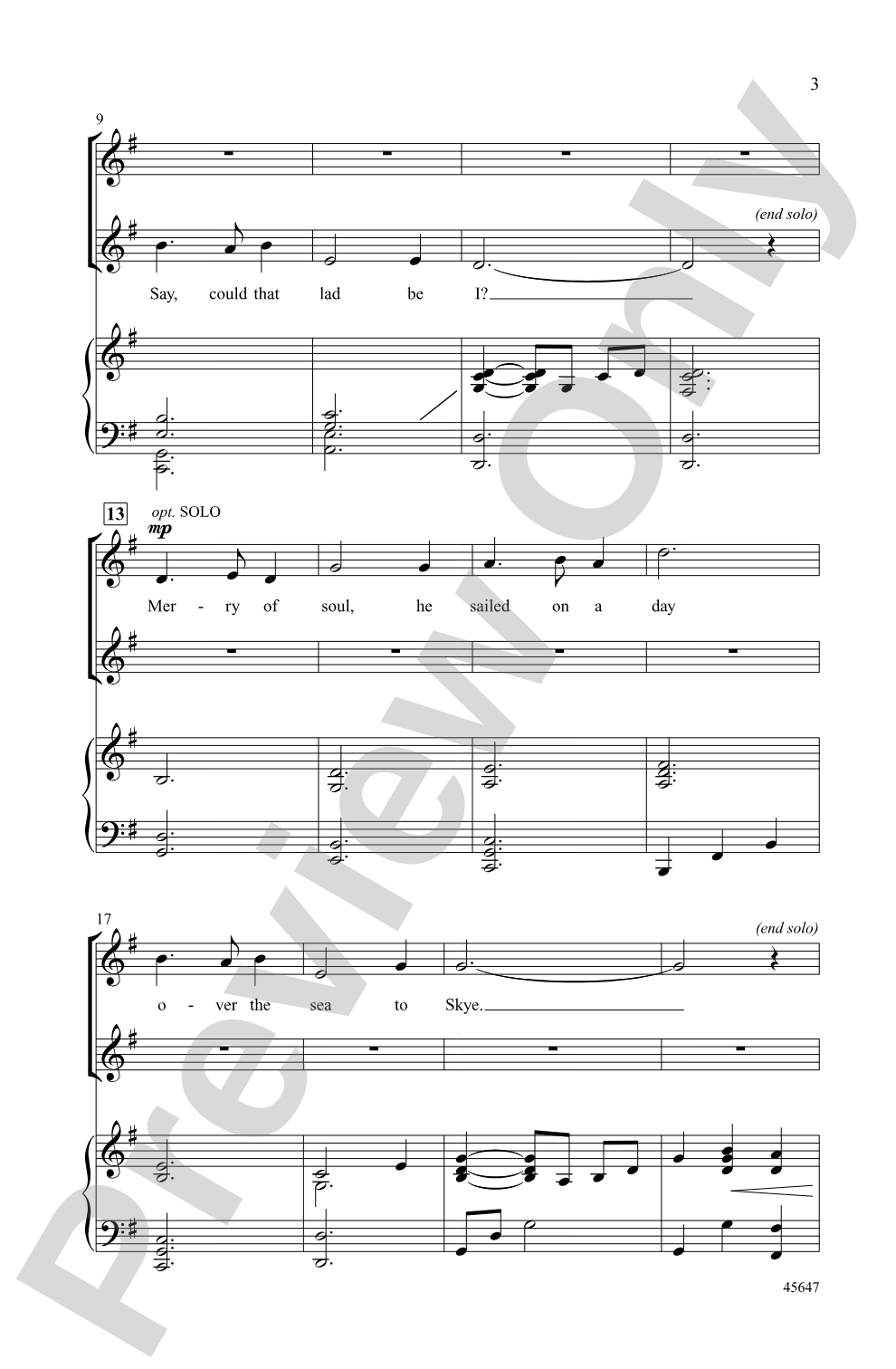

Skye Boat Song: 2-Part Choral Octavo
Scottish Folk Song, words by Robert Louis Stevenson / arr. Jay Althouse
Item: 00-PO-0005527
$1.90
Minimum order quantity: 20 copies
Pickup currently not available
Description
This haunting Scottish folk song tells the story of a long-forgotten rebellion against the British with a beautiful text by Robert Louis Stevenson. It's both touching and dramatic, as unison passages alternate with full choral harmony. The 2-part voicing and a Celtic-sounding SoundTrax CD are new additions to this Alfred Music favorite.


Skye Boat Song: 2-Part Choral Octavo isn't in MakeMusic Cloud just yet...but it could be. Let us know you'd like to see it, and you'll help shape what comes next. In the meantime, start a free trial and dive into thousands of interactive titles your students can play along with today.
Request This Title
Tell us you want it.
Start Your Free Trial
Explore everything that's ready to play right now.
Sample Audio
1
Audio File
--:--
0:00
0:00
Sample Video
Additional Details
Series:
Alfred Choral Designs
Publisher:
Alfred Music
Page Count:
8
SKU:
00-PO-0005527
More about this title
About the Arranger: Jay Althouse

Jay Althouse holds degrees in Music Education and Music from Indiana University of Pennsylvania, where he later received the Distinguished Alumni award. His eight-year career in rights and licensing at a major educational publisher gave him deep insight into what teachers and choirs actually need, and he served on the Executive Board of the Music Publishers Association of America during that time.
With over 800 choral compositions in print, Althouse has established himself as a prolific voice in choral music across all difficulty levels. His work spans secular and sacred repertoire, children's musicals co-written with Sally K. Albrecht, curated vocal solo collections including Folk Songs for Solo Singers, and educational resources like The Complete Choral Warm-up Book and Accent on Composers. He is an ASCAP member and regular recipient of the ASCAP Special Award, and currently serves on the National Advisory Board of the Folk Art Society of America.
Why we love this
Althouse's arrangement respects the ballad's narrative weight while making it immediately singable for developing choirs. The alternation between unison and 2-part harmony gives singers the confidence of unison singing while building comfort with part independence, and the Celtic-inflected accompaniment recording authentically grounds the folk idiom without overwhelming young voices.
What to expect
The melody carries an ache of exile and loyalty, grounded in Stevenson's poetic text. The piece balances intimacy (the unison moments feel like a whispered secret) with moments of fuller voice that suggest both defiance and resignation.
Who it's for
This arrangement opens Scottish folk song to younger choirs and developing singers who benefit from a blend of unison and simple harmony. It's equally strong for adult community choirs seeking meaningful repertoire that combines literary substance with musical accessibility.
How to get the most out of it
- Shape the unison passages with awareness of the story's emotional arc; the rebellion's danger and the ferryman's loyalty should register in your phrasing and dynamics, not just in the harmony.
- Let the SoundTrax recording establish the traditional Scottish character early in rehearsal, but encourage singers to internalize the melody's rhythmic flexibility so they're not locked to a click track.
- Balance the 2-part sections carefully; the second part should support rather than compete, which often means the lower voices need less dynamic intensity than you'd expect.
How to use it
Program this as a centerpiece for a concert exploring folk traditions, either in thematic pairing with other British Isles material or as an emotional anchor in a mixed repertoire set. Its modest length (eight pages) makes it excellent for a winter or spring concert where you want one substantive folk piece without committing to a full concert theme.
Skills your students will build
- Sustaining melodic line through unison singing with expressive intent
- Balancing and blending in simple 2-part harmony
- Navigating text-setting in a traditional folk idiom
- Responding to accompaniment recorded in a stylistically authentic arrangement
- Interpreting narrative content through musical choices