
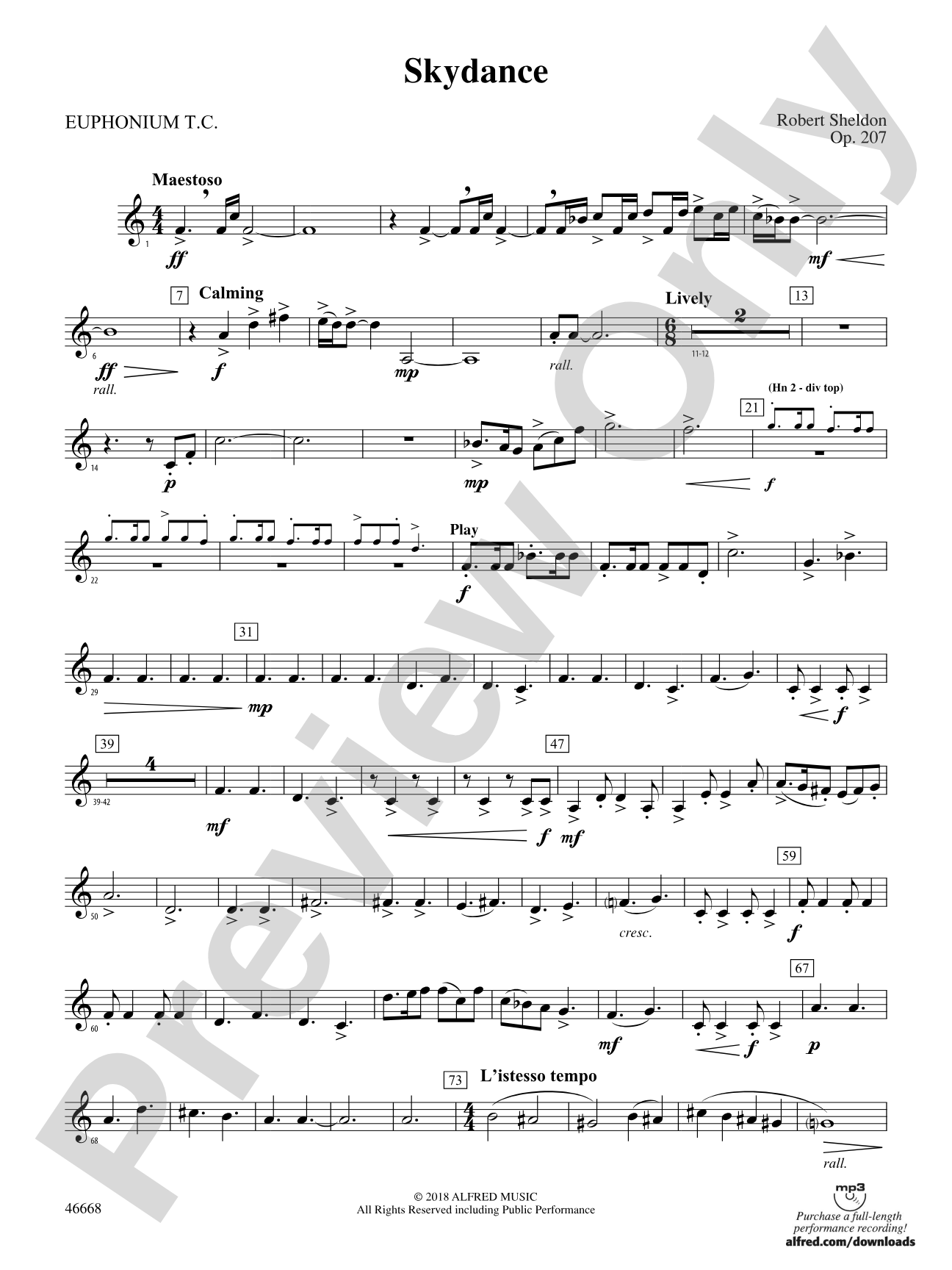

Skydance: Baritone T.C.
By Robert Sheldon
Grade: 4 (Medium Difficult)
Item: 00-PC-0017807_BTC1
$3.00
Pickup currently not available
Description
From its opening fanfare embodying moments of heroism and pride to its joyous journey of playfulness that expresses freedom and a passion for life, "Skydance" is a musical celebration of the human spirit.


Don't just read it, hear it, play along with it, and watch your students grow with it. In MakeMusic Cloud, Skydance: Baritone T.C. comes alive with professional accompaniment, adjustable tempo, and built-in practice tools that turn solo practice into real progress.
Open in the Player
Jump straight in and assign it today.
Start Your Free Trial
Open this title and explore the full library in minutes.
Sample Audio
1
Audio File
--:--
0:00
0:00
Sample Video
Additional Details
Series:
Alfred Concert Band
Publisher:
Alfred Music
Page Count:
284
SKU:
00-PC-0017807_BTC1
More about this title
About the Composer: Robert Sheldon

Robert Sheldon stands among the most frequently performed composers of wind band repertoire globally. His works appear on festival and contest programs worldwide, and his compositions have earned recognition from the American School Band Director's Association, Phi Beta Mu, and ASCAP. He is the lead author of Sound Innovations for Concert Band and regularly accepts commissions for new concert band works.
Sheldon maintains an active schedule as both a clinician and guest conductor, leading All-State and Regional Honor Bands across the United States and internationally in Japan, Canada, Italy, Germany, Australia, and China. His works have been performed at Carnegie Hall, Orchestra Hall, Boston Symphony Hall, the Sydney Opera House, and the Kennedy Center for the Performing Arts. In 2020, VanderCook College of Music awarded him an honorary doctorate in recognition of his contributions to music education.
Why we love this
Sheldon crafts the kind of concert band piece that works equally well in a festival setting or as a centerpiece on a spring concert. The architecture moves from commanding heroic statements into genuinely joyful, energetic writing that lets your ensemble shine without requiring virtuosic technical demands that overshadow the music itself.
What to expect
The piece opens with brass fanfares that announce something important and real, anchored by rhythmic support that feels grounded and assured. As it progresses, the tone shifts toward something lighter and more liberated; the orchestration becomes brighter, the rhythms more playful, inviting performers and listeners alike into a celebration of possibility and vitality.
Who it's for
Concert bands at the medium-difficult level (Grade 4) looking for a piece that programs as both a festival competitor and a concert highlight. Directors seeking repertoire that builds ensemble confidence through rewarding, singable melodic writing and clear structural logic will find strong material here.
How to get the most out of it
- Balance the opening fanfare so that the brass proclamation carries without overpowering the harmonic foundation in the woodwinds; this sets the tonal quality for everything that follows.
- Shape the playful middle section with clear articulation in the fast passages; light tonguing and crisp releases will unlock the freedom and joy Sheldon built into these measures.
- Conduct with attention to phrase direction even in the faster, seemingly rhythmic sections; allowing phrases to breathe prevents the piece from feeling mechanically driven.
- Use dynamics to support the emotional arc rather than simply playing louder at marked crescendos; the progression from heroism to joy works best when each section feels purposeful.
How to use it
This works beautifully as a concert opener that commands attention or as the final selection before an intermission, where its celebratory character leaves the audience energized. It pairs effectively with more introspective or classical repertoire on the same program, offering programmatic contrast without tonal clash.
Skills your students will build
- Balancing multi-part brass harmony with woodwind accompaniment
- Executing clean articulation and releases in fast, rhythmic passages
- Shaping extended melodic lines across phrase boundaries
- Managing dynamic contrast in service of emotional architecture rather than simply playing loud or soft