
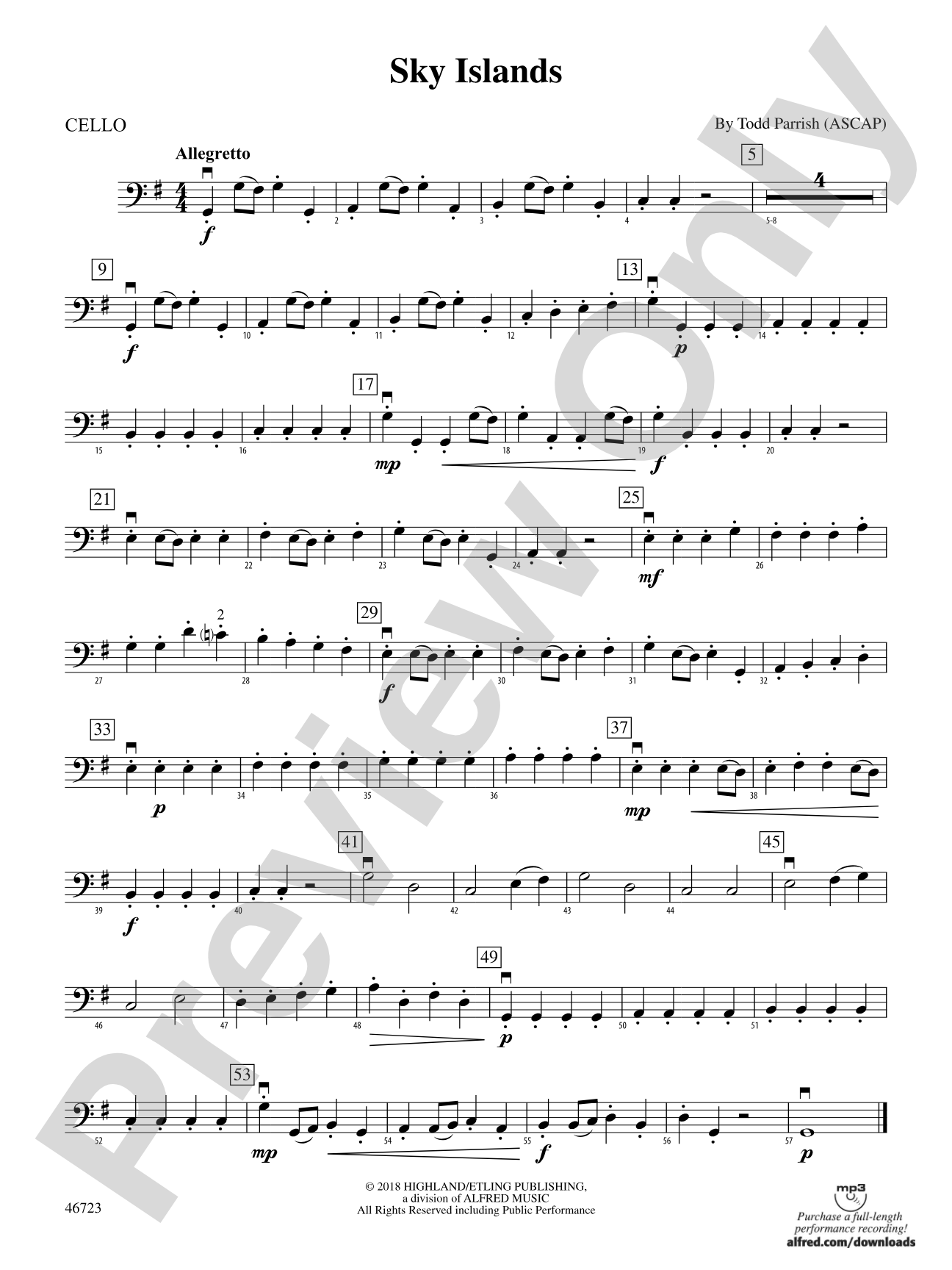

Sky Islands: Cello
By Todd Parrish
Grade: 1
Item: 00-PC-0017858_VC1
$5.99
Pickup currently not available
Description
Reflecting the beauty and grace of clouds passing by, this very easy work gives young students a chance to explore the full range of the key of G major. "Sky Islands," a grade 1 piece by Todd Parrish, includes staccato quarter notes contrasted by half notes and slurred eighth notes to reinforce beginning level rhythms. Interesting dynamic changes from piano to forte enhance the mood, while melodies and counter-melodies flow through all parts. This title is available in MakeMusic Cloud.


Don't just read it, hear it, play along with it, and watch your students grow with it. In MakeMusic Cloud, Sky Islands: Cello comes alive with professional accompaniment, adjustable tempo, and built-in practice tools that turn solo practice into real progress.
Open in the Player
Jump straight in and assign it today.
Start Your Free Trial
Open this title and explore the full library in minutes.
Sample Audio
1
Audio File
--:--
0:00
0:00
Sample Video
Additional Details
Series:
Highland/Etling String Orchestra
Publisher:
Alfred Music
Page Count:
62
SKU:
00-PC-0017858_VC1
More about this title
About the Composer: Todd Parrish
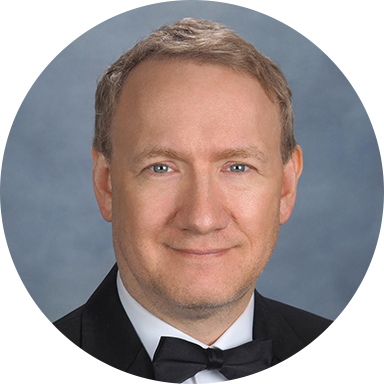
Todd Parrish brings two decades of orchestral teaching experience across public school systems in Illinois, Virginia, and Florida. He holds a Bachelor of Music Education from ORU in Tulsa, where he studied violin and piano, and earned his Master of Music in Orchestral Conducting from the University of Arizona under the mentorship of Jindong Cai, with additional studies in string quartet and violin.
Beyond the classroom, Parrish has established himself as a prolific composer and arranger, with over forty published works across Alfred Music, Wingert-Jones Publications, and Carl Fischer Music. He served as orchestra editor for J.W. Pepper and currently holds the orchestra editor position at Carl Fischer Music. His arranging focuses on making classical music accessible to school orchestras while crafting original compositions that serve young musicians.
Why we love this
Parrish understands what first-year orchestra students need: clear rhythmic contrasts that build confidence without overwhelming complexity. The deliberate pairing of staccato and legato textures, anchored in G major throughout, gives students tangible technical goals while the programmatic title and dynamic arc make rehearsals engaging rather than drill-focused.
What to expect
Serene and flowing, like watching weather patterns drift across an open sky. The piece unfolds gently, alternating between moments of sustained calm (half notes) and lighter, more playful movement (staccato quarters and slurred eighths), creating a sense of grace and natural progression.
Who it's for
First-year string orchestra students and conductors building their Grade 1 repertoire. This work suits beginners who have learned basic bow holds, note reading on their instruments, and can sustain simple rhythms in unison.
How to get the most out of it
- Emphasize the shape of each phrase by drawing the bow deeply on the half notes and slurred eighths; this prevents students from rushing the rhythm changes and teaches line direction in simple terms.
- Use the dynamic shifts as sectional focus points during rehearsal, asking students to listen for the piano-to-forte contrasts in neighboring parts to build awareness of ensemble balance.
- Stagger the entries of counter-melodies by part (starting with one violin section, then adding the other strings) so students hear how melodies interact before playing tutti.
- Let the program note guide your interpretation: invite students to imagine the visual movement of clouds before playing, then return to that image during performance to unify the ensemble's approach to phrasing.
How to use it
Open a fall or spring concert with this piece to set a reflective tone before more energetic works, or pair it with other Grade 1 selections to showcase early-season learning. Its accessible difficulty and concert appeal make it ideal for young orchestras establishing their repertoire identity.
Skills your students will build
- Reading and maintaining consistent rhythm across mixed note values (quarter notes, half notes, eighth notes)
- Sustaining tone on half notes while controlling the bow
- Contrasting staccato and legato articulations in the same piece
- Following dynamic markings (piano and forte) as an ensemble
- Balancing melody and counter-melody within G major tonality