
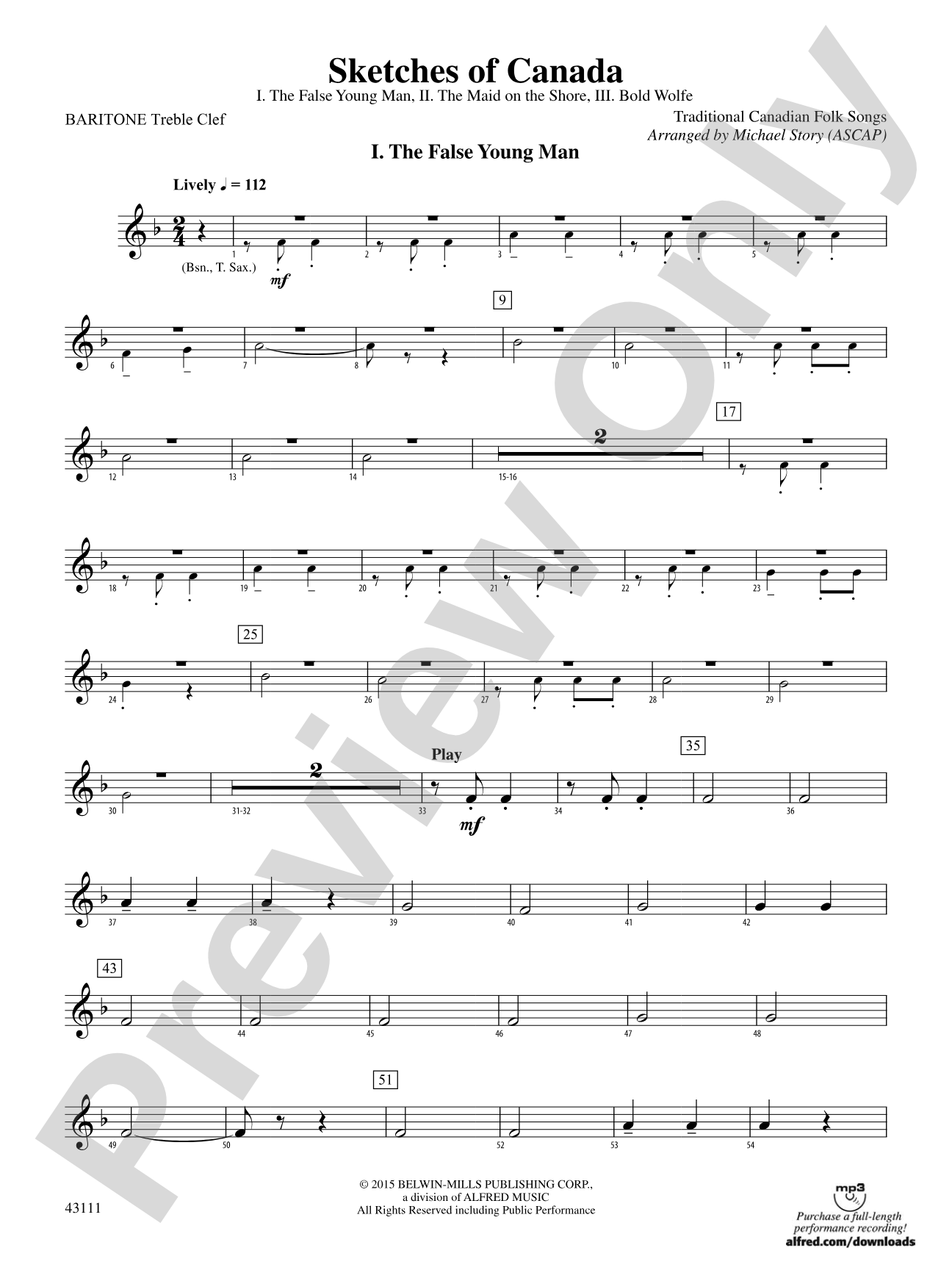

Sketches of Canada: Baritone T.C.
I. The False Young Man, II. The Maid on the Shore, III. Bold Wolfe
Traditional Canadian Folk Songs / arr. Michael Story
Grade: 2 (Easy)
Item: 00-PC-0016762_BTC1
$5.99
Pickup currently not available
Description
This suite features three Canadian folk songs, each with a contrasting style, meter, and key. Beginning with "The False Young Man" in a delicate, light fashion, it continues with the beautiful "The Maid on the Shore"---a folk song from Newfoundland---finally, the suite closes with the powerful "Bold Wolfe." This charismatic series of musical vignettes will offer the opportunity to reinforce a wide variety of musical concepts. (4:00)


Don't just read it, hear it, play along with it, and watch your students grow with it. In MakeMusic Cloud, Sketches of Canada: Baritone T.C. comes alive with professional accompaniment, adjustable tempo, and built-in practice tools that turn solo practice into real progress.
Open in the Player
Jump straight in and assign it today.
Start Your Free Trial
Open this title and explore the full library in minutes.
Sample Audio
1
Audio File
--:--
0:00
0:00
Sample Video
Additional Details
Series:
Belwin Young Band
Publisher:
Alfred Music
Page Count:
246
SKU:
00-PC-0016762_BTC1
More about this title
About the Arranger: Michael Story
Michael Story is a prolific composer and arranger whose work dominates the concert band and wind ensemble repertoire at all levels. His arrangements for young bands combine accessibility with musical integrity, creating pieces that allow students to experience genuine artistry without overwhelming technical demands. Story's gift for orchestration and his deep understanding of how young musicians learn have made him an essential voice in band music education.
Why we love this
Three distinct folk songs in one suite mean your band gets three different musical problems to solve: rhythmic precision in contrasting meters, tonal security across multiple keys, and the interpretive maturity to shift character between delicate, lyrical, and powerful textures. Grade 2 bands rarely encounter this kind of stylistic range in a single piece, and Story's writing ensures each movement teaches something concrete rather than repeating the same challenges.
What to expect
A musical postcard series from Canada. You move from the intimate, almost whispered quality of a folk tale told in candlelight, into the haunting beauty of a maritime song, then land in the dramatic energy of a legendary hero's story. The progression feels purposeful and complete, like three movements of a larger narrative told through melody and arrangement.
Who it's for
Grade 2 concert bands looking for repertoire with real musical substance and instructional value. Directors who want to teach students how to navigate shifting contexts (keys, meters, textures, dynamics) within a single rehearsal piece rather than jumping from one independent work to another.
How to get the most out of it
- Balance the transparent textures in 'The False Young Man' by keeping inner voices clear; this movement's magic lives in detail, not volume.
- Establish a warm, legato sound for 'The Maid on the Shore' by listening for the melody's arc across phrases and shaping the harmonic support beneath it.
- Give 'Bold Wolfe' rhythmic drive without rushing; lock the ensemble on the downbeats and let the stronger dynamic profile carry momentum naturally.
- Use the key and meter shifts between movements as rehearsal anchor points; mark these transitions clearly in parts so the band knows exactly where the musical character changes.
How to use it
Program this as a standalone suite on a concert where you want to show your band's range and maturity without requiring virtuosic technical display. It also works well early in the season as a teaching tool: use the three movements across several rehearsals to reinforce concepts like key changes, meter shifts, and dynamic control before moving into more technically demanding repertoire.
Skills your students will build
- Reading multiple meters (2/4, 3/4, 4/4) within the same piece
- Playing with confidence in concert keys without relying on patterns from previous pieces
- Matching articulation and dynamics to shifting character and texture
- Balancing ensemble sound when inner voices carry important harmonic content
- Shaping longer phrases with purposeful direction and legit
- Executing smooth key and meter transitions between movements