
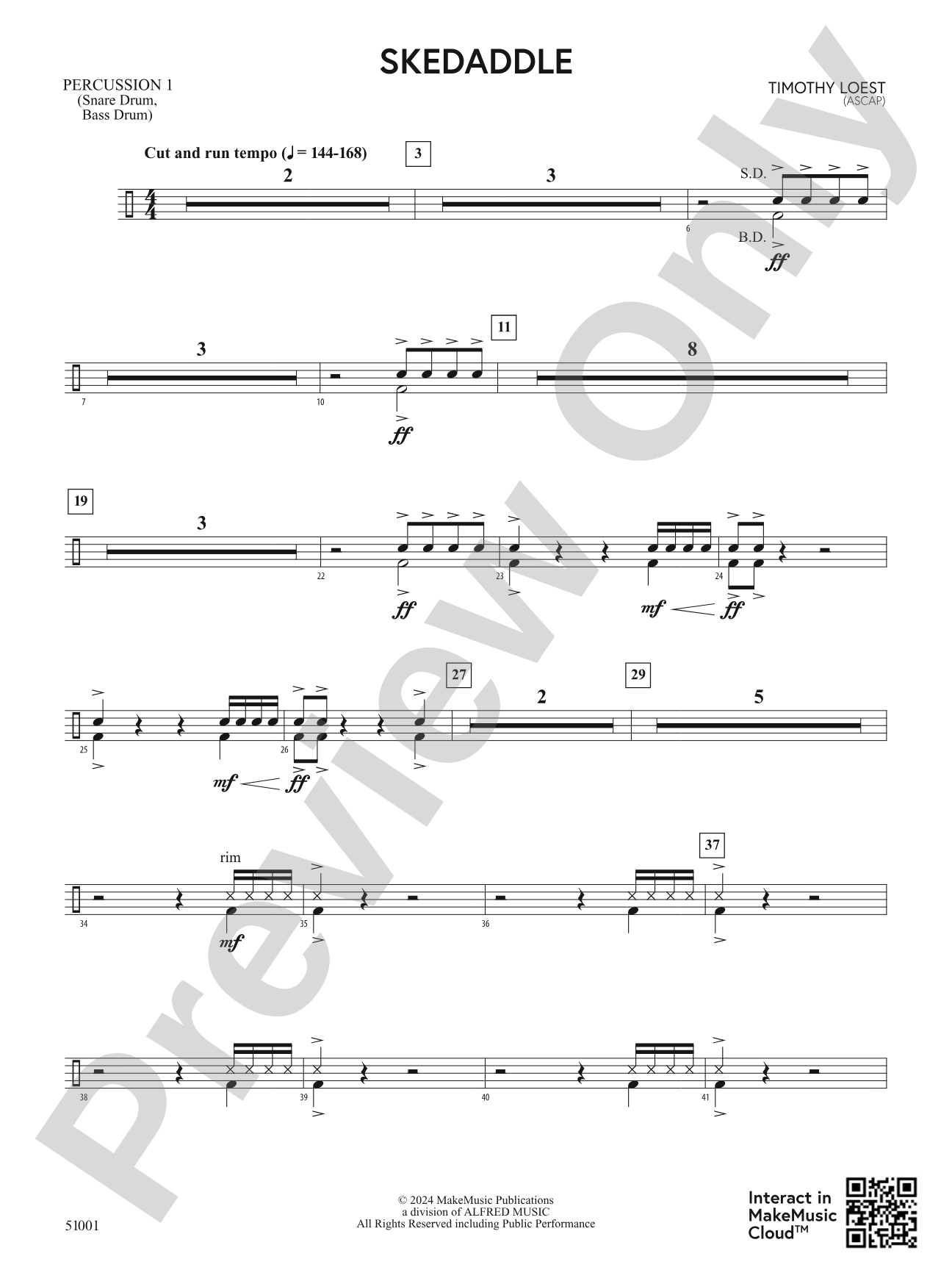

Skedaddle: 1st Percussion
By Timothy Loest
Grade: 1.5-2
Item: 00-PC-0019217_PC1
$5.99
Pickup currently not available
Description
Experience high-speed musical excitement in this fast-paced thriller by Timothy Loest. Pulsating rhythms, shifting accents, and sudden dynamic outbursts will throw your audience back into their seats. Buckle your seat belt and get ready to burn rubber! You're about to Skedaddle! (2:00)


Don't just read it, hear it, play along with it, and watch your students grow with it. In MakeMusic Cloud, Skedaddle: 1st Percussion comes alive with professional accompaniment, adjustable tempo, and built-in practice tools that turn solo practice into real progress.
Open in the Player
Jump straight in and assign it today.
Start Your Free Trial
Open this title and explore the full library in minutes.
Sample Audio
1
Audio File
--:--
0:00
0:00
Sample Video
Additional Details
Series:
MakeMusic Developing Band
Publisher:
MakeMusic Publications
SKU:
00-PC-0019217_PC1
More about this title
About the Composer: Timothy Loest

Timothy Loest has spent over thirty years in the classroom while building an international reputation for compositions that balance artistic integrity with pedagogical purpose. His works for young band are performed worldwide, and his influence extends beyond the concert hall through his association with several foundational methods including Measures of Success and Rhythms and Beyond. In 2017, his composition Cloud Gate (Reflections of a City) reached an audience of over 5,000 at Chicago's Millennium Park, and that same year he received the Illinois Grade School Music Association's Cloyd Myers Memorial Award for Excellence in Music Education.
Loest's publishing history spans nearly three decades, with works appearing on network television programs including The Tonight Show Starring Jimmy Fallon and Good Morning America. He holds degrees from Illinois State University and Northwestern University, maintains ASCAP membership, and founded Fanfare Music Press in 2022 to publish high-quality compositions and arrangements for band. He regularly accepts commissions and continues to compose while residing in Illinois.
Why we love this
Loest captures that rare quality in Grade 1.5-2 writing where every section feels genuinely energized rather than merely busy. The shifting accents and dynamic surprises give your ensemble permission to play with character and personality, which is exactly what young bands need to stay engaged during contest season. At two minutes, it's the perfect length for festival programming without wearing out the group.
What to expect
Skedaddle is a musical joyride: relentless forward motion punctuated by explosive surprises that keep the audience guessing. The pulsating rhythms feel like an engine revving under the hood, while sudden dynamic outbursts and shifting accents create a sense of controlled chaos. By the end of two minutes, both performers and listeners will feel breathless.
Who it's for
Beginning and early intermediate concert bands ready to tackle rhythmic complexity and sudden dynamic contrast. This piece works well for groups that have mastered steady tempos and basic articulation and are ready to explore ensemble awareness and precision. Festival and contest directors looking for exciting, accessible vehicles that challenge without overwhelming.
How to get the most out of it
- Mark the sudden dynamic shifts in your score before rehearsal begins; they're the engine of this piece, and your band will need time to track them together with precision.
- Keep the pulsating rhythms locked in by having your percussion section count out loud during sectional work. The foundation of this piece depends on rhythmic clarity.
- Listen for balance in the melodic lines when multiple sections carry ideas simultaneously; young ensembles often bury important voice parts when excitement takes over.
- Take the accelerando into the climax deliberately. Rushing it robs the audience of the building tension that makes the finale land.
How to use it
Program this as an energetic opener or closer to give your concert immediate momentum and leave a strong final impression. It pairs well alongside lyrical pieces, where its sharp contrasts will highlight the expressive qualities of your neighboring selections. At contest, use it to showcase your section's rhythmic precision and dynamic control on a single, high-impact selection.
Skills your students will build
- Maintaining steady tempo through rapid rhythmic figures and syncopated patterns
- Executing abrupt dynamic changes with ensemble unity and precision
- Tracking shifting accents and their relationship to metric placement
- Balancing independent rhythmic lines across multiple sections simultaneously
- Building and releasing tension through accelerando and controlled intensity