Siyahamba: 2nd Violin Sheet Music Preview

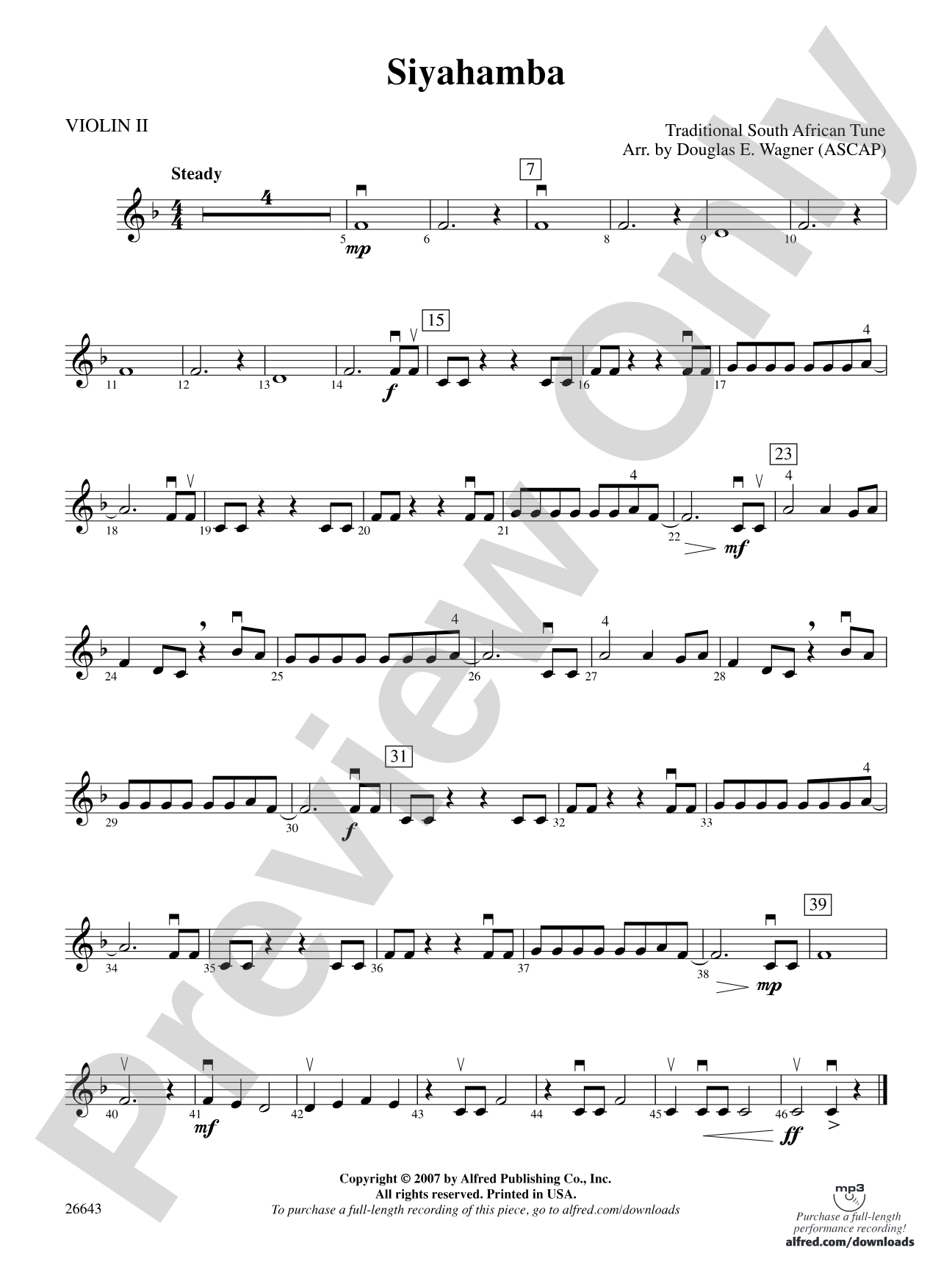
Siyahamba: 2nd Violin

Traditional / arr. Douglas E. Wagner

Grade: 2

Item: 00-PC-0001143_VN2

Digital Download
$3.00
Description
Siyahamba (pronounced: See-yah-hahm-bah), is adapted from a traditional song of the Zulu people, originating in the KwaZulu province of South Africa (now a part of Natal province). With strong ties to the apartheid movement, this tune, with its bold major sixth and seventh leaps, has a resolutely hopeful quality about it. The setting is straightforward, and uses persistent ostinatos in the bass line and percussion parts to provide an energetic background while propelling the theme forward. Several "call and response" patterns that are characteristic of African music have also been incorporated into the musical structure. This title is available in MakeMusic Cloud.

Don't just read it, hear it, play along with it, and watch your students grow with it. In MakeMusic Cloud, Siyahamba: 2nd Violin comes alive with professional accompaniment, adjustable tempo, and built-in practice tools that turn solo practice into real progress.

Sample Audio
0:00
0:00
Sample Video
Additional Details
Series: Belwin Intermediate Full Orchestra
Publisher: Alfred Music
Page Count: 59
SKU: 00-PC-0001143_VN2

More about this title

About the Arranger: Douglas E. Wagner

Douglas E. Wagner

Douglas E. Wagner, a Chicago native, holds undergraduate and graduate degrees in music from Butler University. After three decades leading school music programs as educator and administrator, he transitioned to full-time composition and arrangement work.

Wagner has published over 3,500 titles across choir, concert band, orchestra, handbell ensemble, organ, piano, and voice since 1973. His music has reached well over seventeen million copies worldwide and appears regularly in concert halls, broadcasts, and festival performances across the United States and internationally. He currently lives in Indianapolis with his wife, Sandy.

Why we love this

Siyahamba brings authentic African musical language into the Grade 2 orchestra repertoire without oversimplifying. Wagner respects the call-and-response traditions and rhythmic integrity of the source material while crafting an arrangement that energizes young orchestras and builds genuine musical ownership around a meaningful cultural work.

What to expect

Siyahamba radiates determination and hope. The relentless rhythmic drive of the ostinatos propels the melody forward with joyful energy, while the bold intervallic leaps create moments of uplift that feel earned rather than decorative. Young players discover that simple textures and persistent rhythms can generate real musical power.

Who it's for

Grade 2 full orchestras seeking literature that connects cultural traditions with contemporary ensemble playing. Directors building festivals, concerts, or multicultural programming will find an arrangement that challenges young players to engage with authentic African musical structures while remaining technically accessible.

How to get the most out of it

  • Let the persistent bass line and percussion ostinatos establish the groove before the theme enters; this foundation makes the melody's hopeful character land with full impact.
  • Shape the call-and-response sections with clear sectional leadership so each voice group hears its place in the dialogue rather than playing mechanically.
  • Honor the bold sixth and seventh leaps in the melody by encouraging singers and soloists to move toward them confidently rather than backing away from the intervallic distance.

How to use it

Program this as a centerpiece for cultural programming or use it to open a concert with vibrant, forward-moving energy. Its Grade 2 accessibility makes it ideal for festival submissions where authenticity and musicality matter equally. The straightforward setting also works well alongside other folk or global music selections that build thematic resonance across a full program.

Skills your students will build

  • Call-and-response phrasing and sectional communication
  • Rhythmic precision with persistent ostinato patterns
  • Confident singing or playing of large intervallic leaps (major sixths and sevenths)
  • Understanding of African musical traditions and their cultural context
  • Ensemble cohesion within a Grade 2 texture

You May Also Like