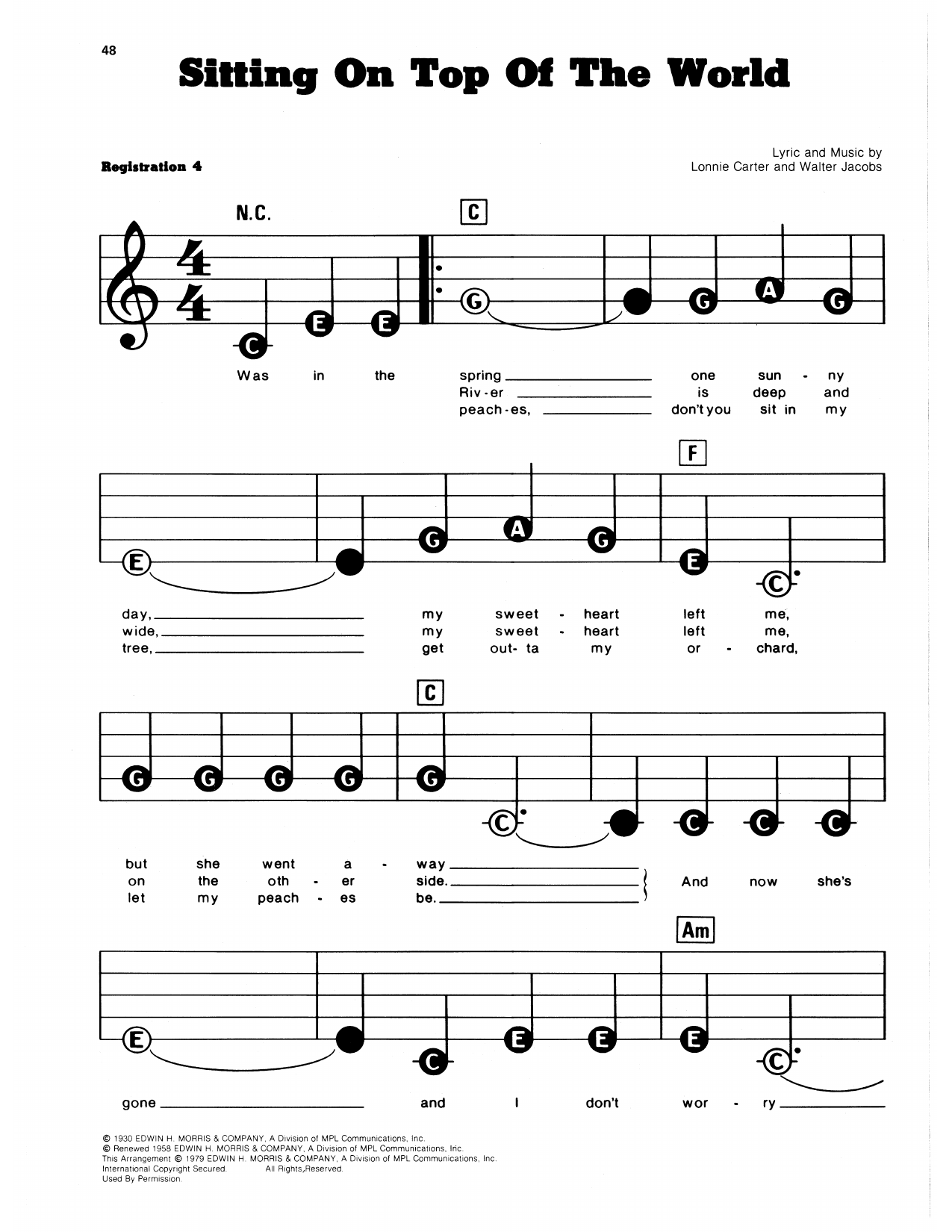
Sitting On Top Of The World: E-Z Play Today

As performed by Doc Watson

Item: 35-DS01915057

Digital Download
$4.99
Description

Sitting On Top Of The World: E-Z Play Today isn't in MakeMusic Cloud just yet...but it could be. Let us know you'd like to see it, and you'll help shape what comes next. In the meantime, start a free trial and dive into thousands of interactive titles your students can play along with today.

Sample Audio
No sample audio found.
Sample Video
Additional Details
Publisher: Hal Leonard
Page Count: 2
SKU: 35-DS01915057

More about this title

About the Artist: Doc Watson

Doc Watson (1923-2012) was a legendary guitarist and vocalist who bridged folk, blues, and country music with remarkable authenticity. Born in North Carolina, Watson became known for his fingerpicking technique, his pure tenor voice, and his ability to inhabit traditional American songs with genuine emotion. His influence on acoustic guitar playing and roots music pedagogy remains foundational in music education.

Why we love this

This arrangement captures the infectious optimism of a blues standard without requiring virtuosic technique, making it accessible for intermediate pianists who want to explore roots music. The straightforward two-page layout lets students focus on the character and swing of the piece rather than wrestling with notation or complex voicings. Programming it offers your students a chance to play authentic American music with real historical roots.

What to expect

There's a quiet confidence in this melody, the kind that comes from sitting somewhere warm, surveying the world with contentment. The blues inflections and country sensibility give it a conversational quality; it asks for restraint rather than display.

Who it's for

This works well for pianists working at the early intermediate level who are expanding beyond classical repertoire into American vernacular styles. It's equally valuable for general music students exploring roots traditions and for accompanists learning to support vocalists in folk and blues contexts.

How to get the most out of it

  • Lean into the blues phrasing by treating written eighth notes with light swing feel; let them breathe rather than quantifying them metrically.
  • Balance the melody line so it sits comfortably above the accompaniment without forcing volume; this tune thrives on intimate delivery.
  • Explore the relationship between left and right hand rhythmically. The accompaniment pattern should feel conversational with the melody, not locked in strict time.
  • Pay attention to dynamics marked in the score; modest swells and pulls create warmth in folk and blues material.

How to use it

Pair this with other Doc Watson interpretations or traditional American standards in a concert exploring roots music and its influence on contemporary styles. It works particularly well as a bridge piece between classical and folk repertoire, or as a showcase for a pianist looking to develop authentic interpretation skills outside the conservatory canon.

Skills your students will build

  • Blues phrasing and swing interpretation in a non-jazz context
  • Accompanying a melody with sensitivity rather than formal harmonic structure
  • Fingering approaches for ragtime and folk-influenced left-hand patterns
  • Balancing simplicity with musical expression

You May Also Like