
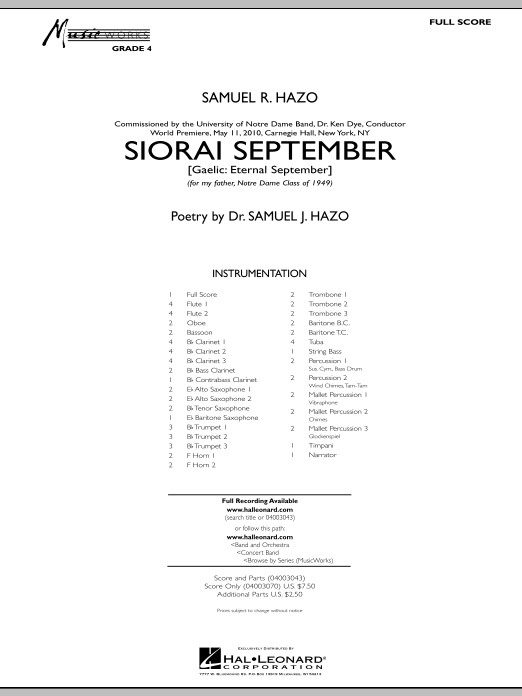

Siorai September: Concert Band Conductor Score & Parts
By Samuel R. Hazo
Grade: 4
Item: 35-PK00181489
$85.00
Pickup currently not available
Buy Extra Parts (Digital PDF Download)
Parts Added to Cart!
Description
Translated from Gaelic as "Eternal September," this marvelous setting for band is designed to take each listener back to their own vivid fall memories on a college campus. Commissioned by the University of Notre Dame and premiered at their Carnegie Hall performance in 2010, this work is also dedicated to the composer's father, Dr. Samuel J. Hazo, a 1949 graduate of Notre Dame. Additionally, Dr. Hazo's poem "Home Are the Sailors" is incorporated in the middle of the piece. Rich in musical references and varied textures, this is a dramatic and rewarding work for mature ensembles. Dur: c. 5:30


Siorai September: Concert Band Conductor Score & Parts isn't in MakeMusic Cloud just yet...but it could be. Let us know you'd like to see it, and you'll help shape what comes next. In the meantime, start a free trial and dive into thousands of interactive titles your students can play along with today.
Request This Title
Tell us you want it.
Start Your Free Trial
Explore everything that's ready to play right now.
Sample Audio
No sample audio found.
Sample Video
No sample videos found.
Additional Details
Publisher:
Hal Leonard
SKU:
35-PK00181489
More about this title
About the Composer: Samuel R. Hazo
Samuel R. Hazo is a composer whose work bridges contemporary concert music with deeply personal narratives. His compositions often draw from literary sources and family heritage, infusing orchestral and band works with emotional specificity and structural sophistication.
Hazo's commissions from major institutions reflect the regard in which his writing is held. His ability to craft textures that honor both the full ensemble sound and intimate musical moments has made his work compelling across educational and professional settings.
Why we love this
Siorai September offers something rare: a Grade 4 work that doesn't sacrifice musical substance for accessibility. The integration of Dr. Samuel J. Hazo's poem alongside the orchestration creates multiple layers of meaning that mature students can genuinely engage with, making this far more than a competent seasonal piece. It's the kind of work that leaves an ensemble and its audience thinking about memory, place, and transition long after the final chord.
What to expect
Siorai September captures the particular ache of seasonal transition and nostalgia without becoming maudlin. The orchestration moves between rich, enveloping textures and crystalline clarity, mirroring how memory itself shifts between vivid detail and impressionistic wash. You hear autumn not as a backdrop but as something lived and felt.
Who it's for
Conductors of solid Grade 4 ensembles who want to program something that respects their students' growing musicianship and emotional intelligence. This work suits bands prepared to balance technical execution with interpretive depth, and ensembles comfortable with a piece that lingers in the listener's mind.
How to get the most out of it
- Balance the literary and musical elements by securing clear diction from your reading section during the poem integration; the words carry as much weight as the instrumental writing around them.
- Attend closely to the varied textures throughout the five and a half minute span. Each section uses a different orchestrational approach, so allow transitions between them time to register with your ensemble.
- Lean into the autumnal imagery without pushing it into sentimentality. The musical references and dramatic arc create enough emotional content on their own.
How to use it
This work fits naturally into fall concerts or festival programming where it can anchor a set of seasonal or thematic repertoire. Its Carnegie Hall premiere and Notre Dame commission also make it a compelling choice for programs celebrating institutional heritage or literary connections in music. Consider pairing it with works that explore similar territory of place and memory, or let it stand as a centerpiece that allows the remainder of your program to build from or contrast with its reflective character.
Skills your students will build
- Sustained dynamic control across longer phrases
- Balance and blend in multi-textured passages
- Interpretation of literary text within instrumental context
- Stylistic navigation between lyrical and dramatic sections
- Ensemble listening across a five-minute formal arc