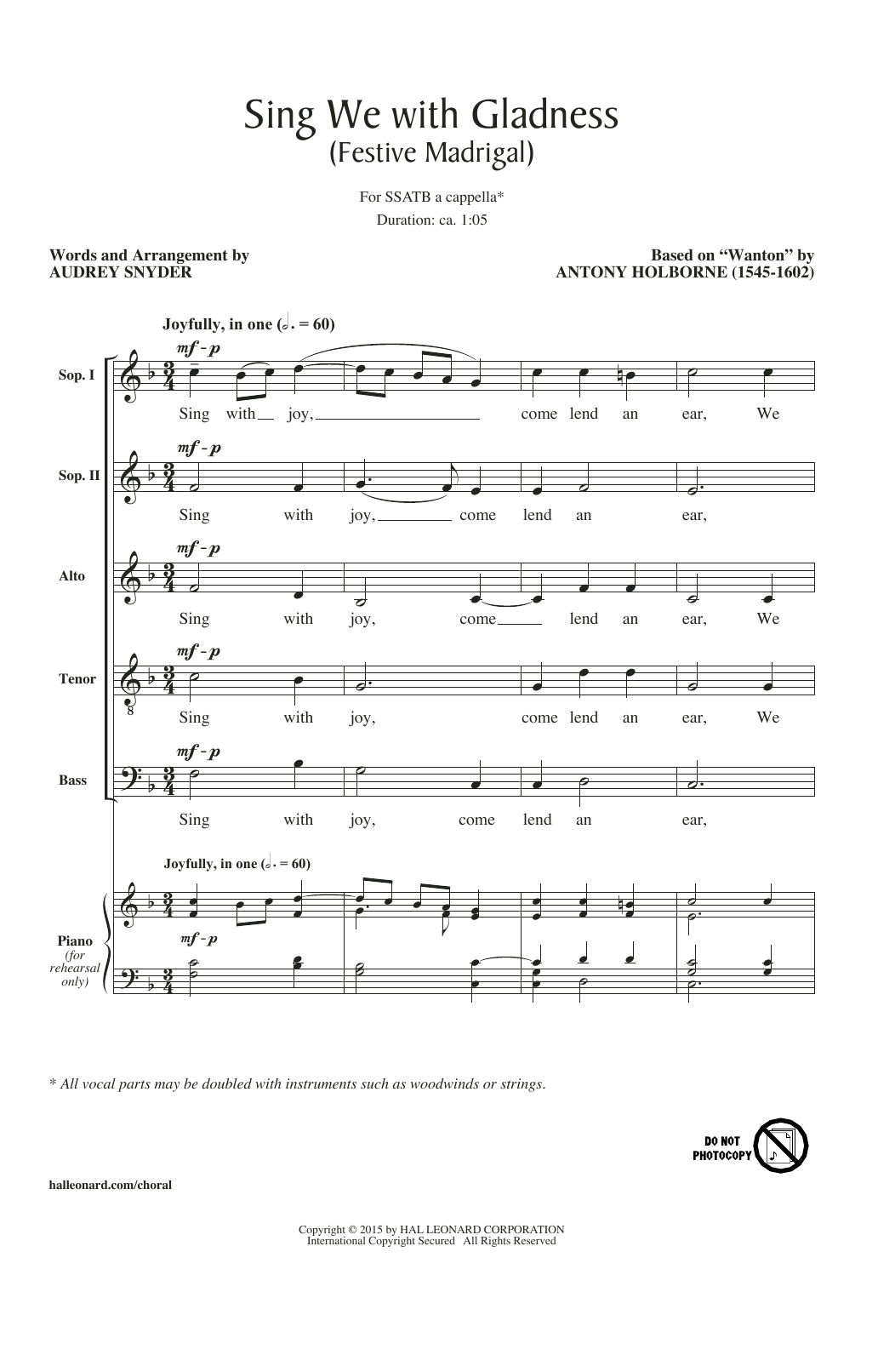
Sing We With Gladness (Festive Madrigal) Sheet Music Preview

Sing We With Gladness (Festive Madrigal): SATB Choral Octavo

As performed by Antony Holborne / Arranged by Audrey Snyder

Item: 35-DS00309325

Digital Download
$2.99
Description

Sing We With Gladness (Festive Madrigal): SATB Choral Octavo isn't in MakeMusic Cloud just yet...but it could be. Let us know you'd like to see it, and you'll help shape what comes next. In the meantime, start a free trial and dive into thousands of interactive titles your students can play along with today.

Sample Audio
No sample audio found.
Sample Video
Additional Details
Publisher: Hal Leonard
Page Count: 5
SKU: 35-DS00309325

More about this title

About the Artist: Antony Holborne

Antony Holborne was an English composer and lutenist of the late Renaissance, active in the court of Queen Elizabeth I during the 1580s and 1590s. He published two collections of instrumental music that reveal a sophisticated command of counterpoint and dance forms, making him a significant figure in the development of English secular music. His works bridge the world of courtly instrumental music and vocal composition, establishing him as a composer whose craftsmanship and melodic invention continue to resonate with performers today.

Holborne's legacy in music education rests on his ability to write idiomatically for the voice while maintaining the harmonic and structural integrity that characterizes Renaissance polyphony. His pieces have proven enduring vehicles for teaching ensemble singing, blend, and stylistic awareness across centuries.

Why we love this

Audrey Snyder's arrangement captures the spirited character of Holborne's original without overshadowing its Renaissance roots. The piece sits in a sweet spot for holiday programming: festive and celebratory without requiring technical pyrotechnics, making it accessible to solid SATB choirs while sounding substantive and considered on concert.

What to expect

Warm, celebratory, and genuinely joyful without sentimentality. The madrigal texture creates a sense of intimate communal singing, as though the choir is inviting the audience into their gladness rather than performing at them.

Who it's for

SATB choirs looking for a concert piece with period character and festive spirit. This arrangement works equally well for holiday programs, secular Christmas concerts, and spring concerts seeking Renaissance repertoire.

How to get the most out of it

  • Balance the text carefully across all four voices. Renaissance polyphony depends on equal weight in the ensemble; if sopranos dominate, the inner lines disappear and the piece loses its architectural elegance.
  • Shape phrases by the text, not the bar line. Let the language breathe naturally, and the rhythm will feel less mechanical and more conversational.
  • Emphasize the text repetition and any brief imitative gestures between sections. These textural moments create lift and keep the piece from feeling static.

How to use it

Place this alongside other Renaissance or holiday selections to build a thematic set, or use it as a lighter moment between heavier contemporary works. Its five-page length and approachable difficulty make it ideal for holiday concerts where rehearsal time is limited but musical impact must be substantial.

Skills your students will build

  • Renaissance harmonic language and voice leading conventions
  • Textual clarity and diction in polyphonic contexts
  • Balancing four independent melodic lines without one dominating
  • Shaping phrases by syntax rather than meter
  • Period-appropriate articulation and style in secular vocal music

You May Also Like