Sing We and Chant It Sheet Music Preview

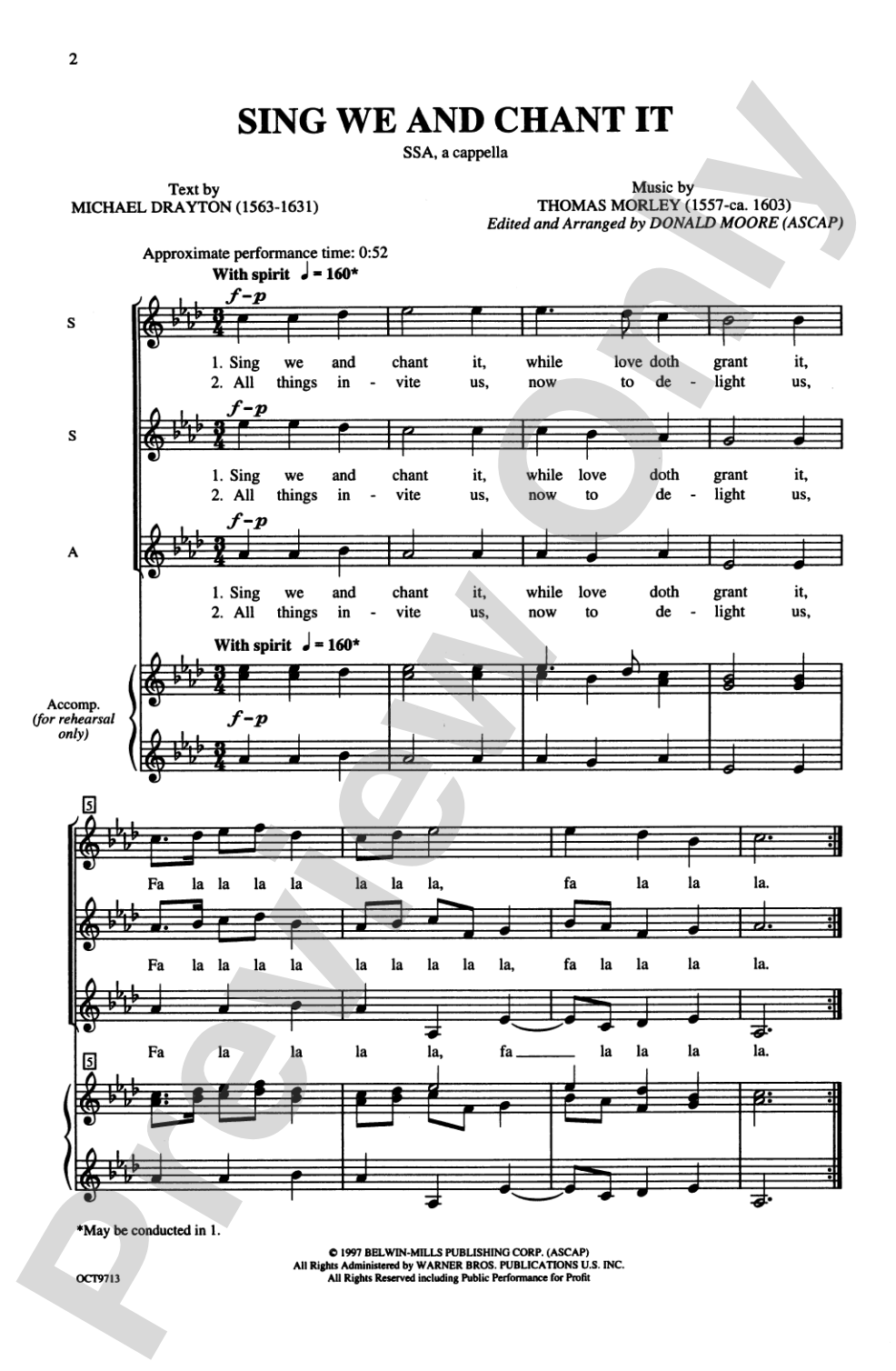
Sing We and Chant It: SSA, a cappella Choral Octavo

Text by Michael Drayton, music by Thomas Morley / ed. and arr. Donald Moore

Item: 00-PO-0005151

Digital Download
$2.25

Minimum order quantity: 20 copies

Description
Donald Moore delivers a fresh new setting of this, the most famous of Thomas Morley's madrigals. Written in SSA or TTB editions to be performed by either your men's or women's ensembles, the arrangements are easy to sing, yet sound delightful. Add some variety to any concert with this one!

Sing We and Chant It: SSA, a cappella Choral Octavo isn't in MakeMusic Cloud just yet...but it could be. Let us know you'd like to see it, and you'll help shape what comes next. In the meantime, start a free trial and dive into thousands of interactive titles your students can play along with today.

Sample Audio
No sample audio found.
Sample Video
Additional Details
Series: Alfred Archive Edition: Belwin Festival Series
Publisher: Alfred Music
Page Count: 4
SKU: 00-PO-0005151

More about this title

About the Composer: Thomas Morley

Thomas Morley (1557-1602) stands as one of the most prolific and versatile English composers of the Renaissance. A student of William Byrd and later a gentleman of the Chapel Royal, Morley helped establish the English madrigal as a distinctive artistic form, blending Italian models with English sensibility and wit. His madrigals remain cornerstones of the secular choral repertoire, prized for their singability, textual clarity, and genuine musical substance.

"Sing We and Chant It" exemplifies Morley's gift for crafting music that feels both accessible and genuinely artful. The piece has endured four centuries as a teaching and performance standard, a testament to its melodic grace and the pleasure it brings to singers of all levels.

Why we love this

This arrangement opens the door to authentic Renaissance choral literature without requiring advanced ensemble technique. Moore's SSA setting preserves the elegance of the original while making it genuinely enjoyable for younger or developing choirs to learn and perform, and the madrigal's inherent charm guarantees audience delight regardless of the ensemble's experience level.

What to expect

Buoyant and playful, with the kind of melodic charm that feels as fresh now as it did in Morley's time. The piece has an inherent lightness and rhythmic spring that invites singers to enjoy the music as they perform it.

Who it's for

SSA choirs seeking genuine Renaissance repertoire that remains engaging and achievable. This works well for women's and treble-voiced ensembles at the developing to intermediate level, as well as for school choirs introducing singers to madrigals for the first time.

How to get the most out of it

  • Shape phrases with gentle dynamic inflection rather than dramatic swells. The text should guide your phrasing, with natural breath points and moments of slight emphasis that highlight Morley's word-painting.
  • Balance the lines carefully in the a cappella setting. Without instrumental support, each voice part needs independence and clarity; resist the urge to let any section overshadow the others.
  • Approach the piece with rhythmic precision and textual clarity. Morley's rhythmic patterns are straightforward, but articulation and vowel consistency across the ensemble will make the difference between competent and polished.
  • Consider the emotional arc: this is a celebration and a dance, not a solemn processional. Light tone, clear diction, and a sense of forward motion will bring the text to life.

How to use it

Pair this with other Renaissance secular works to build a focused choral concert segment, or use it as a bright, accessible contrast within a mixed-genre program. Its brevity and appeal also make it well-suited for festivals, showcase concerts, or educational events where you want to highlight ensemble joy and textual clarity.

Skills your students will build

  • Singing Renaissance polyphony with text clarity and ensemble blend
  • Maintaining independent melodic lines in a cappella texture
  • Understanding word-painting and text expression in madrigal style
  • Performing with light, articulate tone and rhythmic precision in secular repertoire

You May Also Like