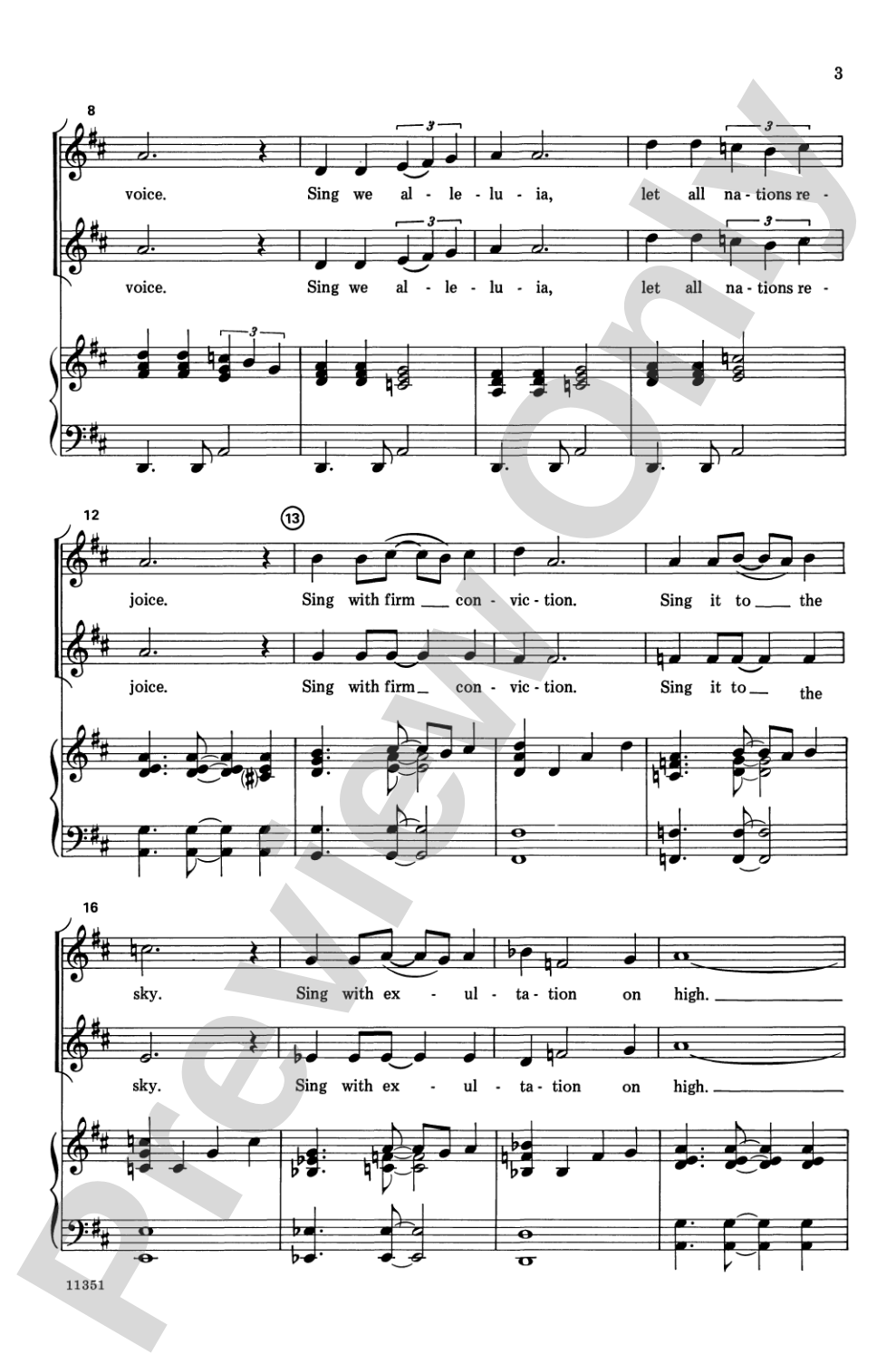
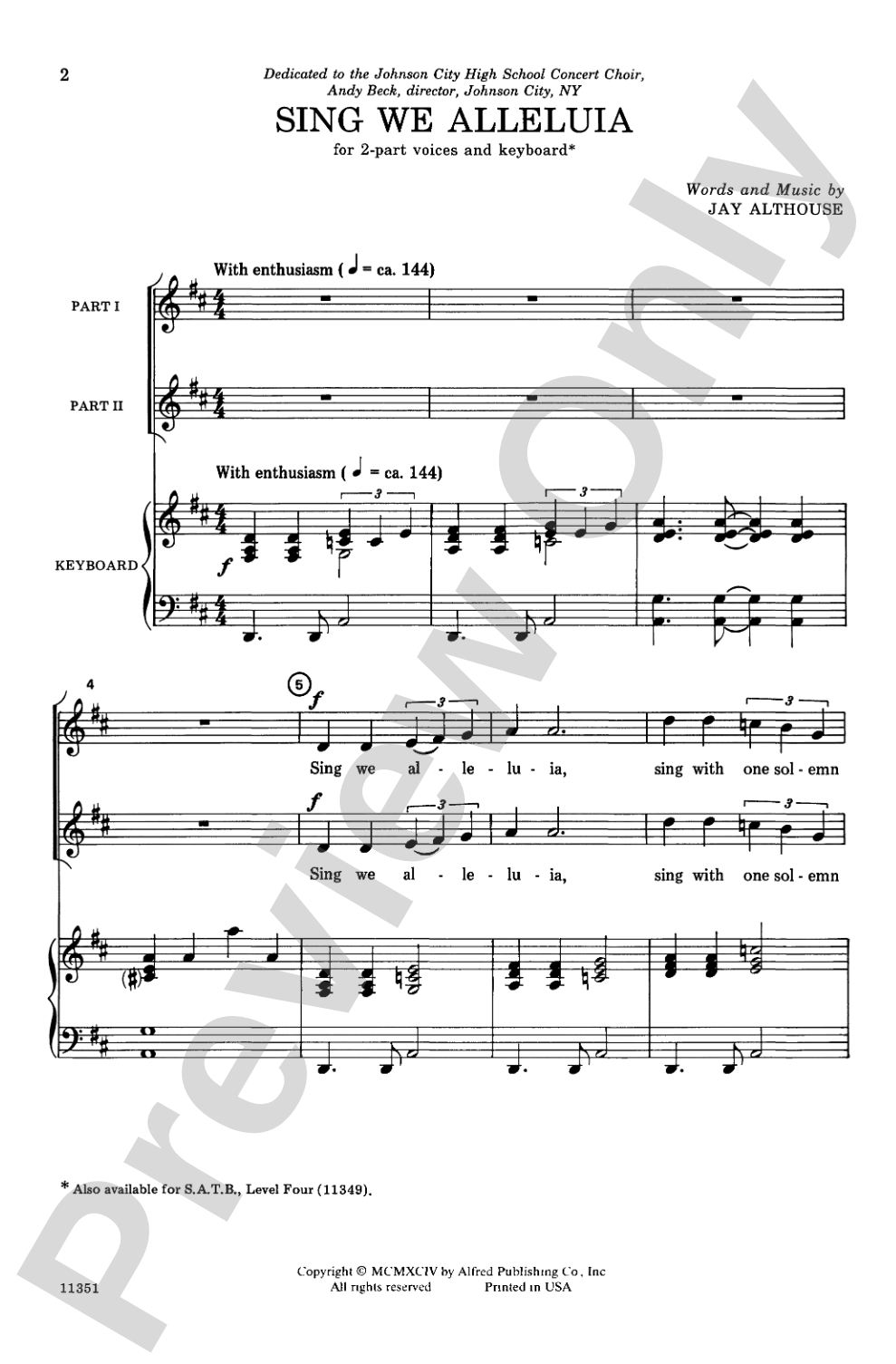
Sing We Alleluia Sheet Music Preview

Sing We Alleluia: 2-Part Choral Octavo

Music by Jay Althouse

Item: 00-PO-0003800

Digital Download
$2.25

Minimum order quantity: 20 copies

Description
With SING WE ALLELUIA, Jay Althouse continues his tradition of rhythmically exciting choral works, and this one has it all: an echo section (for easy teaching), a full-sounding homophonic section, and a contrasting, chant-like middle section. Use it any time of the year, including Christmas. Powerful!

Sing We Alleluia: 2-Part Choral Octavo isn't in MakeMusic Cloud just yet...but it could be. Let us know you'd like to see it, and you'll help shape what comes next. In the meantime, start a free trial and dive into thousands of interactive titles your students can play along with today.

Sample Audio
No sample audio found.
Sample Video
Additional Details
Series: Alfred Archive Edition: Alfred Choral Designs
Publisher: Alfred Music
Page Count: 12
SKU: 00-PO-0003800

More about this title

About the Composer: Jay Althouse

Jay Althouse

Jay Althouse holds degrees in Music Education and Music from Indiana University of Pennsylvania, where he was honored with the Distinguished Alumni award. His career spans eight years as a rights and licenses administrator for a major educational music publisher, during which he served on the Executive Board of the Music Publishers Association of America. As a composer, Althouse has created more than 800 choral works performed throughout the English-speaking world and maintains ASCAP membership with multiple Special Awards for his compositions.

Beyond composition, Althouse has co-written children's musicals with his wife Sally K. Albrecht, compiled vocal solo collections including Folk Songs for Solo Singers, and co-authored The Complete Choral Warm-up Book and Accent on Composers. His educational resources for classroom use include Ready to Read Music, Sixty Music Quizzes, and One-Page Composer Bios. His choral composition I Hear America Singing, co-written with Albrecht, was performed by the San Francisco Girls and Boys Choirs at President Barack Obama's inauguration in 2009. Althouse resides in Wake Forest, North Carolina, and serves on the National Advisory Board of the Folk Art Society of America.

Why we love this

Althouse's gift for structural clarity shines here: the echo section does the teaching work for you, letting singers internalize rhythmic energy without lengthy instruction. The piece moves between three distinctly different musical textures (echo, homophonic, and chant-like), which keeps singers engaged and gives you natural rehearsal divisions.

What to expect

The piece pulses with rhythmic vitality, especially in the echo and homophonic sections where voices lock into an infectious groove. The chant-like middle passage offers meditative contrast, creating a journey that feels complete and purposeful rather than episodic.

Who it's for

Directors working with developing or mid-level treble or mixed choirs will find this piece accessible yet substantial. The 2-part voicing keeps ranges comfortable while the varied musical sections challenge singers to shift between styles.

How to get the most out of it

  • Isolate the echo section in early rehearsals. Have one voice part sing the phrase full, then the other echo it back. This call-and-response builds confidence and rhythmic precision before combining both parts.
  • Shape the homophonic section with dynamic contrast. The full sound here is a payoff moment, so let it breathe and support the singers through the sustained notes.
  • Treat the chant-like middle section as a moment to recenter. This shift in texture and tempo gives your ensemble a natural breath and creates contrast that makes the return to rhythmic drive feel fresh.

How to use it

Program this during the winter season for Christmas concerts, or use it year-round as an energetic opener that captures attention immediately. Its flexibility and varied character make it equally effective as a standalone feature or as a bridge between more introspective and more celebratory pieces on your concert.

Skills your students will build

  • Echo singing and call-and-response precision
  • Rhythmic accuracy and ensemble lock in syncopated passages
  • Contrasting articulation and tone production across three distinct musical textures
  • Sustaining longer phrases in the homophonic section
  • Transition between rhythmic and chant-based vocal styles

You May Also Like