Sing Unto God Sheet Music Preview

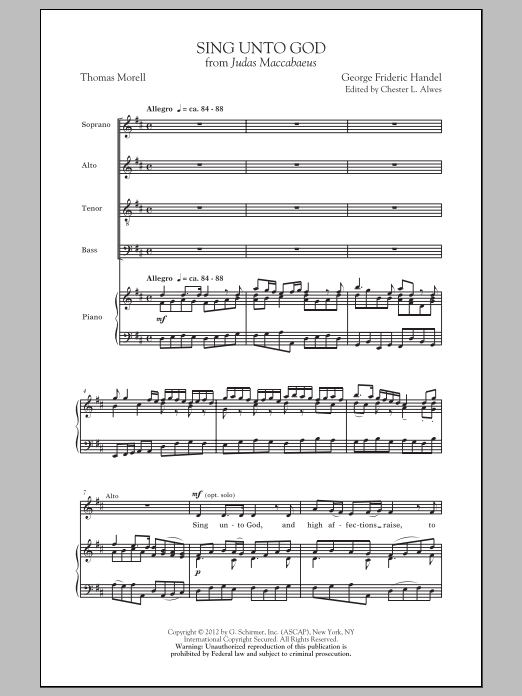
Sing Unto God: SATB Choral Octavo

By George Frideric Handel

Item: 35-DS00236482

Digital Download
$2.75
Description

Sing Unto God: SATB Choral Octavo isn't in MakeMusic Cloud just yet...but it could be. Let us know you'd like to see it, and you'll help shape what comes next. In the meantime, start a free trial and dive into thousands of interactive titles your students can play along with today.

Sample Audio
No sample audio found.
Sample Video
Additional Details
Publisher: Hal Leonard
Page Count: 12
SKU: 35-DS00236482

More about this title

About the Composer: George Frideric Handel

George Frideric Handel (1685-1759) was a master of both instrumental and vocal music whose career spanned the courts of Italy, Germany, and England. His sacred works, including anthems and oratorios, demonstrate his gift for setting English text with clarity and musical sophistication, blending Italian melodic sensibility with contrapuntal craft. Handel's music remains central to choral repertoire because of its accessibility, dramatic momentum, and the way it rewards both singers and listeners with memorable melody and purposeful harmony.

Why we love this

Handel's sacred writing sits at an ideal intersection: the piece feels substantial and refined without demanding excessive rehearsal time or technical fireworks. The text setting is transparent and speech-like, which means students connect quickly to the meaning, and the harmonic language is rich enough to hold a serious concert program alongside larger works.

What to expect

There is directness and warmth here, the kind of musical sincerity that comes from Handel's command of both dignity and accessibility. The piece unfolds with spacious melodic lines and clear harmonic motion, creating an impression of confident expression rather than ornamental display.

Who it's for

This octavo works for intermediate to advanced sacred choirs preparing for concert, festival, or contest contexts. It suits directors seeking material that builds choral craft while maintaining strong audience appeal and is substantial enough to anchor a program or frame a themed concert around Baroque sacred works.

How to get the most out of it

  • Establish the pulse early in rehearsal and anchor it with continuo or organ; Baroque rhythm should feel propulsive without rushing.
  • Shape phrases with clarity of intent rather than overdoing dynamics; Handel's text naturally suggests where musical momentum should peak.
  • Balance the voices to let the soprano line sing forward while maintaining warm, unified tone across all parts.
  • Mark breath points that align with the text's grammar, not arbitrary phrase lengths; this keeps the piece sounding conversational and alive.

How to use it

Position this as a centerpiece of a Baroque or sacred music concert, where it can anchor a set of shorter anthems or provide a moment of reflective weight. It also works well in a program that builds from Renaissance polyphony through the Baroque to later centuries, showing how text-setting and harmonic language evolved.

Skills your students will build

  • Singing with clarity in Baroque phrase structure
  • Managing part independence within homophonic texture
  • Connecting text meaning to musical shape and pacing
  • Balancing vowel consistency across a sustained melodic line
  • Executing clean, unified ensemble cutoffs

You May Also Like