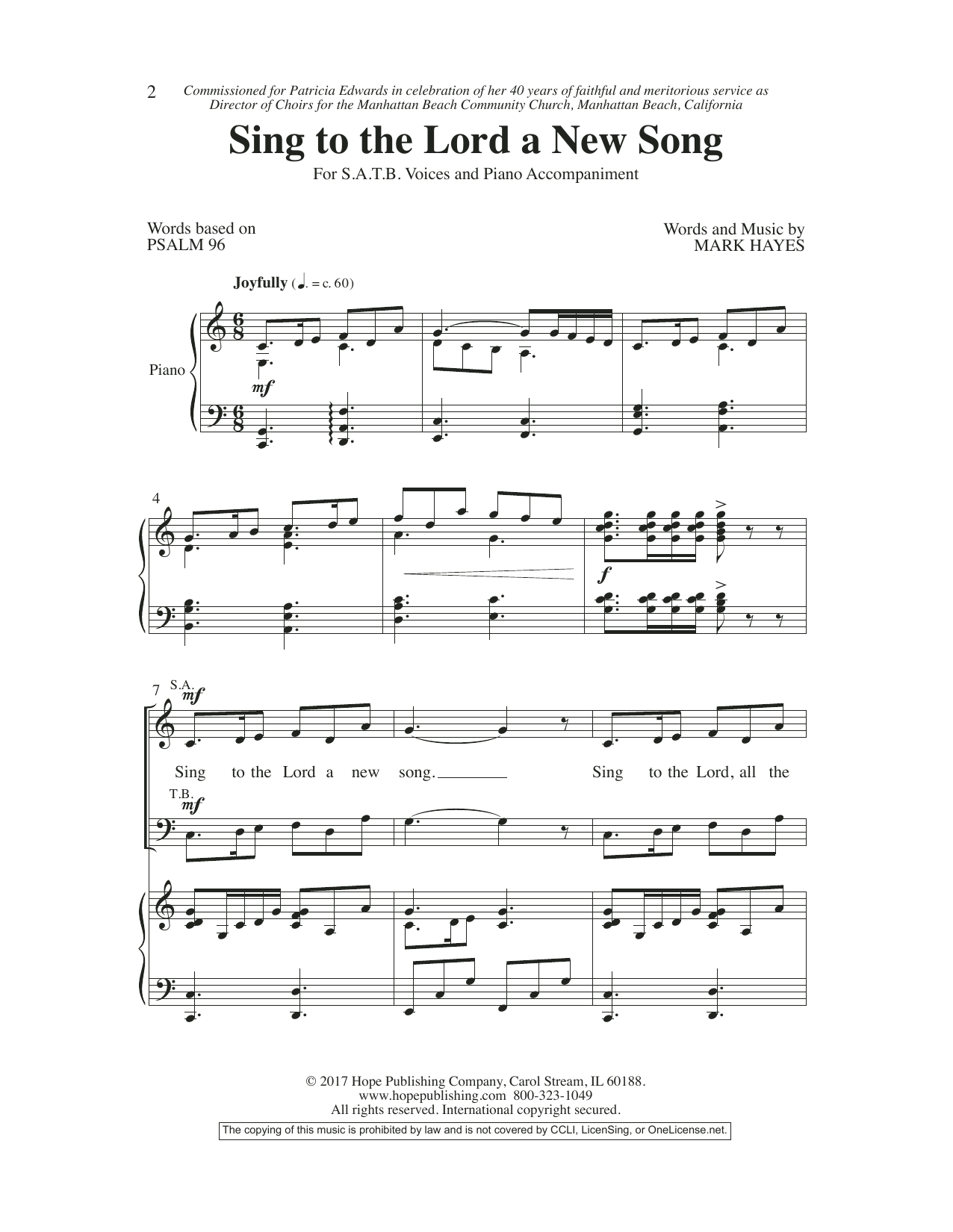
Sing To The Lord A New Song Sheet Music Preview

Sing To The Lord A New Song: SATB Choral Octavo

By Mark Hayes

Item: 35-DS00433827

Digital Download
$2.99
Description

Sing To The Lord A New Song: SATB Choral Octavo isn't in MakeMusic Cloud just yet...but it could be. Let us know you'd like to see it, and you'll help shape what comes next. In the meantime, start a free trial and dive into thousands of interactive titles your students can play along with today.

Sample Audio
No sample audio found.
Sample Video
Additional Details
Publisher: Hal Leonard
Page Count: 12
SKU: 35-DS00433827

More about this title

About the Composer: Mark Hayes

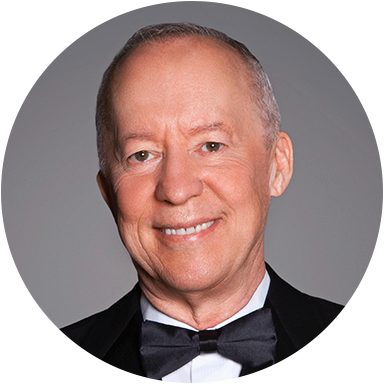
Mark Hayes

Mark Hayes stands among the most prolific composers in contemporary choral music, with over 1,750 published works spanning sacred, secular, and instrumental genres. A summa cum laude graduate in Piano Performance from Baylor University, he has conducted major venues including Lincoln Center, the National Cathedral, and Carnegie Hall, while premiering significant works like his Requiem at the Vatican as part of the Festival Pro Musica E Arte Sacra. Beyond his conducting engagements, Hayes maintains an expansive catalog of piano publications and has contributed orchestrations and musical direction to theatrical productions, earning recognition including the 2010 Award for Exemplary Leadership in Christian Music from his alma mater.

Based in Kansas City, Missouri, Hayes continues to balance a dual life as both performing artist and composer, concertizing internationally while maintaining active work at the piano and manuscript desk. His versatility across gospel, classical, jazz, and Broadway idioms reflects a composer whose gifts extend across virtually every musical style. For church and educational musicians, his sacred choral works represent some of the most singable and liturgically useful pieces in print today.

Why we love this

Hayes crafts sacred texts with an instinctive sense of how voices sit together; the writing feels natural from the first rehearsal without sacrificing harmonic sophistication. His arrangements of hymnic and biblical material consistently find that elusive middle ground where the piece sounds polished enough for concert performance yet remains accessible for volunteer choirs and collegiate singers alike.

What to expect

The piece carries the warmth and directness of contemporary sacred writing, with harmonies that feel modern without abandoning tonal grounding. There is an earnestness here, a sense that the text matters deeply and the music exists to serve the meaning of the words.

Who it's for

This octavo works well for volunteer church choirs, college and university treble or mixed ensembles, and semi-professional groups seeking repertoire that balances theological substance with musical accessibility. It suits both concert programs and liturgical settings where singers can prepare something dignified without requiring extensive rehearsal time.

How to get the most out of it

  • Balance the melodic interest across all four voices rather than featuring the soprano line exclusively; Hayes frequently distributes thematic material through the ensemble, and your sound opens considerably when each section owns its musical content.
  • Consider the text underlay carefully during rehearsals, as syllabic writing at faster tempos can blur diction if singers rush ahead of proper vowel formation.
  • Shape phrases by tracking the harmonic rhythm rather than relying on breath marks; this approach reveals the underlying musical architecture and prevents the piece from fragmenting into isolated measures.

How to use it

Position this as a centerpiece for a sacred choral concert or as a strong closing selection for a mixed repertoire program. Its 12 pages allow substantial musical development while remaining compact enough to fit alongside other works without overwhelming the concert arc, making it ideal for spring liturgical services or choral festivals where singers from multiple ensembles participate.

Skills your students will build

  • Reading and executing SATB voicing with clear part independence
  • Sustaining phrase length and musical direction across contemporary harmonic language
  • Text expression in sacred music and matching textual emphasis to harmonic movement
  • Intonation in four-part writing, particularly at chord changes
  • Collaborative listening and blend within a mixed ensemble

You May Also Like