

Sing Out with Joy!: 2-Part Choral Octavo
Music by Sally K. Albrecht
Item: 00-PO-0004453
$2.25
Minimum order quantity: 20 copies
Pickup currently not available
Related Items
Sing Out with Joy!: 2-Part Choral Octavo |
$2.25
|
View |
Description
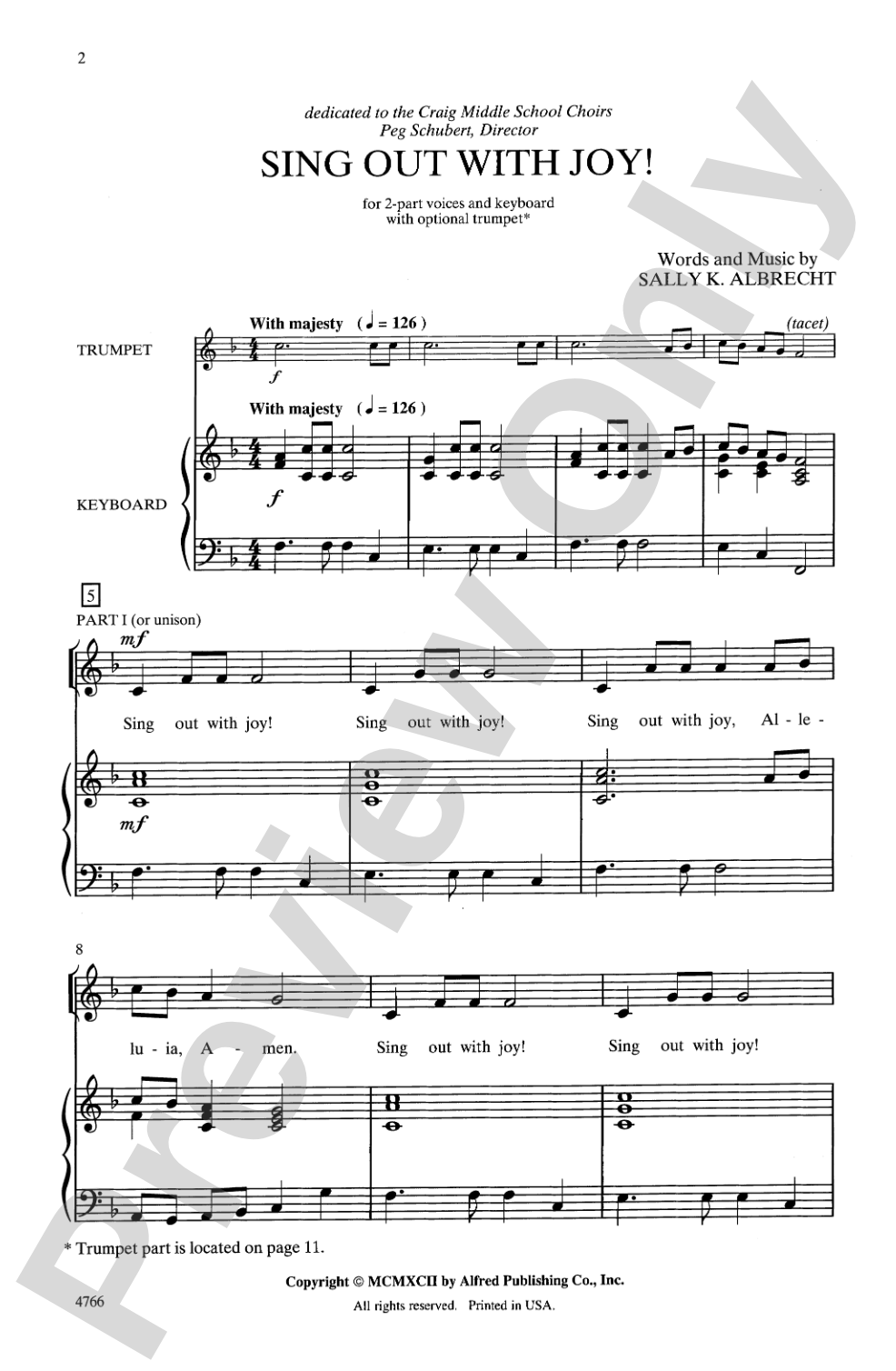
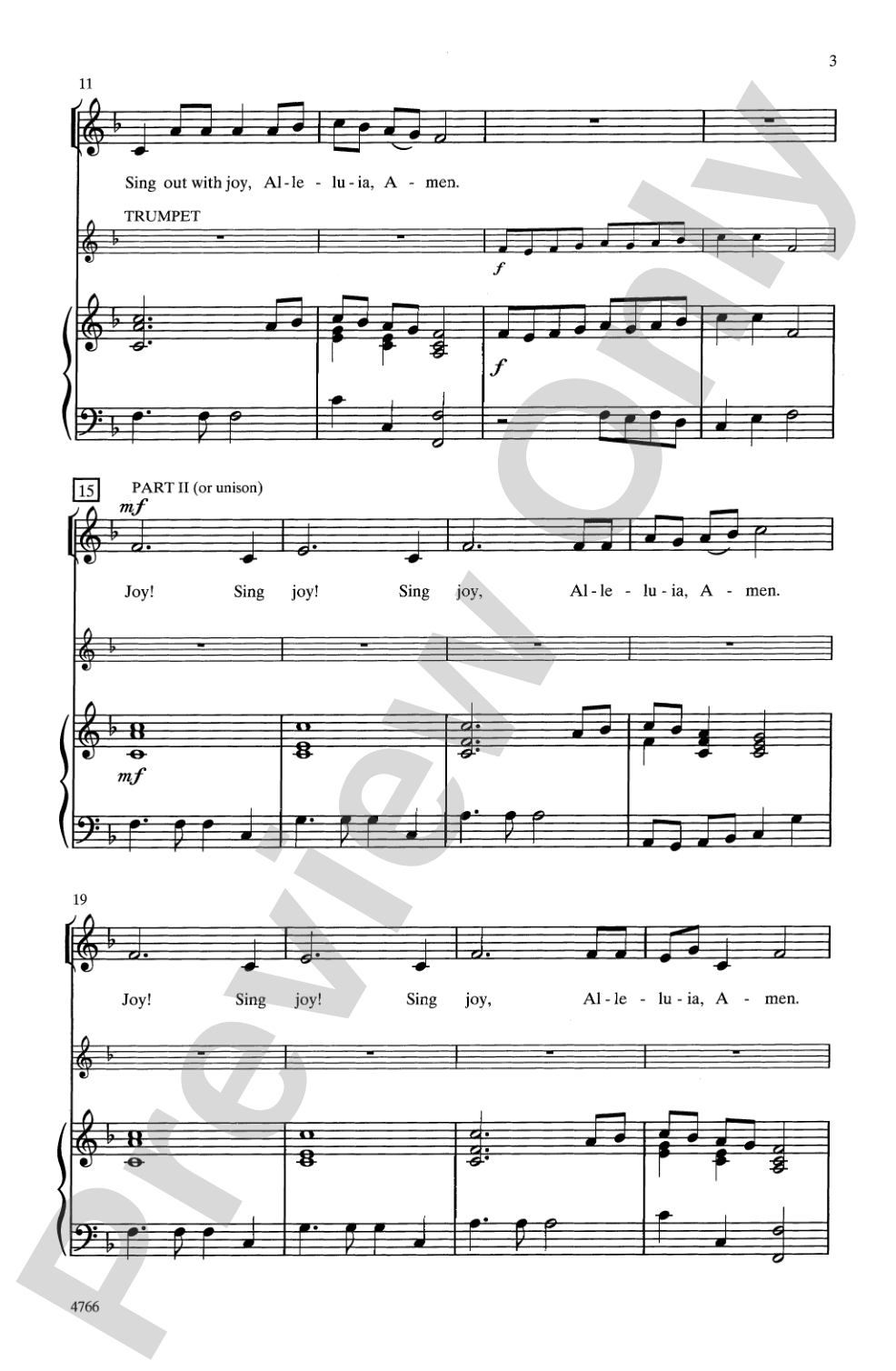
Another fine 2-part concert number from Sally Albrecht. The partner-song format is ideal for young singers. Lots of text repetition makes it easy to teach and an optional descant and trumpet part make it full-sounding. A wonderful educational piece for young and developing choirs. Optional Christmas text is included.


Sing Out with Joy!: 2-Part Choral Octavo isn't in MakeMusic Cloud just yet...but it could be. Let us know you'd like to see it, and you'll help shape what comes next. In the meantime, start a free trial and dive into thousands of interactive titles your students can play along with today.
Request This Title
Tell us you want it.
Start Your Free Trial
Explore everything that's ready to play right now.
Sample Audio
1
Audio File
--:--
0:00
0:00
Sample Video
No sample videos found.
Additional Details
Series:
Alfred Archive Edition: Alfred Choral Designs
Publisher:
Alfred Music
Page Count:
12
SKU:
00-PO-0004453
Instrumentation:
Opt. Trumpet
More about this title
About the Composer: Sally K. Albrecht

Sally K. Albrecht has shaped choral music education for decades through her prolific output and leadership in the field. Since receiving the ASCAP Special Music Award annually since 1987, she has published over 600 choral works alongside 75 larger musicals and songbooks. Her conducting experience spans prestigious venues including Lincoln Center, Carnegie Hall, and The Kennedy Center, where she has led honor choirs and festival events nationwide.
Albrecht's career has centered on making quality choral music accessible to young singers. She served as Director of School Choral, Vocal, and Elementary Publications for Alfred Music and earlier publishers, directly shaping what students across the country sing in rehearsal. Her academic background includes degrees from Rollins College (B.A. in Music and Theater, 1976) and the University of Miami (M.A. in Drama, 1977; M.M. in Accompanying, 1979). She has taught at Oakland University, Jersey City State College, and Meredith College and currently resides in Wake Forest, North Carolina with her husband, composer and arranger Jay Althouse.
Why we love this
Albrecht's gift for the partner-song format shines here. Two independent melodic lines moving together create textural richness without overwhelming developing singers, and the text repetition means less time spent on learning notes and more time building interpretation. The optional descant and trumpet part let you expand the sound as your ensemble grows, making this piece work for multiple year's worth of choirs at different levels.
What to expect
Sing Out with Joy radiates warmth and accessibility. The partner-song structure creates a conversational, almost call-and-response quality that feels natural to sing, while the text repetition builds momentum and encourages genuine expression rather than complicated interpretation.
Who it's for
Young and developing choirs benefit most from this piece. The 2-part voicing and abundant text repetition make it manageable for singers still building sight-reading and part-singing skills, while the optional descant and trumpet part allow advanced ensembles or older choirs to perform it with added sophistication.
How to get the most out of it
- Highlight the independence of each voice part during rehearsal by having singers initially learn their own line without the other part. This builds confidence and clarity before bringing them together.
- Use the optional trumpet part in performance to anchor the descant and add brightness to the final sections, even if the part doubles one of the vocal lines.
- Experiment with dynamics between the two parts. The partner-song format invites call-and-response energy; explore moments where one line steps forward while the other accompanies underneath.
- If adding the Christmas text, rehearse both versions separately before deciding on performance. The flexibility keeps the piece relevant beyond the holiday season.
How to use it
Position this as a centerpiece for holiday concerts or spring choral festivals where younger singers need a well-crafted feature. It also works beautifully as a confidence builder early in the rehearsal year, letting newer singers experience the satisfaction of singing in parts without the technical demands of more complex literature.
Skills your students will build
- Singing in two independent parts while maintaining awareness of other voices
- Reading from a score with optional instrumental parts
- Sustaining long phrases with consistent breath support
- Following text repetition as a tool for rhythmic and melodic clarity