
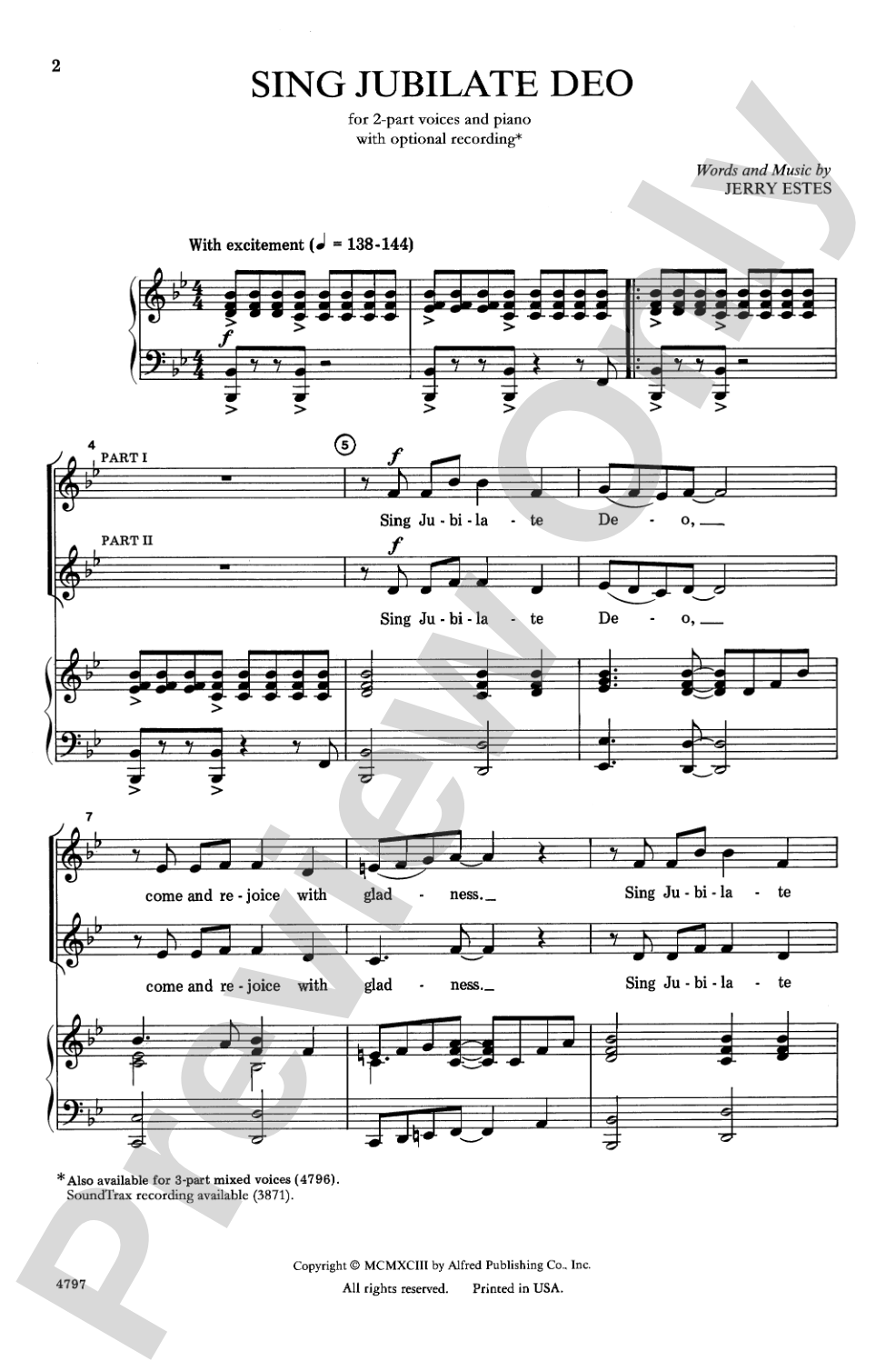
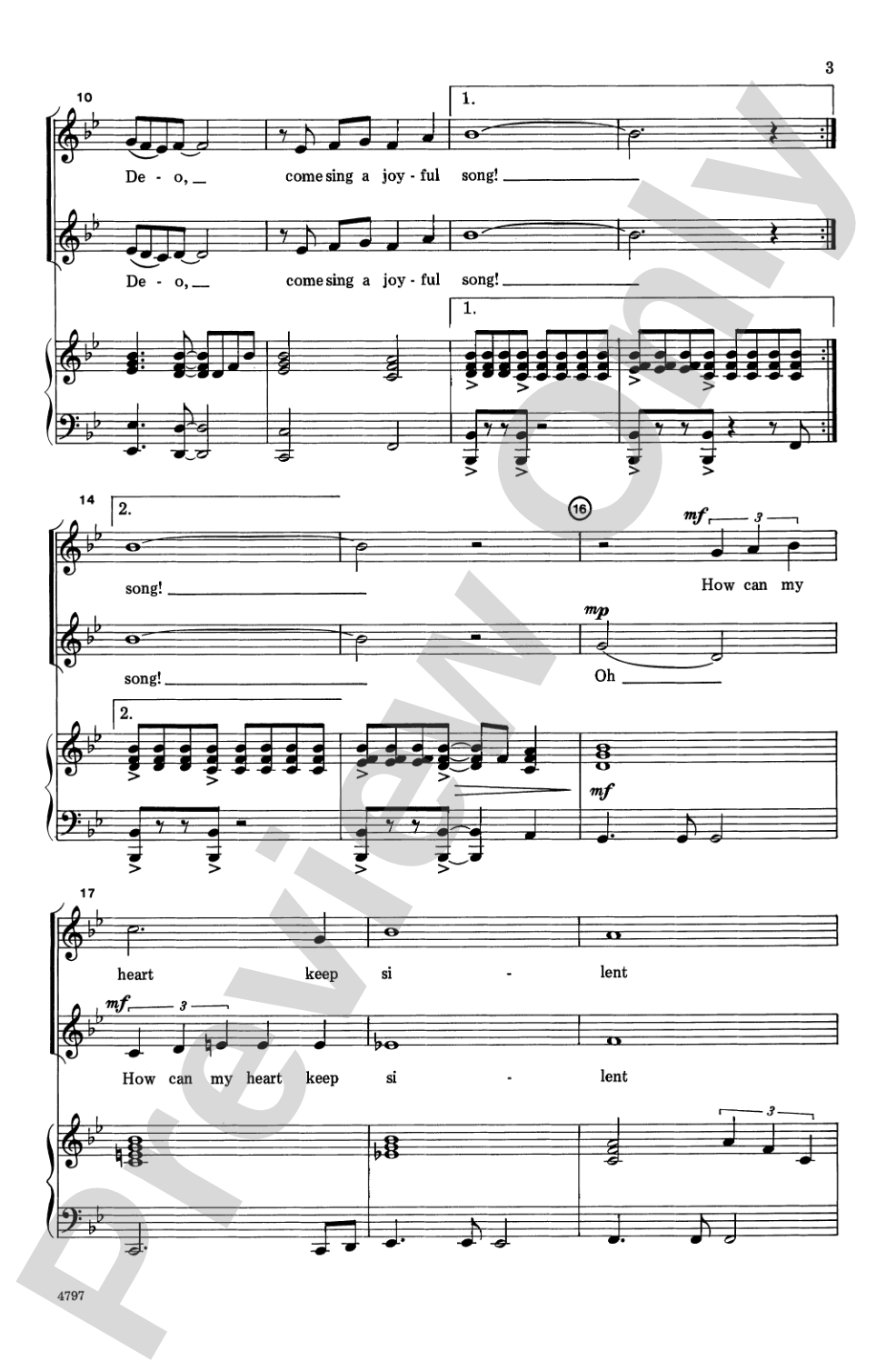

Sing Jubilate Deo: 2-Part Choral Octavo
Music by Jerry Estes
Item: 00-PO-0002460
$2.25
Minimum order quantity: 20 copies
Pickup currently not available
Description
A driving, supportive piano part makes this a great choice for 2 and 3-part choirs. Easy to learn, yet exciting to sing. The text mixes the Latin phrase "Jubilate Deo" with a fresh, new English lyric. Very accessible for growing choirs. SoundTrax cassette features brass and timpani for a "concert hall" sound. For general or Christmas use.


Sing Jubilate Deo: 2-Part Choral Octavo isn't in MakeMusic Cloud just yet...but it could be. Let us know you'd like to see it, and you'll help shape what comes next. In the meantime, start a free trial and dive into thousands of interactive titles your students can play along with today.
Request This Title
Tell us you want it.
Start Your Free Trial
Explore everything that's ready to play right now.
Sample Audio
No sample audio found.
Sample Video
No sample videos found.
Additional Details
Series:
Alfred Archive Edition: Alfred Choral Designs
Publisher:
Alfred Music
Page Count:
8
SKU:
00-PO-0002460
More about this title
About the Composer: Jerry Estes

Jerry Estes brings classroom experience and formal training to his work as a composer. He holds degrees in vocal music education from Southwest Baptist University (B.M.E.) and Southern Illinois University (M.M.), grounding his compositional voice in pedagogical practice. As a vocal music educator at the middle school level, Estes understands the developmental needs and capabilities of young singers.
Active in music education organizations including MENC and ASCAP, Estes has built a catalog of accessible choral works that balance musicality with sincerity. His compositions reflect his daily work mentoring emerging vocalists, evident in writing that challenges singers without overwhelming them.
Why we love this
Estes structures this piece to succeed with exactly the singers you have right now. The driving piano part carries the harmonic weight, freeing your developing vocalists to focus on text clarity and ensemble blend rather than part independence. That mix of Latin and English text gives the piece liturgical weight while keeping it contemporary and singable.
What to expect
The driving piano energy lifts the piece beyond stillness while the text fusion of "Jubilate Deo" and fresh English creates a joyful, celebratory character. Singers experience the support of a strong harmonic foundation, which builds confidence and allows them to focus on expressive singing rather than survival.
Who it's for
This octavo works best for choirs at the 2-part to early 3-part stage, particularly middle school ensembles or community choirs with mixed experience levels. Directors seeking accessible sacred repertoire with genuine musical content will find Estes's writing appropriate for singers who are still developing musicianship foundations.
How to get the most out of it
- Emphasize the rhythmic precision of the piano accompaniment in rehearsal. Have pianists lock in with your conductor's tempo before adding voices, then layer singers in gradually so they feel supported rather than chasing the part.
- Shape the phrase arcs by having singers sustain the longer note values on "Jubilate Deo" to let the Latin text shine. English phrases can move more conversationally.
- If using the recorded accompaniment with brass and timpani, balance vocal volume carefully in the early rehearsals so singers can hear themselves establishing the melody line.
How to use it
Program this as an energetic standalone number in a concert setting where you want to showcase your choir's growing capability without programming a major work. It works equally well in a sacred or Christmas concert context, giving you flexibility in seasonal programming and adding a festive lift to the second half of a program.
Skills your students will build
- Singing and sustaining diatonic melodies with accurate intervals
- Blend and balance in a 2-part texture with supportive accompaniment
- Text projection across two languages (Latin and English) within a single phrase
- Following and responding to piano accompaniment rather than conductor alone