
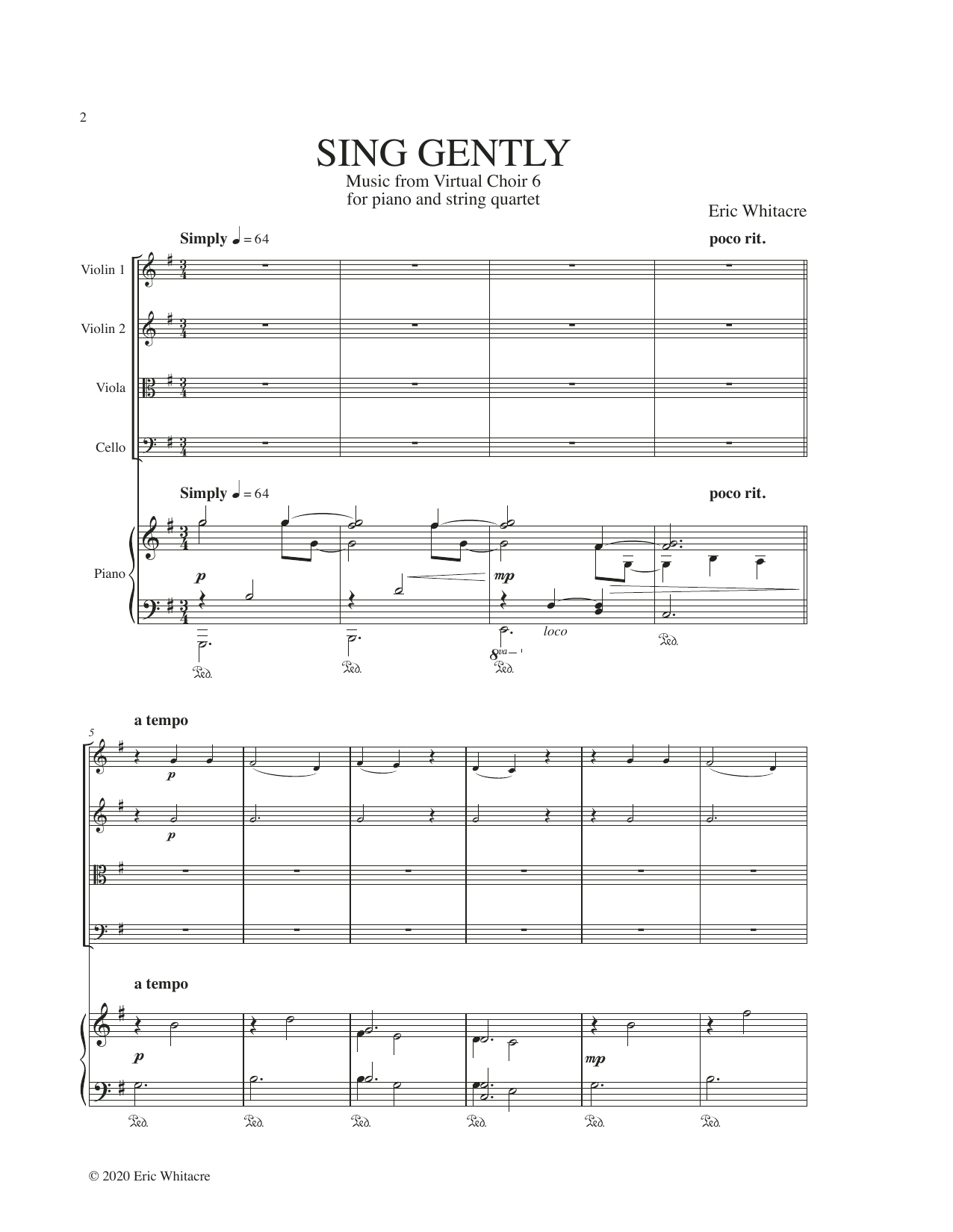

Sing Gently (for Piano Quintet)
By Eric Whitacre
Item: 35-PK01130134
$14.99
Pickup currently not available
Buy Extra Parts (Digital PDF Download)
| Product | Price | Quantity |
|---|---|---|
| Sing Gently (for Piano Quintet) - Full Score | $14.99 | |
| Sing Gently (for Piano Quintet) - Violin 1 | $14.99 | |
| Sing Gently (for Piano Quintet) - Violin 2 | $14.99 | |
| Sing Gently (for Piano Quintet) - Viola | $14.99 | |
| Sing Gently (for Piano Quintet) - Cello | $14.99 |
Parts Added to Cart!
Description
Sing Gently was written by Eric Whitacre in response to the 2020 global pandemic. Originally written for choir piano, he adapted the work for string quartet and piano to create the soundtrack to the Virtual Choir 6 film credits.


Discover MakeMusic Cloud: thousands of interactive titles your students can play along with today.
Sample Audio
No sample audio found.
Sample Video
Additional Details
Publisher:
Hal Leonard
SKU:
35-PK01130134
More about this title
About the Composer: Eric Whitacre
Eric Whitacre has shaped contemporary choral music through his distinctive harmonic language and innovative approach to ensemble writing. His works for choir, orchestra, and chamber ensemble consistently prioritize accessibility without sacrificing artistic depth, making him a trusted voice in music education and concert programming.
Why we love this
Whitacre's response to collective grief and isolation speaks directly to why we program music in the first place. The arrangement for string quartet and piano maintains the intimate, meditative quality of the original while adding textural richness that keeps performers engaged across multiple rehearsals and performances.
What to expect
The piece carries quiet introspection and gentle affirmation. Whitacre's harmonic vocabulary creates moments of unexpected warmth within a contemplative context, evoking a sense of shared human resilience without sentimentality.
Who it's for
String quartet and piano ensembles seeking repertoire that honors contemporary classical aesthetics without extreme technical demands. This works equally well for chamber musicians exploring recent concert music or for programs pairing traditional and modern works.
How to get the most out of it
- Balance the melodic line between strings and piano; the writing asks the accompaniment to support rather than compete, but its presence should feel substantial and intentional.
- Approach phrase endings with restraint. Whitacre's compositional voice thrives on understated emotional clarity rather than dramatic gesture.
- Allow silence and space to breathe. The piece's power comes from what is heard and what is not.
How to use it
Position this as a reflective midpoint in a chamber music recital or as a closing work that leaves audiences in thoughtful silence. It pairs naturally with early Romantic era chamber works or with other contemporary pieces that value clarity and restraint.
Skills your students will build
- Ensemble balance in mixed timbral contexts (strings and piano)
- Sustaining long melodic phrases with consistent tone and intonation
- Interpreting minimalist harmonic language and subtle harmonic movement
- Collaborative listening and response to textural roles