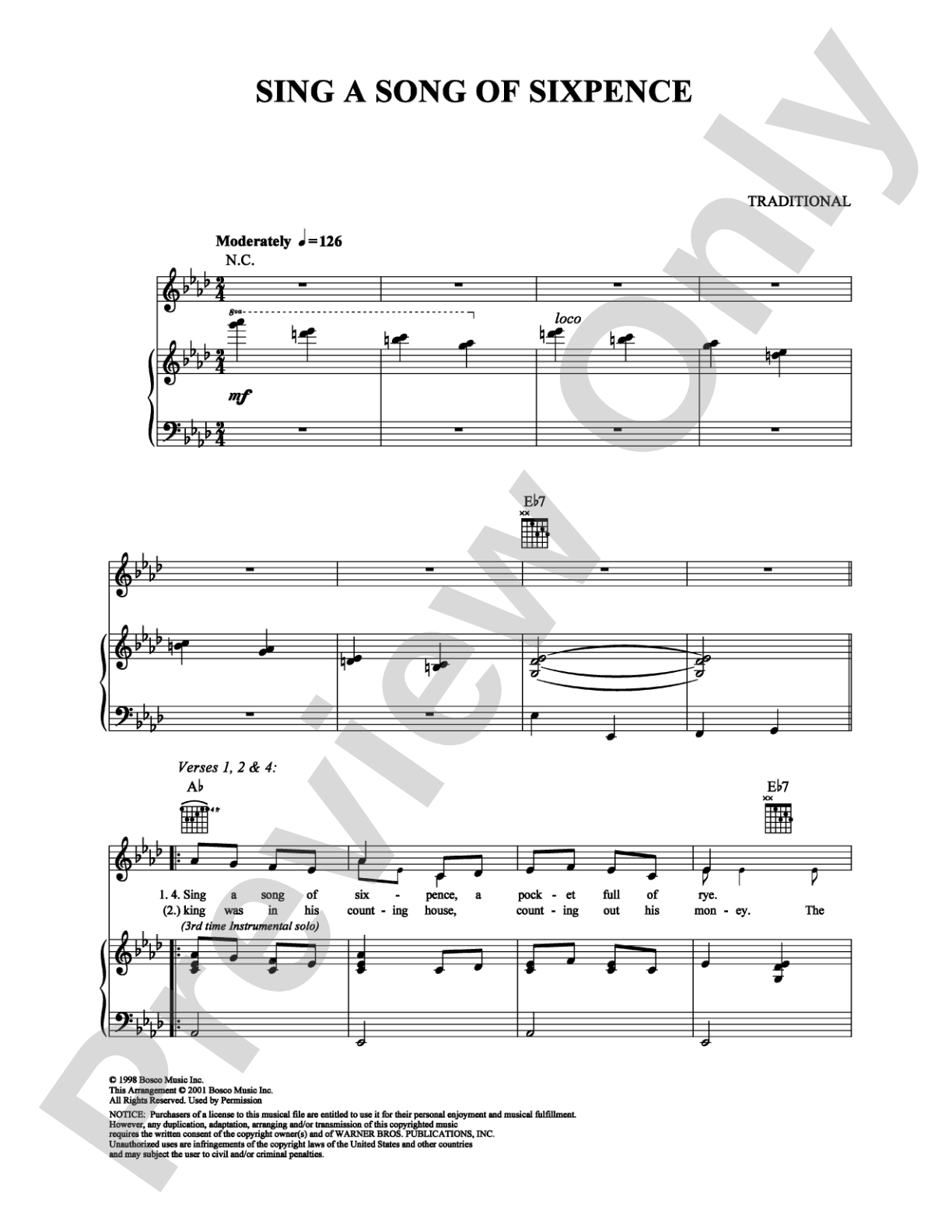
Sing a Song of Sixpence: Piano/Vocal/Chords Digital Sheet Music

Sing a Song of Sixpence: Piano/Vocal/Chords Digital Sheet Music

Traditional

Item: 00-PS-0006555

Digital Download
$3.99
Description

Sing a Song of Sixpence: Piano/Vocal/Chords Digital Sheet Music isn't in MakeMusic Cloud just yet...but it could be. Let us know you'd like to see it, and you'll help shape what comes next. In the meantime, start a free trial and dive into thousands of interactive titles your students can play along with today.

Sample Audio
No sample audio found.
Sample Video
Additional Details
SKU: 00-PS-0006555

More about this title

Why we love this

This traditional nursery rhyme works beautifully as a piano/vocal arrangement, offering accessibility for young singers and pianists while maintaining genuine musicality. The inclusion of chord symbols makes it immediately playable for guitarists or keyboard players learning accompaniment skills, and it's a natural fit for early music programs, storytelling recitals, or themed concerts celebrating folk traditions.

What to expect

There's an infectious, almost music-box quality to this nursery rhyme that captures childhood wonder. The simplicity of the melody allows singers to focus on clear phrasing and character, while the harmonic framework invites pianists to find their own interpretive voice through rhythmic and stylistic choices.

Who it's for

This digital sheet music serves young pianists and singers preparing their first vocal/instrumental duets, as well as classroom teachers and private instructors looking for accessible, culturally familiar repertoire. It's equally useful for adult hobbyists discovering new accompaniment material or singers building a collection of traditional songs.

How to get the most out of it

  • Let the vocal line sit naturally over the piano accompaniment; the melody should never fight for attention with dense keyboard textures.
  • Use the chord symbols to experiment with different accompaniment styles: a simple folk-style block chord approach works just as well as a more elaborate broken-chord pattern.
  • Pay attention to diction in the text to keep the song's playful character intact, especially on repeated phrases.
  • Consider the age and range of your vocalist; this melody sits well for young voices but can be effectively sung across different voice types with minor transposition.

How to use it

Include this in a program celebrating family concert traditions, early childhood music education, or international folk repertoire. It works well as a gentle opener before more substantial pieces, or as part of a storytelling sequence that draws on nursery rhyme literature.

Skills your students will build

  • Singing over harmonic accompaniment
  • Reading chord symbols and choosing appropriate voicings
  • Balancing vocal and piano parts dynamically
  • Text clarity and characterization in folk repertoire
  • Transposition and key awareness

You May Also Like