
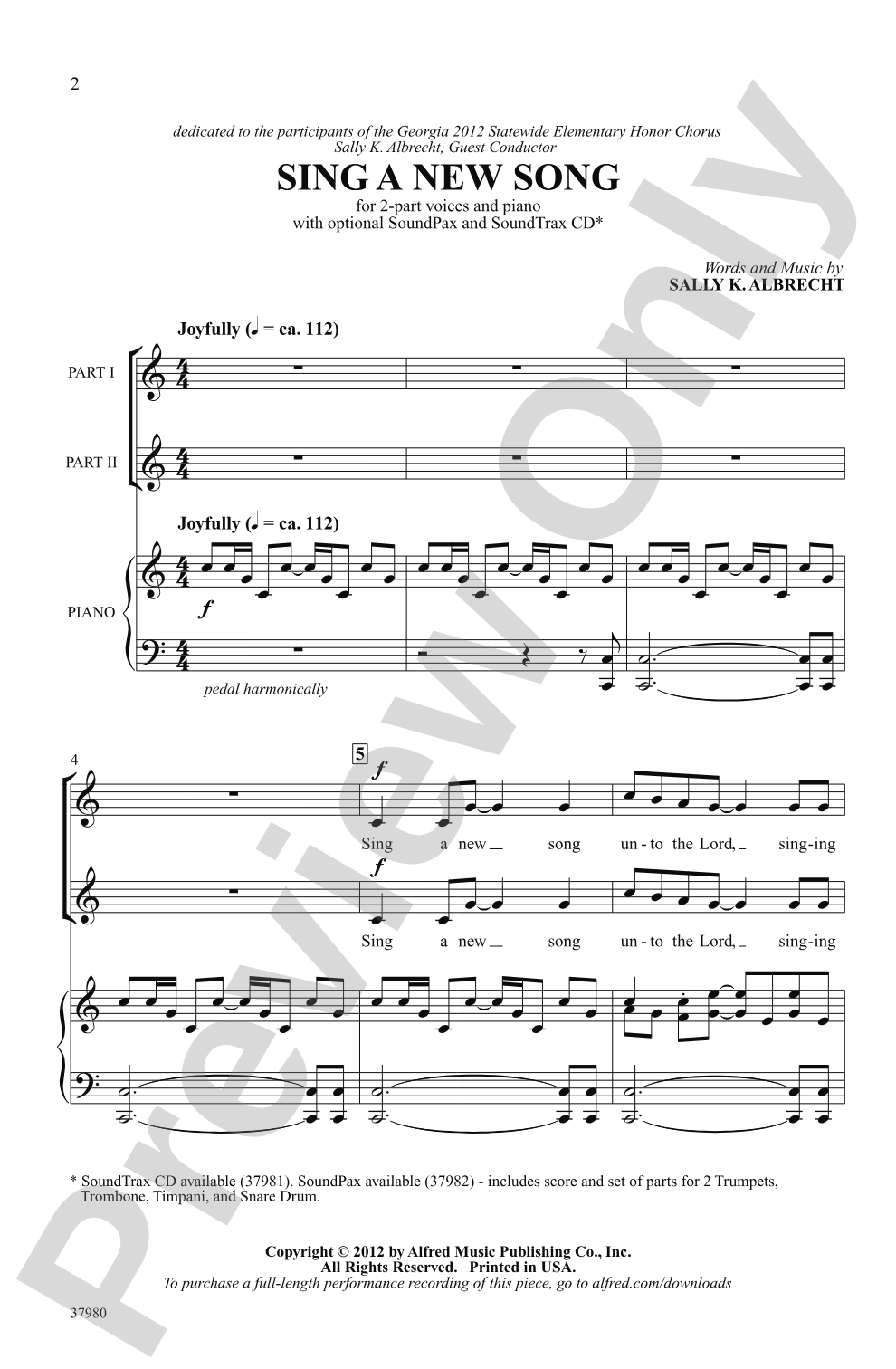

Sing a New Song: 2-Part Choral Octavo
Words and music by Sally K. Albrecht
Item: 00-PO-0001314
$1.80
Minimum order quantity: 20 copies
Pickup currently not available
Description
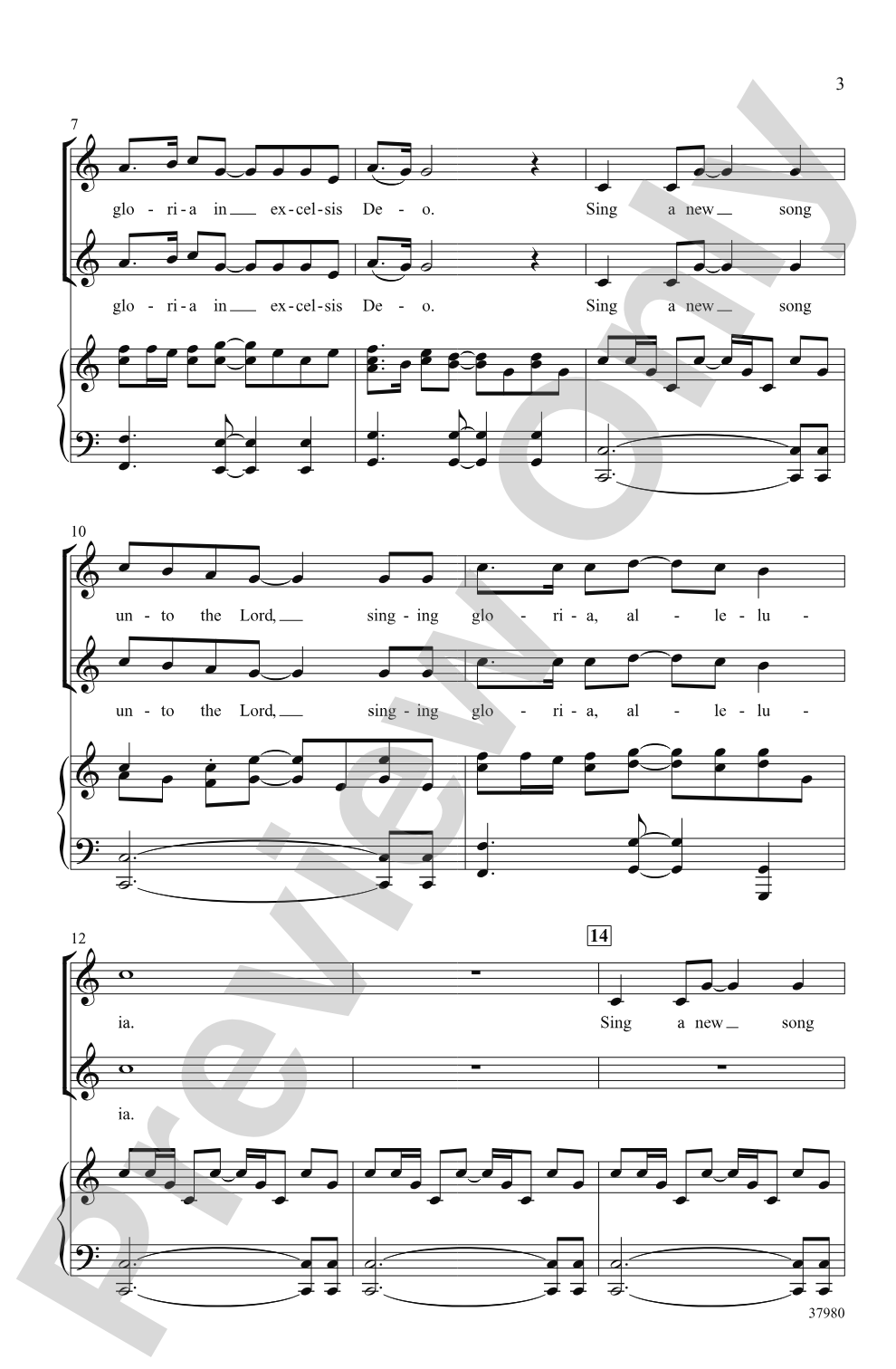
This rhythmic song of joy will be easy to assemble for general or holiday concerts, school or church. Written with vocal echoes, a counterpoint "Cantate Domino" section, and a mixture of Latin and English texts.


Sing a New Song: 2-Part Choral Octavo isn't in MakeMusic Cloud just yet...but it could be. Let us know you'd like to see it, and you'll help shape what comes next. In the meantime, start a free trial and dive into thousands of interactive titles your students can play along with today.
Request This Title
Tell us you want it.
Start Your Free Trial
Explore everything that's ready to play right now.
Sample Audio
1
Audio File
--:--
0:00
0:00
Sample Video
No sample videos found.
Additional Details
Series:
Alfred Choral Designs
Publisher:
Alfred Music
Page Count:
12
SKU:
00-PO-0001314
More about this title
About the Composer: Sally K. Albrecht

Sally K. Albrecht has shaped choral music education for over three decades, serving as Director of School Choral, Vocal, and Elementary Publications at major educational publishers, including her tenure at Alfred Music. A conductor and clinician renowned for integrating movement into choral performance, she has led honor choirs at prestigious venues including Lincoln Center, Carnegie Hall, and The Kennedy Center. Since 1987, she has received the ASCAP Special Music Award annually, with more than 600 choral publications and 75 songbooks and musicals currently in print.
Albrecht holds a B.A. in Music and Theater from Rollins College (1976) and both an M.A. in Drama and an M.M. in Accompanying from the University of Miami. She has taught in music departments at Oakland University, Jersey City State College, and Meredith College. Her leadership extends beyond composition; she served as Chair of the Board of Trustees for the Omicron Delta Kappa National Leadership Honor Society and received their "Pillar of Leadership" award. In 2021, she was honored with the Distinguished Alumna Award from both the University of Miami Frost School of Music and Rollins College, where she serves on the Board of Trustees.
Why we love this
Albrecht writes with real understanding of what makes two-part singing feel satisfying rather than thin. The vocal echoes and "Cantate Domino" counterpoint section give singers something engaging to do while remaining accessible, and the blend of Latin and English text creates natural variation that keeps both the singers and audience interested throughout.
What to expect
Bright and celebratory, with a modern rhythmic sensibility that keeps the energy moving. The interplay between echoing sections and the layered counterpoint creates texture and interest despite the limited voicing, while the sacred text grounds everything in genuine purpose.
Who it's for
General or church choirs seeking a joyful, rhythmically engaging piece that doesn't demand extensive rehearsal time. The two-part voicing makes it ideal for developing singers, mixed-age ensembles, or any group looking for a concert work that feels fresh without overshadowing other repertoire on the program.
How to get the most out of it
- Balance the vocal echoes so the responding part is clearly heard but doesn't overshadow the initial phrase; this teaches precision in entrances without requiring aggressive singing.
- In the "Cantate Domino" counterpoint section, have singers mark where their line intersects with the other part so they can hear the independence required and lock in to the harmonic structure.
- Use the recorded accompaniment to establish the rhythmic energy early in rehearsal; this piece thrives on forward motion, and the recording models the intended tempo and style effectively.
- Highlight the text transitions between Latin and English; singers will engage more deeply when they understand what they're singing and can communicate that shift to the audience.
How to use it
This works beautifully as an opening or closing number for holiday or sacred concerts, setting an uplifting tone without requiring elaborate staging. Its moderate length and accessibility make it an excellent choice for a spring or early fall program where you're building ensemble confidence alongside more substantial works.
Skills your students will build
- Singing independent melodic lines in two-part counterpoint
- Executing rhythmic precision in call-and-response textures
- Sight-reading mixed English and Latin texts
- Listening for and balancing with another vocal line while maintaining forward momentum