
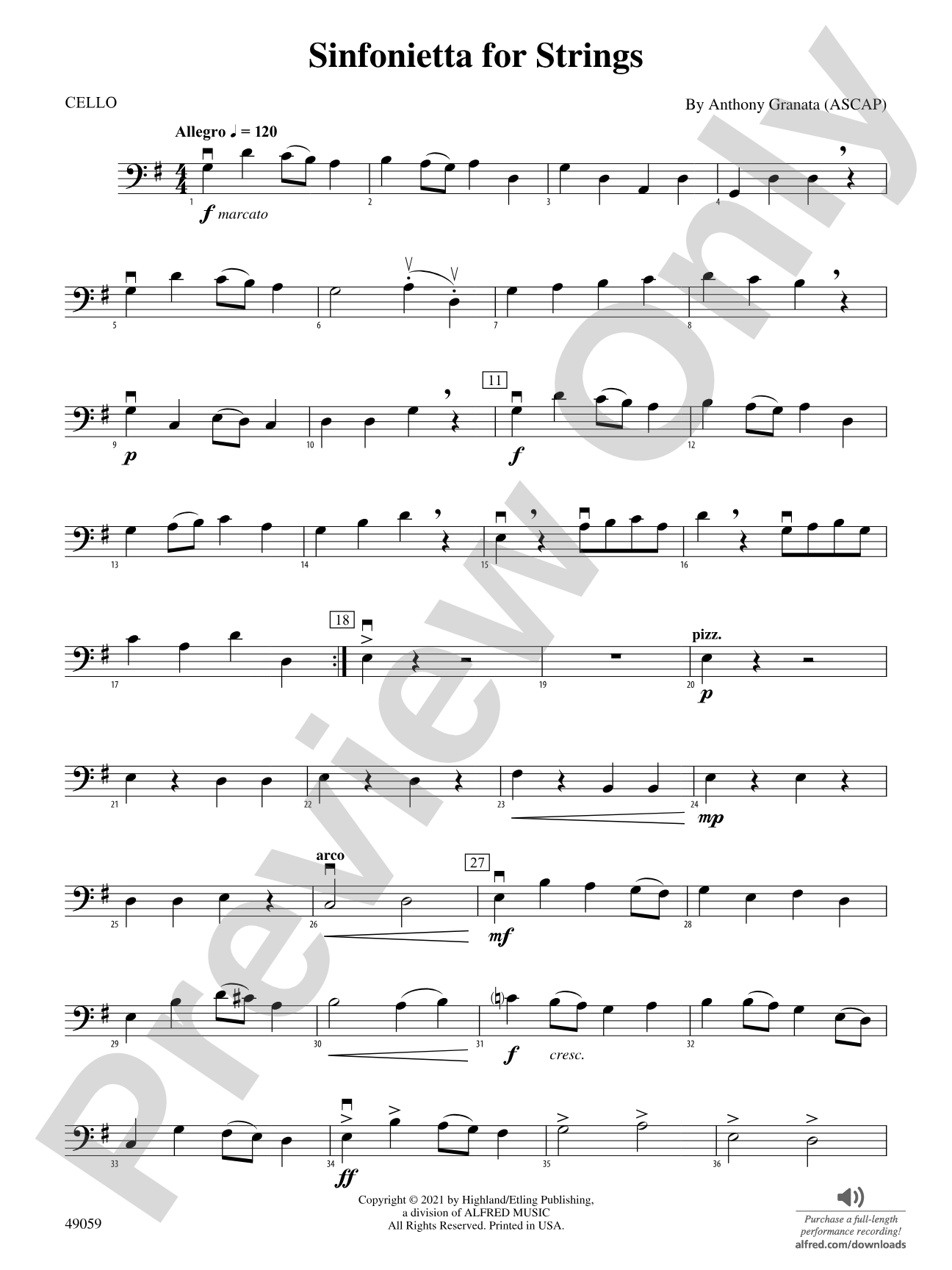

Sinfonietta for Strings: Cello
By Anthony Granata
Grade: 2
Item: 00-PC-0018657_VC1
$3.00
Pickup currently not available
Description
Written specially to help young players gain confidence and build upon their beginning playing abilities, Sinfonietta for Strings by Anthony Granata echoes the composition style of the classical period. A Sinfonietta is a smaller and lighter version of the symphony. Set in the key of G major, students will love the broad and vigorous unison opening, the sudden change to E minor, and the mixture of dialogue and easy counterpoint interwoven throughout the piece. This piece will help your students develop skills in proper right-hand bow facility, simple slur and bowing patterns, common rhythms, identification of accidentals, and use of dynamics to achieve a very strong and dramatic sound. (3:05) This title is available in MakeMusic Cloud.


Don't just read it, hear it, play along with it, and watch your students grow with it. In MakeMusic Cloud, Sinfonietta for Strings: Cello comes alive with professional accompaniment, adjustable tempo, and built-in practice tools that turn solo practice into real progress.
Open in the Player
Jump straight in and assign it today.
Start Your Free Trial
Open this title and explore the full library in minutes.
Sample Audio
1
Audio File
--:--
0:00
0:00
Sample Video
Additional Details
Series:
Highland/Etling String Orchestra
Publisher:
Alfred Music
Page Count:
74
SKU:
00-PC-0018657_VC1
More about this title
About the Composer: Anthony Granata

Anthony Granata teaches middle school orchestra in Westport, Connecticut, and is an accomplished violist who performs regularly. He studied at Western Connecticut State University and has worked across elementary, middle, and high school settings teaching band, chorus, and orchestra. His own string education came through the Norwalk public school music program, giving him deep roots in public school music advocacy.
Granata began composing at age twelve and returned to writing music after focusing on his teaching career. His recent work concentrates on pieces that address specific pedagogical challenges his young string players face. He is currently pursuing a degree in school administration while maintaining his teaching practice.
Why we love this
This piece respects the classical period's architectural clarity while meeting young players exactly where they are. The sudden key change from G major to E minor keeps students engaged and models how composers use contrast to hold attention, making it ideal for festival programming that needs both substance and accessibility.
What to expect
Confident and bright in its opening G major section, with energetic unison playing that lets every student feel like they're part of something grand. The turn toward E minor brings introspection and lighter orchestration, creating a satisfying emotional arc that holds attention while remaining playable by developing musicians.
Who it's for
Beginning to early intermediate string orchestras (Grade 2) looking for repertoire that builds bow control and rhythmic confidence without overwhelming young players. Directors seeking contest or festival programming will appreciate the three-minute timeframe and the combination of technical challenge with musical narrative.
How to get the most out of it
- Shape the opening unison passage with unanimous weight on the downbeat and gradual diminuendo through the phrase; young orchestras often rush when playing in unison, so consistent bow direction and synchronized releases are your anchors.
- Isolate the dialogue sections in sectional rehearsals before combining voices; students need to hear their melodic line clearly before negotiating when another part enters.
- Address the accidentals in the E minor section by highlighting them visually in parts and reviewing them in context before full rehearsal; context sticks better than isolated theory.
- Use dynamic contrast to clarify form; the shift from forte unison to softer counterpoint should feel like opening a different door, not stumbling into one.
How to use it
Pair this with a lighter work or a baroque arrangement as the anchor piece of a concert themed around form and key relationships; its classical period echoes make a natural bridge between baroque and romantic selections. The three-minute length fits neatly into youth orchestra or school orchestra concerts where balanced programming matters, and its festival-appropriate difficulty makes it valuable for competitions early in the season.
Skills your students will build
- Unified bow technique and right-hand facility across the entire section
- Slur execution and basic bowing pattern consistency
- Recognition and intonation of accidental notes (sharps and naturals in context)
- Dynamic shaping to clarify musical phrases and emotional intent
- Part independence when moving between unison and contrapuntal textures
- Reading and response to key signature changes mid-piece