
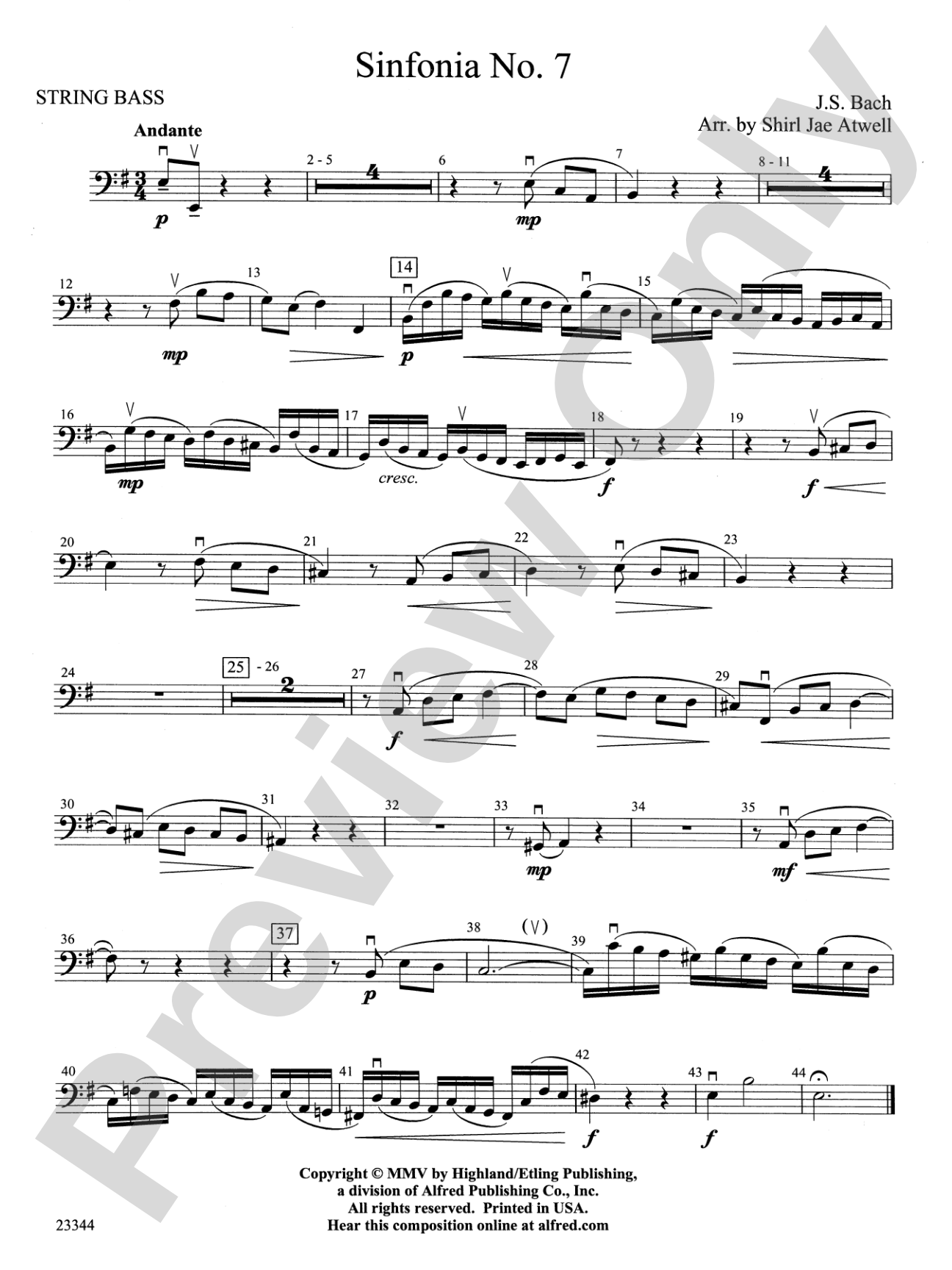

Sinfonia No. 7: String Bass
By Johann Sebastian Bach / arr. Shirl Jae Atwell
Grade: 4
Item: 00-PC-0000689_SB
$5.99
Pickup currently not available
Description
J. S. Bach's "Sinfonia in E minor" is the seventh 3-part invention from the Clavier-Büchlein, a music instruction book Bach devised for his eldest son, Wilhelm Friedemann. This challenging yet satisfying work will make a great addition to your next concert.


Don't just read it, hear it, play along with it, and watch your students grow with it. In MakeMusic Cloud, Sinfonia No. 7: String Bass comes alive with professional accompaniment, adjustable tempo, and built-in practice tools that turn solo practice into real progress.
Open in the Player
Jump straight in and assign it today.
Start Your Free Trial
Open this title and explore the full library in minutes.
Sample Audio
1
Audio File
--:--
0:00
0:00
Sample Video
No sample videos found.
Additional Details
Series:
Highland/Etling String Orchestra
Publisher:
Alfred Music
Page Count:
62
SKU:
00-PC-0000689_SB
More about this title
About the Composer: Johann Sebastian Bach
Johann Sebastian Bach (1685-1750) stands as one of history's most prolific and influential composers, creating works across nearly every Baroque genre except opera. His output spans over 1,000 compositions, from intimate keyboard works to monumental choral cycles, all distinguished by rigorous counterpoint and harmonic depth. Bach's pedagogical works, particularly the Clavier-Büchlein and the Well-Tempered Clavier, were designed to train young musicians in both technique and musical thinking, making them enduring resources for music education.
The Clavier-Büchlein, compiled around 1720 for his eldest son Wilhelm Friedemann, contains the three-part inventions that Bach used to develop his students' understanding of voice independence and fugal writing. These compact yet sophisticated works demonstrate that Bach's teaching materials were never simplified; they ask students to engage with the same compositional principles that governed his grandest works.
Why we love this
Shirl Jae Atwell's orchestration transforms Bach's three-part invention into a satisfying concert work without compromising the composer's intellectual rigor. The arrangement honors Bach's counterpoint while giving string players the chance to navigate genuine part-writing, making this a genuine repertoire choice rather than a filler piece. At Grade 4, it strikes that rare balance between technical demand and musical substance that keeps orchestras engaged through rehearsal and audiences engaged in performance.
What to expect
E minor lends this invention a searching, introspective quality characteristic of Bach's minor-key keyboard works. The three-part texture creates constant dialogue among the voices, producing an almost conversational energy that builds naturally across the piece without dramatic gesture. It is music that rewards close listening and careful playing, revealing new contrapuntal details with each rehearsal.
Who it's for
String orchestras at the intermediate-advanced level seeking Baroque repertoire that develops genuine musicianship without compromise. Conductors programming chamber-scale works or who want to introduce students to Bach's pedagogical approach will find this arrangement particularly valuable. It suits orchestras preparing for festival competition or concert programming that highlights classical mastery.
How to get the most out of it
- Maintain absolute rhythmic precision in the sixteenth-note figures; this music's elegance depends on clarity rather than rubato. Use the conductor score to establish exact tempos with the ensemble before sectionals.
- Balance the three independent lines by rotating which section carries the primary melodic material. Remind students that each part supports the whole, not just fills in harmony.
- Pay particular attention to the bass line in lower strings. It often moves in contrary motion to the upper voices, and clarity here prevents harmonic muddiness.
- Shape phrases through subtle dynamic shaping rather than abrupt changes. The E minor tonality has inherent gravity; allow it to speak without overstatement.
How to use it
Place this early in a concert to establish the evening's musical foundation, or pair it with other Baroque works to create thematic programming. It works equally well as a pre-concerto opener or as part of a composer retrospective. The 62-page score and parts suggest a substantial rehearsal commitment, making it suitable for mid-season programming when sectional work is already established.
Skills your students will build
- Reading three independent, equally important voice parts simultaneously
- Maintaining rhythmic precision in sixteenth-note figurations across an ensemble
- Understanding contrary motion and voice independence in Baroque texture
- Balancing ensemble sound when all parts carry musical weight
- Phrasing and shaping Baroque counterpoint without modern rubato
- Sight-reading Bach's contrapuntal writing