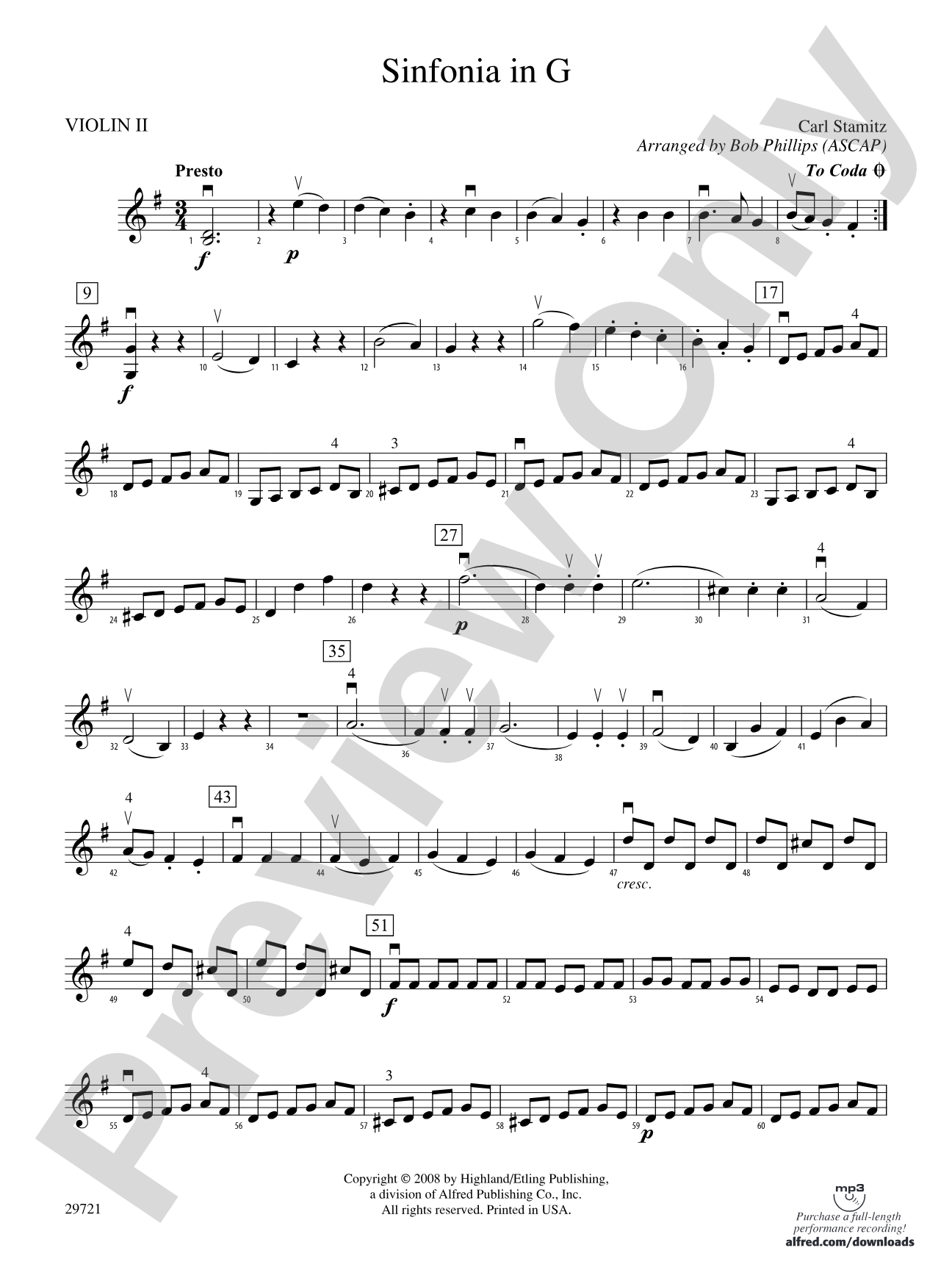
Sinfonia in G: 2nd Violin Sheet Music Preview

Sinfonia in G: 2nd Violin

Arr. Bob Phillips

Grade: 2.5

Item: 00-PC-0001574_VN2

Digital Download
$5.99
Description
A fantastic introduction to symphonic literature for young players, the rhythmic signature of Stamitz will make this a favorite of students and audience alike. Perfect for reinforcing technical skills while developing musicianship in the setting of the Classical period. (3:00) This title is available in MakeMusic Cloud.

Don't just read it, hear it, play along with it, and watch your students grow with it. In MakeMusic Cloud, Sinfonia in G: 2nd Violin comes alive with professional accompaniment, adjustable tempo, and built-in practice tools that turn solo practice into real progress.

Sample Audio
0:00
0:00
Sample Video
Additional Details
Series: Highland/Etling String Orchestra
Publisher: Alfred Music
Page Count: 124
SKU: 00-PC-0001574_VN2

More about this title

About the Arranger: Bob Phillips

Bob Phillips

Bob Phillips has spent his career reimagining how strings can engage young musicians with substantive repertoire. A conductor, pedagogue, and prolific composer, he built a string program in Saline, Michigan that grew to over 700 students and became a national model for both classical and contemporary music education. His work extends across 25+ published series, from Sound Innovations to his genre-spanning Philharmonic collections (Jazz, Rock, Mariachi, Latin, and Fiddlers), demonstrating his conviction that strings deserve access to living, varied musical traditions.

Phillips has conducted at every major honor orchestra in America, served as resident conductor and arranger for the Wintergrass Festival in Seattle for 12 years, and directed the internationally recognized Saline Fiddlers Philharmonic. His arrangements and original works appear regularly at the Midwest Clinic, and he has been recognized as an ASCAP award-winning composer. His String Clinics to Go instructional DVDs have shaped teaching practices in thousands of schools.

Why we love this

Phillips has arranged this Classical gem with acute awareness of what young string players can achieve musically without overwhelming them technically. The rhythmic profile and melodic shape of Stamitz shine through while remaining accessible at Grade 2.5, making it ideal for contests and concerts where you want substance without struggle.

What to expect

This Sinfonia breathes with the clarity and poise of the Classical era. Simple but elegant melodies unfold over transparent harmonies, giving young musicians the satisfaction of playing something that sounds grown-up while remaining within their grasp.

Who it's for

String orchestra directors working with young players at the intermediate level who want to introduce authentic Classical literature without sacrificing accessibility. This arrangement serves students ready to expand beyond exercise books into genuine symphonic repertoire while still building fundamental ensemble skills.

How to get the most out of it

  • Shape the main theme in Stamitz's idiom by allowing the melody to breathe; avoid rushing through the characteristic rhythmic motives that give the work its character.
  • Balance the inner voices carefully so that harmonic movement supports rather than obscures the primary melodic line; this is where musicianship begins to develop.
  • Use the three-minute span to teach ensemble listening: younger players can focus on staying together in a longer work when the material is transparent and well-orchestrated.

How to use it

Place this on a concert dedicated to Classical period composers, or pair it with other Grade 2.5 works to demonstrate stylistic variety within student-accessible repertoire. Its three-minute length makes it an excellent centerpiece for a competition set or a dignified opener for a spring concert.

Skills your students will build

  • Phrasing and expression within the Classical idiom
  • Rhythmic precision with Stamitz's characteristic motives
  • Ensemble balance and transparent voicing
  • Sustaining focus through a three-minute multi-section work
  • Recognition of period style conventions

You May Also Like