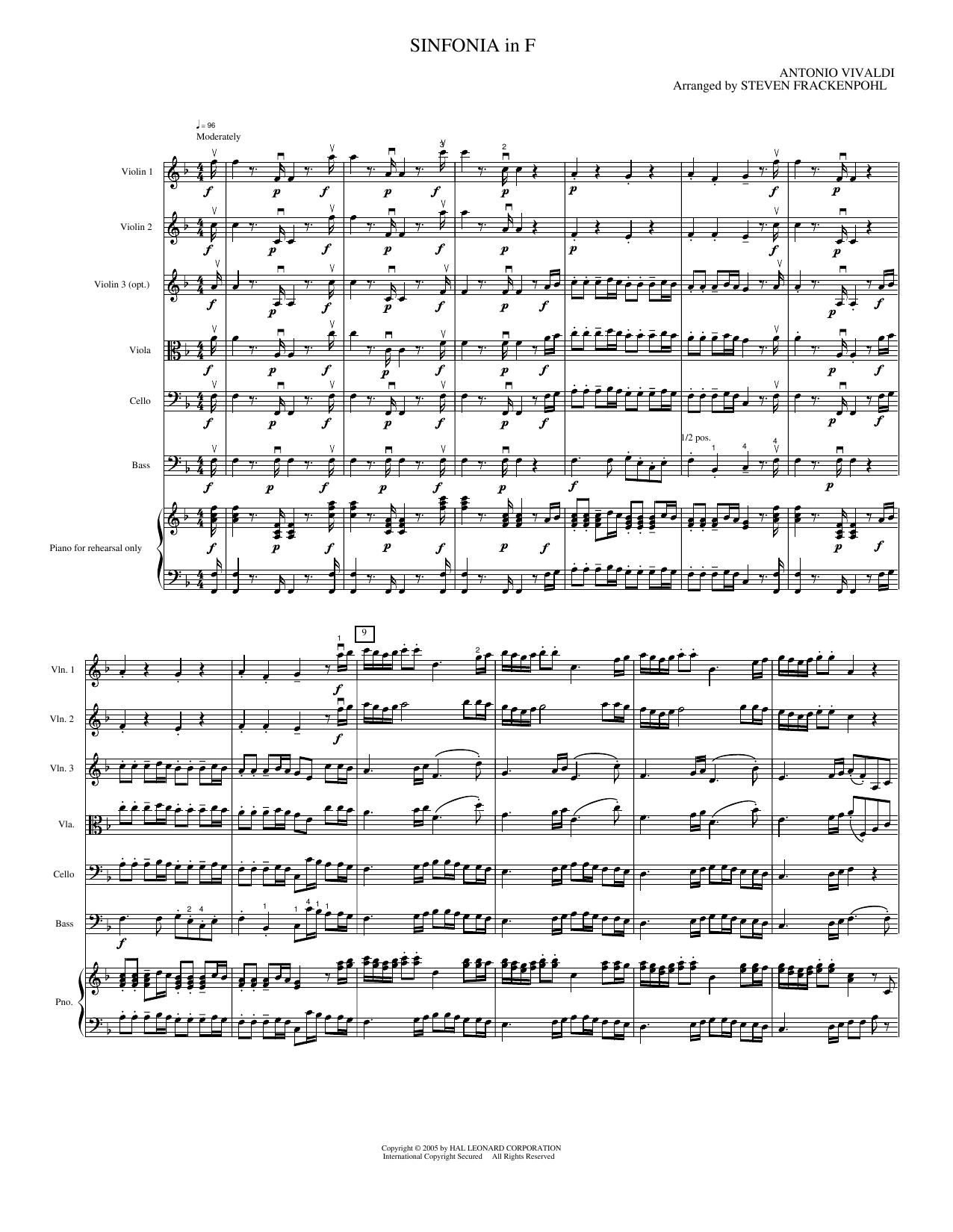
Sinfonia in F Sheet Music Preview

Sinfonia in F: String Orchestra Conductor Score & Parts

By Antonio Vivaldi / Arranged by Steven Frackenpohl

Grade: 3-4

Item: 35-PK00426663

Digital Download
$40.00

Buy Extra Parts (Digital PDF Download)

Product Price Quantity
Sinfonia in F - Full Score $40.00

Parts Added to Cart!

Description
Sinfonia in F

Sinfonia in F: String Orchestra Conductor Score & Parts isn't in MakeMusic Cloud just yet...but it could be. Let us know you'd like to see it, and you'll help shape what comes next. In the meantime, start a free trial and dive into thousands of interactive titles your students can play along with today.

Sample Audio
No sample audio found.
Sample Video
Additional Details
Publisher: Hal Leonard
SKU: 35-PK00426663

More about this title

About the Composer: Antonio Vivaldi

Antonio Vivaldi (1678–1741) shaped the concerto grosso and solo concerto into forms that defined the Baroque era. A virtuoso violinist and prolific composer, he wrote over 500 works across nearly every genre, yet remained grounded in pedagogy; much of his output emerged from teaching at the Ospedale della Pietà in Venice, where he composed for talented young musicians. His influence on instrumental writing remains foundational to music education because he understood how to write idiomatically for players at every level.

Vivaldi's orchestral sinfonias occupy a distinctive middle ground between overture and symphony. These three-movement works showcase the clarity and architectural logic that made his music essential to composers across Europe. String orchestras continue to gravitate toward his sinfonias because they balance musical substance with accessibility.

Why we love this

Frackenpohl's arrangement unlocks Vivaldi's transparent orchestration for string players who are ready to tackle real repertoire but not yet seasoned enough for unedited Baroque scores. The Grade 3–4 scoring maintains harmonic integrity while solving practical problems: reasonable string ranges, cues that prevent section letdowns, and a texture that breathes. Directors appreciate this because it lets younger ensembles experience the architecture of a genuine three-movement work.

What to expect

Sunlit and direct. The opening fastmovement breathes with the crisp energy of the Venetian streets, and the harmonic language is clean enough to stay transparent even at full orchestra. The slow movement softens into genuine lyricism, creating contrast without drama, before the finale snaps back into focus with purposeful forward momentum.

Who it's for

String orchestras transitioning from simplified arrangements to authentic Baroque repertoire. This works equally well for festival preparation or concert programming when you need a substantial yet rehearsal-efficient work. Directors seeking to build student awareness of multi-movement form will find the sinfonia's straightforward three-movement structure perfectly pedagogical.

How to get the most out of it

  • Shape the opening theme with gentle direction rather than driving it forward; Baroque phrasing lives in the architecture of the line itself, not in aggressive articulation.
  • Balance inner voices carefully during the slower middle movement. This is where students learn that accompaniment requires as much attention as melody.
  • Keep the finale moving with rhythmic clarity but avoid rushing; the articulation in the eighth-note figures should feel sprightly without losing definition.
  • Use the parts to identify which sections carry the harmonic weight in each movement, then rehearse those lines first to establish the foundation.

How to use it

Pair this with other short Baroque works to create a coherent thematic concert, or use it as a festival selection that demonstrates both technical progress and musical maturity. Placed early in a spring concert program, it establishes sophistication without exhausting the ensemble's energy reserves for larger works that follow.

Skills your students will build

  • Reading Baroque articulation and phrasing conventions
  • Balancing melody against sustained harmonic accompaniment
  • Maintaining rhythmic precision in faster passagework across three connected movements
  • Listening for transparency in multi-voice textures
  • Interpreting period-appropriate ornamentation and style markers

You May Also Like