
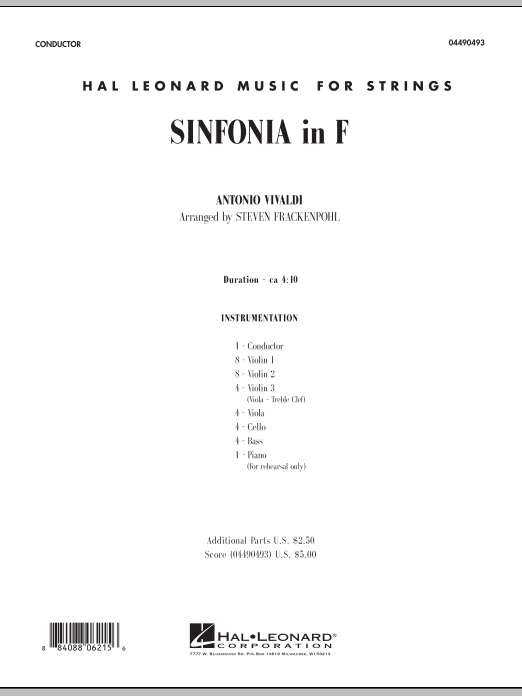

Sinfonia In F: String Orchestra Conductor Score & Parts
By Antonio Vivaldi / Arranged by Steven Frackenpohl
Grade: 3-4
Item: 35-PK00143761
$40.00
Pickup currently not available
Buy Extra Parts (Digital PDF Download)
| Product | Price | Quantity |
|---|---|---|
| Sinfonia In F - Conductor Score (Full Score) | $6.00 | |
| Sinfonia In F - Violin 1 | $7.00 | |
| Sinfonia In F - Violin 2 | $7.00 | |
| Sinfonia In F - Violin 3 (Viola T.C.) | $7.00 | |
| Sinfonia In F - Viola | $7.00 | |
| Sinfonia In F - Cello | $7.00 | |
| Sinfonia In F - String Bass | $7.00 | |
| Sinfonia In F - Piano | $7.00 |
Parts Added to Cart!
Description
Arranger Steven Frackenpohl brings us another outstanding teaching and performance piece for string orchestra with this superb movement from Vivaldi. The well-designed part writing for each section gives ample teaching material in the time-tested tradition of the grand Baroque style. Dur: 4:10


Sinfonia In F: String Orchestra Conductor Score & Parts isn't in MakeMusic Cloud just yet...but it could be. Let us know you'd like to see it, and you'll help shape what comes next. In the meantime, start a free trial and dive into thousands of interactive titles your students can play along with today.
Request This Title
Tell us you want it.
Start Your Free Trial
Explore everything that's ready to play right now.
Sample Audio
No sample audio found.
Sample Video
No sample videos found.
Additional Details
Publisher:
Hal Leonard
SKU:
35-PK00143761
More about this title
About the Composer: Antonio Vivaldi
Antonio Vivaldi (1678–1741) stands as one of the most prolific composers of the Baroque era, creating music of tremendous vitality and structural clarity. His output spanned concertos, operas, sacred works, and orchestral pieces that defined the instrumental music of his time and influenced composers across Europe for generations.
Why we love this
Frackenpohl's arrangement preserves the essential character of Vivaldi's writing while tailoring the part writing for student string sections. The piece teaches solid Baroque phrasing and sectional independence without overwhelming younger players, and four minutes gives you a substantial concert work that rehearses efficiently.
What to expect
Bright and energetic, with the crystalline clarity typical of Vivaldi's instrumental writing. The Baroque harmonic language sits comfortably in young players' hands while the melodic material sparkles with authentic character and period charm.
Who it's for
String orchestras at the intermediate level seeking substantial Baroque repertoire with clear pedagogical value. This works equally well for concert performance and as a teaching vehicle for students developing their understanding of eighteenth-century style.
How to get the most out of it
- Shape phrases in two- and four-bar units rather than treating each measure as a separate impulse; this mirrors how Baroque composers constructed their melodic architecture.
- Balance the violas and cellos as harmonic anchors. They carry crucial inner voices that define the Baroque texture, so resist the urge to let the violins dominate the sound.
- Maintain rhythmic precision in the accompaniment figures; Baroque style depends on clean, even articulation in repeated patterns to keep harmonic motion clear.
- Consider the lowest register of the basses as your harmonic foundation. Their line dictates the harmonic rhythm, so lock ensemble entrances and chord changes to their movement.
How to use it
Include this in a Baroque or Classical concert alongside other arranged works from the same era to build a cohesive programming statement. Its length and accessible brilliance make it an excellent opener or a confident closer for a concert featuring younger ensembles.
Skills your students will build
- Baroque articulation and phrasing conventions
- Independent inner-voice writing across sections
- Reading and maintaining rhythmic patterns in accompaniment figures
- Balancing melody and harmonic support in period style
- Understanding harmonic progressions through figured bass conventions