
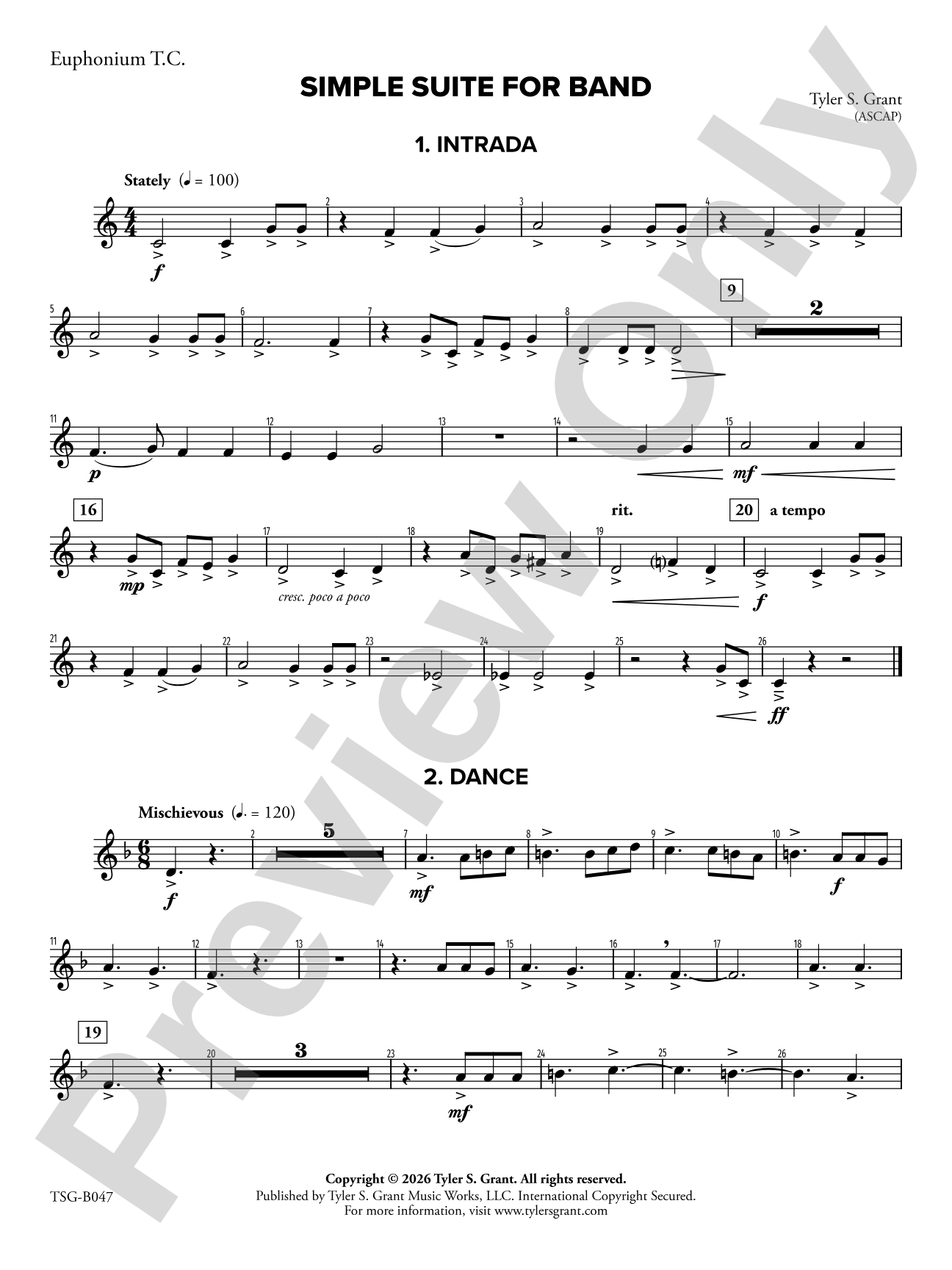

Simple Suite for Band: Baritone T.C.
Tyler S. Grant
Item: 98-PC-0000072_BTC1
$3.00
Pickup currently not available
Description
This spectacular four-movement suite is an ideal showpiece for developing bands. Featuring a variety of meters and key signatures, this piece may be performed in full or as individual excerpts. Movements include Intrada, Dance, Song and March. This suite is both exciting and achievable at any time of the year.


Simple Suite for Band: Baritone T.C. isn't in MakeMusic Cloud just yet...but it could be. Let us know you'd like to see it, and you'll help shape what comes next. In the meantime, start a free trial and dive into thousands of interactive titles your students can play along with today.
Request This Title
Tell us you want it.
Start Your Free Trial
Explore everything that's ready to play right now.
Sample Audio
1
Audio File
--:--
0:00
0:00
Sample Video
Additional Details
Publisher:
Tyler S. Grant Music Works
SKU:
98-PC-0000072_BTC1
Instrumentation:
Concert Band
More about this title
About the Composer: Tyler S. Grant

Tyler S. Grant has built a reputation as a composer and arranger whose music appears regularly on honor ensemble programs and publisher's choice lists across the country. His works have been performed at prestigious venues including Carnegie Hall, The Midwest Clinic, and the Macy's Thanksgiving Day Parade, with commissions and new publications flowing steadily since 2010. His Panoramic Fanfare won the Dallas Wind Symphony's 2014 Call for Fanfares Competition and has since become a staple in collegiate and professional wind band repertoire.
Beyond the page, Grant is an active clinician who has worked with over 100 school programs across more than 15 states, bringing his expertise directly to students and teachers. He studied instrumental music education and conducting at the University of Alabama under Professor Randall Coleman and credits mentor Brian Balmages as instrumental to his development as a composer. Grant's contributions extend to educational materials, podcast interviews, and articles in major publications like The Instrumentalist and School Band & Orchestra Magazine.
Why we love this
Grant builds each movement to showcase different textures and demands, giving every section of the band something meaningful to play while keeping technical difficulty reasonable. The flexibility to perform movements individually means you can use this piece strategically throughout the year, whether as a warm-up number at contest, a concert closer, or a teaching tool for specific technical goals.
What to expect
The four movements take you on a complete musical journey: a stately processional that establishes presence, a rhythmically playful dance that asks the band to lock into varied meters, a lyrical song that lets players sink into expressive line, and a propulsive march that sends the audience out energized. The piece balances excitement with musical substance, never asking for flash at the expense of craft.
Who it's for
Developing concert bands looking for substantial yet accessible repertoire that rewards focused rehearsal. This suite works equally well for groups building fundamentals and those preparing for contest, since each movement can be extracted and developed independently.
How to get the most out of it
- Balance the Intrada's opening statement across the full ensemble; the movement works best when listeners hear all four voices rather than just the melody line. Intentional dynamic control from your front row brass pays dividends here.
- Let the Dance section breathe rhythmically. The variety of meters asks players to think actively about their pulse, so isolate those transitions in rehearsal before putting the whole movement together.
- Shape the Song with continuous phrase momentum rather than stopping at each barline. This movement reveals itself through line, not through individual notes.
- The March demands crisp articulation and a driving tempo, but save extreme speed for later in the season when your section lock is tighter. A well-controlled march at a moderate tempo will impress judges far more than one that falls apart at measure 40.
How to use it
Use the individual movements to address specific rehearsal goals throughout the year: the Intrada for balance and ensemble blend early in the season, the Dance to tackle mixed meters in October, the Song to develop phrasing in December, and the March as a pre-contest confidence builder. Alternatively, program the complete suite as a major work on a winter or spring concert, where its substantial four-movement arc justifies a significant block of rehearsal time.
Skills your students will build
- Reading multiple key signatures and meters within a single work
- Balancing ensemble texture across woodwinds, brass, and percussion
- Sustaining phrase shape across longer lyrical sections
- Executing clean meter transitions (particularly in the Dance movement)
- Articulation clarity and rhythmic precision in marchlike material
- Dynamic control and listening for individual line independence