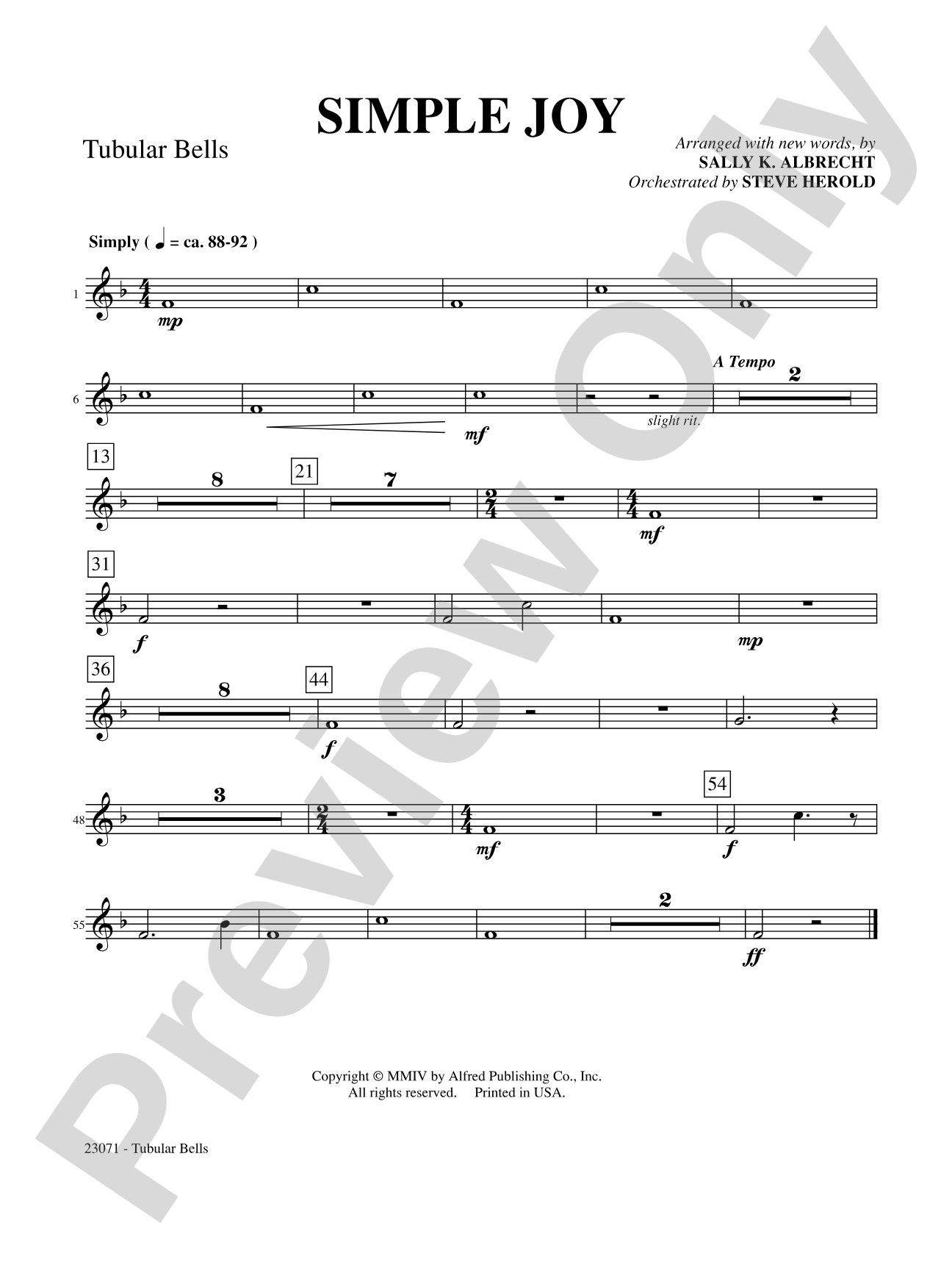
Simple Joy (Simple Gifts / Joy to the World): Bells Sheet Music Preview

Simple Joy (Simple Gifts / Joy to the World): Bells: Choral SoundPax

Arr. Sally K. Albrecht

Item: 00-PC-0000617_B

Digital Download
$3.00
Description
Includes parts for 2 flutes, 2 clarinets, guitar, synthesizer, chimes, and 2 percussion.

Don't just read it, hear it, play along with it, and watch your students grow with it. In MakeMusic Cloud, Simple Joy (Simple Gifts / Joy to the World): Bells: Choral SoundPax comes alive with professional accompaniment, adjustable tempo, and built-in practice tools that turn solo practice into real progress.

Sample Audio
0:00
0:00
Sample Video
Additional Details
Series: Alfred Choral Designs
Publisher: Alfred Music
SKU: 00-PC-0000617_B
Instrumentation: SoundPax

More about this title

About the Arranger: Sally K. Albrecht

Sally K. Albrecht

Sally K. Albrecht has shaped American choral music for over three decades, first as Director of School Choral, Vocal, and Elementary Publications at major educational publishers, then as a prolific composer and arranger in her own right. Her catalog includes more than 600 published works and 75 larger songbooks and musicals, alongside a steady stream of ASCAP Special Music Awards dating back to 1987. She is equally recognized as a clinician and conductor, having led honor choirs at Lincoln Center, Carnegie Hall, and The Kennedy Center.

Albrecht's training spans multiple disciplines. She earned a B.A. in Music and Theater from Rollins College (Florida) in 1976, then pursued graduate study at the University of Miami, completing an M.A. in Drama and an M.M. in Accompanying. Her work with choral movement and accessible arranging reflects both her theatrical background and her deep understanding of what singers and directors need in the classroom. She currently lives in North Carolina with her husband, composer and arranger Jay Althouse.

Why we love this

Albrecht understands how to blend a beloved spiritual with one of the most recognizable Christmas melodies while respecting the integrity of both. The instrumental arrangement is colorful and flexible, making this work equally at home in a traditional holiday concert or a more contemporary service setting. What makes this special is how the SoundPax format gives you real instrumental texture without requiring your school to have a full orchestra.

What to expect

There is a quiet radiance here, born from the meditative opening of the spiritual and brightened by the warmth of the Christmas melody. The combination of voices, flutes, clarinets, and synth creates an intimate yet full sound, as though the arrangement has wrapped the hymn in soft instrumental light.

Who it's for

This arrangement works for church and school choirs of mixed ability who want to perform a spiritually resonant piece with contemporary instrumental color. Directors seeking a fresh take on holiday repertoire that respects both its sacred roots and its musical tradition will find this accessible at multiple ability levels.

How to get the most out of it

  • Balance the choir's entrance against the synthesizer and chimes backdrop; the opening needs space to breathe before the full ensemble joins.
  • Layer the instrumental parts gradually across the first phrase. Consider having flutes enter first, followed by clarinets, then guitar, so the texture builds naturally rather than arriving all at once.
  • Use the recorded accompaniment to lock ensemble confidence during rehearsal, then pull back the volume in performance to let your singers own the sound.
  • The percussion and chimes provide harmonic color, not rhythmic drive. Resist the urge to push them forward; they anchor the piece without dominating.

How to use it

Position this as a turning point in a Christmas concert, perhaps bridging traditional and contemporary sections of your program. It also serves well as a reflective moment in a holiday worship service, especially when your choir needs something singable yet orchestrally present without requiring live instrumentalists.

Skills your students will build

  • Blending two distinct melodic traditions within a single phrase
  • Listening to and balancing against mixed instrumental accompaniment
  • Sustaining tone through legato passages while maintaining text clarity
  • Responding to instrumental cues in a multi-part ensemble setting

You May Also Like